Nicholas Hedges

Art, Writing and Research

  • Amazon
  • Behance
  • Facebook
  • Instagram
  • Pinterest
  • YouTube
  • Art
    • Digital
    • Drawing
    • Grids
      • Correspondence
      • The Wall
      • The Tourist
    • Ink on paper
      • Shadow Calligraphy
    • Installation
      • Murder
      • Echo
    • Painting
    • Patterns
    • Mixed Media
    • Photographic installation
      • St. Giles Fair 1908
      • Cornmarket 1907
      • Headington Hill 1903
      • Queen Street 1897
    • Research/Sketches
    • Stitched Work
      • Missded 1
      • Missded 2
      • Missded 3
      • Missded 4
    • Text Work
  • Blogs
    • Family History
    • Goethean Observations
    • Grief
    • Light Slowed But Never Stilled
    • Lists
    • Present Empathy
    • Shadow Calligraphy
    • Trees
    • Time
    • Walking Meditations
  • Video
  • Photography
    • Pillars of Snow
    • Creatures
    • The Trees
    • Snow
    • St. Giles Fair 1908
    • Cornmarket 1907
    • Headington Hill 1903
    • Queen Street 1897
    • Travel
  • Illustration and Design
  • Music
  • Projects
    • Dissonance and Rhyme
    • Design for an Heirloom
    • Backdrops
    • Shadow Calligraphy
  • Exhibitions
    • A Line Drawn in Water
      • Artwork
    • A Line Drawn in Water (Blog)
    • Mine the Mountain 3
      • Artwork
    • Mine the Mountain 2
      • Artwork
      • The Wall
    • The Woods, Breathing
      • Artwork
    • Snow
      • Artwork
    • Echo
      • Artwork
    • Murder
      • Artwork
    • The Tourist
    • Dreamcatcher
    • Mine the Mountain
      • Artwork
      • The Tourist
    • M8
    • The Gate
    • Creatures
      • Artwork
    • Residue
      • Artwork
    • A visit to Auschwitz
      • Artwork
  • Me
    • Artist’s Statement

Thoughts about my Nan

September 27, 2010 by Nicholas Hedges

As I stood in the church hall following the service of thanksgiving for my Nan who died on September 16th at the age of 98, I looked towards the stage at the back of the hall, through the door on the left hand side and into the short corridor behind. At that moment, in a split second, a number of memories crashed down around me, as if the way I was standing – the shape of my body – had unlocked the door behind which they’d been piled. The Christmas Bazaar, when I was a child was one of them, in particular the lucky dip box filled with sawdust and prizes. That was the first. It had stood there, just before the stage near the steps. I can still smell the sawdust; I can feel it on my hands as I search, in my mind, for a prize. Father Christmas had always made an appearance and would hand out gifts in his grotto. It was, in many ways when Christmas began, even though it was always held in the last week of November. It was at the Christmas Bazaar that I bought Nan a hideous ornament – china flowers in a china pot; gaudy coloured and chipped.

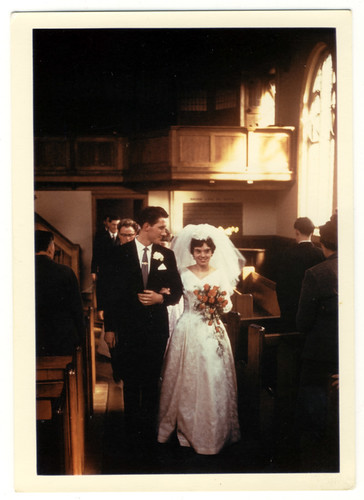
When I heard my Nan had died (I was on holiday in Spain at the time) my mind, for some reason, took me into the room which once ran the width of the church behind the large cross at the front. It was once an open gallery (you can see it in a photo of my aunt and uncle’s wedding), but had long since been blocked off from the church. Back then, when I was a child, it was always full of junk. It was where Father Christmas has his Grotto, and whatever the time of year, there was something of Grotto about it, with or without the old man in the red suit.
Back in the hall on the day of my Nan’s funeral, I could see the stage in my mind’s eye complete with the box at the front, one which ran the length of the stage, which when it was opened revealed a long line of lightbulbs. When I was a child, most of the bulbs were missing. You could see the sockets and the wires, but they hadn’t been used for years. There was a lighting box on the left hand side – just before the door through which I was looking – in which the old switches and levers had become grown over with time. In the single wooden panel, dividing it from the stage, was a hole through which you could see what was going on. My cousin and I had operated a tape player in there, some time in the mid 1980s for the performance of a pantomime whose name for the moment escapes me.

Inevitably, as I write, my thoughts are going to wander, as one memory leads to another, but back on the day of my Nan’s funeral, I thought about what I’d just remembered; the lucky dip, the Christmas Bazaar and the lightbulbs underneath the box. These were not isolated memories, they didn’t come to me like pictures in a gallery, one after the other. Instead they were physical and part of a web of memories, the threads of which seemed to vibrate with all that I had felt and experienced before. For a moment, when I moved, I could almost feel them again, I could hear the hubbub of the bazaar, see the stalls piled with jumble and the Christmas decorations hanging above. I was in the company of people who’d long since gone.

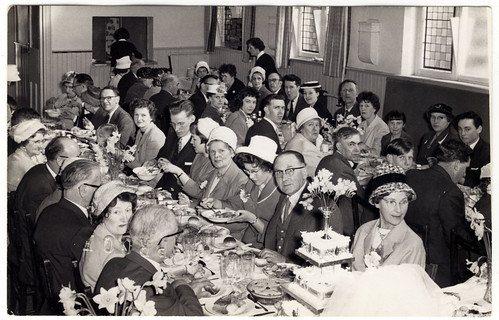
The photo below is of my Aunt and Uncle’s wedding reception, which took place in the hall. Very little has changed, apart from all the people.
Back to the day my Nan died – it’s interesting that my first thought was of the room immediately behind the church, but hardly surprising when you consider, that along with my Grandad, she’d lived in a house just opposite the hall. The house and the church were linked by Sundays, on which day we would cross the road to the house to select our sweets from the sweet-tin. Bon-bons, lemon sherbets, candied peanuts, mint imperials… we could choose 5, 6 or 7; the number changed from week to week. I can see the tin now – a round biscuit tin, I can hear the sweets rattle as the lid is prised off.

 Whenever we slept at Nan’s, my brother and I would find paper bags beneath our pillows in the morning, with a few sweets inside. Before bed, we’d have Ritz biscuits and grated cheese whilst watching TV. The television was one that had to warm up before the picture was fully revealed. I’m always reminded of Boxing Day when I think of the front room. That and the Two Ronnies – and in particular the Phantom Raspberry Blower. Seaside Summer Special too. I can feel the texture of the chairs and the sofa. It’s the afternoon on Boxing Day as I think of it now, and while some have gone to the football, everyone else stays in the warm, getting things ready for tea; cold meats, pickles etc.

I remember once, when I was 5 or 6, when my brother and I slept over at my Nan’s. It was in the summer, late at night. The night was warm and a storm was brewing. We couldn’t sleep and at about 11 or 12 o’clock, my Nan came upstairs and asked if we wanted to run around in the garden. Of course we did, and so out we went, into the garden with Nan as the storm approached. It was a simple thing, but in many ways a magical one. Back then, as can be seen from the photograph above, there was a large apple tree in the garden which I remember vividly that night. It’s gone now. A house has been built on top.

In the 1980s, the church was remodelled, with the space between the church and the church hall – which until then had been open to the elements – covered over. Many of the rooms were also remodelled. It was necessary, and no doubt it made the church more comfortable, but of course something was inevitably lost as a result, just as it was when the church itself was changed several years before. The corridor down which I’d looked from the front of the church hall, had once been part of a single room in which we had our Sunday school classes. I remember the tiny chairs and the out-of-tune piano in the corner. Leaving this room, you’d find yourself outside. A door straight ahead led to the toilet (always cold and full of spiders) and one to the left into the gallery room – or Santa’s Grotto. To the left, after the door to the Gallery Room and the just before the loo, a flight of metal steps led down to the church. A green gate blocked the way to the street, while the steps themselves were hazardous by today’s standards, especially in winter. I can still hear the sound they made as you walked down. At the bottom, you turned left and in front of you was another room (The Fellowship Room) and another toilet opposite (even colder and with even more spiders). In my mind it’s always damp here. I can always see puddles outside, and in the Fellowship Room there is the smell of old clothes; costumes which were always kept in a walk-in cupboard (blankets for Shepherds in the Nativity).

Filed Under: Family History Tagged With: Death, Family History, Memory, Nan

Dame Myra Hess

August 31, 2009 by Nicholas Hedges

I have just been chatting with my 97 year old grandmother who was telling me how she remembered going to see pianist Dame Myra Hess play at Reading Town Hall some time during the war. The name rang a bell and I remembered watching a programme about lunchtime concerts at the National Gallery which took place during the war when all the paintings had been removed to the mines of Wales. I was sure the pianist was the same and indeed, looking her up on the web I discovered this was the case.

I’ve never heard my grandmother say anything about this before and although it’s just a short memory and nothing of great significance, it nonetheless gives me a way into the past which wasn’t there before.

Filed Under: Uncategorized Tagged With: Dame Myra Hess, Memory, Nan

Death Flowers of the Mines

October 13, 2008 by Nicholas Hedges

The following is an extract taken from a book which I remember from my childhood. The book, ‘Folklore Myths and Legends of Britain’ is owned by my Nan and it was whilst seeing her yesterday that I saw the book again. Flicking through and looking for myths associated with Wales I found the following:

“Underground coal-mining began in Wales over 400 years ago and, since then, generations of miners have faced a daily struggle against darkness and danger. Belief in the Supernatural came easily to those who were constantly threatened by sudden disaster and superstition was rife among coal-mining communities. It was unlucky to be late for work, or to forget something and return home for it. If, on his way to work, the miner met someone with a squint, or a rabbit or bird crossed his path, he would go home for the day. Whenever anyone in his family dreamt of death, an accident or broken shoes, a mire was often forced to stay at home by his frightened relatives on the day after the dream.
Ever since Christ was crucified on a Friday, the day has been associated with bad luck. in South Wales, many colliers refused to start new work on any Friday, referred to as ‘Black Friday’, but especially on one preceding a holiday when miners in Monmouthshire would complain of having ‘the old black dog’ on their backs, an evil spirit which caused illness and accidents. Throughout Wales, pitworkers stayed away from the mines on Good Friday, but there were other days when they missed work for reasons unconnected with foreboding… 

The sight of a robin, pigeon or dove flying above the pithead was thought to foretell disaster, and many miners refused to work if such birds were seen near the mines. They were also called ‘corpse birds’ and are said to have been seen before the explosion at the Senghennydd Colliery in Mid Glamorgan in 1913, when over 400 pitworkers died in the worst mining disaster in Welsh history. In the mines themselves, whistling and the word ‘cat’ were strictly taboo. 

In 1890, miners at the Morfa Colliery near Port Talbot reported many eerie manifestations which occurred in the neighbourhood and in the mine itself. Fierce hounds, known locally as ‘the Red Dogs of Morfa’ were seen running through the district at night. The colliery was filled with a sweet rose-like perfume emanating from invisible ‘death flowers’. Cries for help and sounds of falling earth were heard and flickering lights, called ‘corpse candles’, appeared in the tunnels. The ghosts of dead miners and coal trams drawn by phantom white horses were seen, and rats swarmed out of the mine. On March 10, nearly half the workers on the morning shift stayed at home. Later that day there was an explosion at the colliery and 87 miners were buried alive and died in the disaster.”

Filed Under: Uncategorized Tagged With: Death, Flowers, Mine, Myth, Nan

Family Tree

November 20, 2007 by Nicholas Hedges

With both my Grandmothers still with us (both were born in 1912), I’m very fortunate to have living connections with the late nineteenth century. When they talk about their childhoods and youth, they are describing a world which has always seemed completely alien to that in which we live today, and using one’s imagination, to go beyond that world, further back into the past, that place, the world, becomes stranger still. This world, when conceived within the imagination is like a fiction. In a talk I gave as part of my residency at OVADA in May 2007, I stated that:

“…as a child, I liked to create and map worlds; countries which I would build from fragments of the world around me; forests, mountains and plains – unspoilt landscapes. And in these worlds there would exist towns and cities, created from ‘the best bits’ of those I had visited. 

These invented worlds became, as I grew up, the ‘invented’ or imagined landscapes of Oxford’s past; landscapes that were – just as they still are – created from fragments, parts of the past which are still extant in the city; old buildings, walls, objects and so on. Between these structures, these fragments, I would fill the gaps, with my own imagination, with thoughts derived from my own experience. The city’s past and the past in general, as it exists within my mind, is then, to use the metaphor of cloning in Jurassic Park, a cloned dinosaur. The extant buildings, structures and objects within museums, are like the mosquitoes trapped inside the amber. They are broken strands of DNA. All that is required is for me to fill the gaps, and this I can do with my own DNA. I am in effect, the frog.”

I will return to the frog later.

All I knew prior to my research, was that part of my family, on my father’s side, came from South Wales and worked in the mines, and that my family on my mother’s side heralded from Reading. My paternal grandfather was always an Oxford man and his family had been in the area for generations. My maternal great-grandmother (born in 1878 and who I can remember) was said to have come from Suffolk and was the daughter of a farmer (Norfolk as it would transpire).

Researching the family tree quickly becomes, not so much obsessive, but rather, compulsive; necessary. The dead, and at that, the anonymous dead, come back to life and make themselves known to you, and, what is more compelling, one feels oneself become more solid, more flesh and blood than ever before; one begins to exist in four dimensions rather than simply three (as if we, in the present, are not really a part of time) becoming part of a network whose strings vibrate like those plucked on an old musical instrument – whose sound, although feint, can nonetheless be heard or even felt. It’s rather like plugging a short-wave radio into the vast network of cables that comprise the national grid, and listening to the distant voices of ancestors telling you who you are; crackling like the damp wood of a fire which will never quite go out.

What has particularly interested me, aside from the obvious personal interest in finding lost relatives (one is also taken aback by the sheer volume of living relatives one must have but which one doesn’t know about), is how the whole project fits in so precisely with what I have been doing with my artwork; finding and identifying with the anonymous dead buried in the traumas of history, placing myself in the spaces of the past which have witnessed the most terrible catastrophes – placing myself, in effect, in the panorama of history itself. Through doing this over the past year, history has become overwhelming, its incomprehensible size as impossible to grasp as the distance of the stars. But through locating myself in the personal panorama of family history, History itself becomes a little less overwhelming; events of the past become known through great-great grandmothers and fathers – they are personalised, and yet, with this list of names and dates and with this new geography of the past, dwelling as it does in the villages of Monmouthshire and Norfolk, Lincolnshire and Oxon, one’s own impossibility is augmented still further. What were the chances of my great-great grandfather, Jabez, meeting his wife Elizabeth (what were the chances of either of them being born) and then having their son Albert? What were the odds against him doing everything he did in life exactly as he did; meeting my great-grandmother Elizabeth and having my grandfather Norman? The further one goes back into the shadows of family history, the less likely and more impossible one becomes, and this heightens, to a dramatic effect, one’s sense of place in both time and space.
Again, from the talk I gave as part of my residency, I stated:

“This metaphor [the frog and the dinosaur] is interesting in that DNA patterns are, of course, unique to everyone. My DNA is different to everybody else’s as there’s is to mine. Therefore, using my imagination to plug in the gaps of the past, means that the ‘past’ will comprise large parts of my own experience; my dinosaur will contain elements of my own being. But although my DNA is unique, it is nonetheless derived from my own past, elements have been passed down by my ancestors from time immemorial. The code which makes me who I am, comprises parts of people I know now (parents and grandmothers), people I knew (grandfathers and great-grandmother) and people lost to the past altogether (great-great grandparents and so on) [people whose names have since I wrote this become so familiar I feel as if I knew them, or rather know them]. What interests me about this, is that, through stating above how ‘my dinosaur will contain elements of my own being’ I can now see that it will also comprise elements of hundreds – indeed thousands – of people, the majority of whom I will of course never know and who have been dead for centuries. I like to think therefore, that ‘my dinosaur’ and my imagination aren’t entirely unique.
The philosopher Henri Bergson says of the past:
‘I believe that our whole physical existence is something just like this single sentence… I believe that our whole past still exists.’
Given that DNA strands are made up of letters I found this quote particularly interesting.”

The further back in time we go, the less unique we become, at least in terms of our DNA, and therefore, our individual dinosaur, that subjective sense of History created from fragments of the past (objects, buildings etc.) is increaingly attenuated; less individual and less subjective, because the ‘DNA’ (our individual selves) with which we plug the gaps is derived from that of hundreds, indeed thousands of people. That very history we are seeking to build inside myself is already there. What is more, the further back we go, with each step and every generation, the wider the family net is thrown and the greater number our number of relatives. Things which happen to other people, things on the news and so on, could be happening to people with whom we share a common past; and indeed, the same is true of events in the past. Separated by time and space, we may in fact be linked by the very fact of existence.

Filed Under: Family History Tagged With: DNA, Family History, Imagined Landscapes, Landscape, Maps, Nan, Nana

© Nicholas Hedges 2024

  • Facebook
  • Instagram
  • Twitter
  • YouTube

Copyright © 2025 · Outreach Pro on Genesis Framework · WordPress · Log in