Nicholas Hedges

Art, Writing and Research

  • Amazon
  • Behance
  • Facebook
  • Instagram
  • Pinterest
  • YouTube
  • Art
    • Digital
    • Drawing
    • Grids
      • Correspondence
      • The Wall
      • The Tourist
    • Ink on paper
      • Shadow Calligraphy
    • Installation
      • Murder
      • Echo
    • Painting
    • Patterns
    • Mixed Media
    • Photographic installation
      • St. Giles Fair 1908
      • Cornmarket 1907
      • Headington Hill 1903
      • Queen Street 1897
    • Research/Sketches
    • Stitched Work
      • Missded 1
      • Missded 2
      • Missded 3
      • Missded 4
    • Text Work
  • Blogs
    • Family History
    • Goethean Observations
    • Grief
    • Light Slowed But Never Stilled
    • Lists
    • Present Empathy
    • Shadow Calligraphy
    • Trees
    • Time
    • Walking Meditations
  • Video
  • Photography
    • Pillars of Snow
    • Creatures
    • The Trees
    • Snow
    • St. Giles Fair 1908
    • Cornmarket 1907
    • Headington Hill 1903
    • Queen Street 1897
    • Travel
  • Illustration and Design
  • Music
  • Projects
    • Dissonance and Rhyme
    • Design for an Heirloom
    • Backdrops
    • Shadow Calligraphy
  • Exhibitions
    • A Line Drawn in Water
      • Artwork
    • A Line Drawn in Water (Blog)
    • Mine the Mountain 3
      • Artwork
    • Mine the Mountain 2
      • Artwork
      • The Wall
    • The Woods, Breathing
      • Artwork
    • Snow
      • Artwork
    • Echo
      • Artwork
    • Murder
      • Artwork
    • The Tourist
    • Dreamcatcher
    • Mine the Mountain
      • Artwork
      • The Tourist
    • M8
    • The Gate
    • Creatures
      • Artwork
    • Residue
      • Artwork
    • A visit to Auschwitz
      • Artwork
  • Me
    • Artist’s Statement

Big Ships on the Horizon

November 6, 2010 by Nicholas Hedges

The big coal ships have fascinated me ever since I first saw them when I arrived in Newcastle. Like the huge clouds above them, they seem on the face of it not to be moving, but rather – like a photograph – fixed in their shape. Only over a period of time, as one watches, do the ships reveal themselves as moving, changing their course, just as the seemingly immutable clouds change their shape.
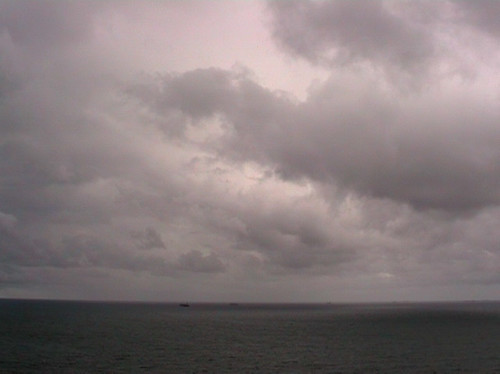
Coal Ships - Video Stills

The past too is like this. It appears to us fixed in its final shape by history, but when we observe at length we begin to see things differently – just as with the ships and the clouds, the past changes shape not unlike the way the present constantly changes its shape around us; because the past was once the present.

I have for a long while been interested in old photographs, in the distant parts of photographs where things are not the ‘subject’ of the picture. For example, the image below is a detail from a holiday snap taken some time in the early 1980s. I’ve no idea who the girl is and only noticed her when I enlarged the image.
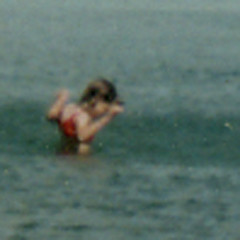
16

Merleau-Ponty once wrote how distance was not a property of the horizon, and distance too – we might say – is not a property of those people occupying the background of these photographs. They are – or were – as much a part of the scene as those of us in the foreground – the subjects of the photograph. We are always as much a part of the distance and the foreground as everyone else; we are both these things at one and the same time. In terms of history, we in the present are like the subject of a photograph, and those in the past are like those in the distance. Everything is the same part of the present, just seen from different perspectives.

The past is as much about movement as is the present (just as the distance contains as much movement as the foreground) and to observe this movement in the past (or the distance) requires us to be patient – to watch and to listen.

It is interesting that watching and listening to the distance has become a theme during my residency here, and that the image above – a video still of the ships and the sky – was filmed from Shepherd’s Point, a place from which the Services would listen and watch for the enemy during World War 2.
Filed Under: Artist in Residence Tagged With: A Line Drawn In Water, Artist in Residence, Australia, Creatures, Family Hedges, Family History, GPS, Hedges, Lines, Merleau-Ponty, Photographs, Positioning, Stephen Hedges, Walks

Pantygasseg

November 27, 2007 by Nicholas Hedges

It was – if my ‘facts’ are correct – either my great-grandfather or great-great-grandfather who worked in the Pantygasseg mine in South Wales and having Googled the place, I found the following on Wikipedia:

“Pantygasseg (Pant-y-gaseg) is the name given to a single row of houses on the mountain to the west of Pontypool in Torfaen county borough, South Wales. The name means ‘Hollow in the mare’s back’: mare’s (caseg>gaseg) hollow (pant). This is due to the shape of the mountain as it appears on the horizon.”

What interested me about this description was the meaning of the name, particularly as I’ve recently been working on photographs in which I’ve taken distant people and enlarged them so as to become the principal subjects of new versions of the images. Distance is a theme I wish to explore over the coming weeks and taking the description above, I could at once see its relevance, for the horizon is of course the horizon because its in the distance. Pantygasseg therefore gets its name through its being – in some respects – a part of (or identified with) the distance.

In his book, ‘Phenomenology of Perception’, Merleau-Ponty writes:

“I am the absolute source, my existence does not stem from my antecedents, from my physical and social environment; instead it moves out towards them and sustains them, for I alone bring into being for myself… the tradition which I elect to carry on, or the horizon whose distance from me would be abolished – since that distance is not one of its properties – if I were not there to scan it with my gaze.”

In this extract, Merleau-Ponty observes how a place cannot be distant in terms of its actual, physical properties; it can be big, small, rural, urban etc. but it cannot be distant; distance dependends on the location of the observer; without the observer distance would, as Merleau-Ponty states, be ‘abolished’. The fact that Pantygasseg is so named because of is being a part of the shape of the distance – a hollow in the horizon (shaped like a mare’s back) conjures up the image of an eternal stranger looking at it from far away; someone outside the village, who sees it, knows it well enough to know its name, but is not himself a part. I feel exactly like that stranger. Pantygasseg would have been a well known feature of the landscape of my great-great-great-grandfather’s life and those of his descendents including my grandmother (in her youth) and is therefore both part of my landscape (a landscape from which I have come) and at the same time utterly unknown, a metaphor for all those distant places I know, but of which I am not a part.

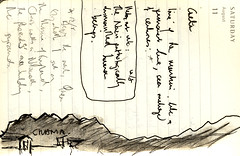
Thinking of the shape of the mountain I was reminded of a drawing I made in my diary whilst on holiday in Chania earlier this year.

Chania

It is a sketch of the mountains which dominate the horizon, and every day, as I looked at them and followed the contours with my eyes, I couldn’t help but think how those who lived in the city thousands of years ago would have seen that same shape, the same jagged line in the distance. There is something timeless about mountains which make one feel every bit the mortal we are. Pantygasseg as a place, at least through its name is a part of that timeless past and a part of my past, a line which my ancestors would have traced with their eyes and one which I realise I must also follow.

Returning again to the quote from Merleau-Ponty; he writes how his existence does not stem from his antecedents, or from his physical and social environment; instead it moves out towards them and sustains them. I was taken by this, as by going to Pantygasseg, I will be moving towards my antecedents, to sustain them in my memory.

Filed Under: Uncategorized Tagged With: Distance, Hafodyrynys, Merleau-Ponty, Pantygasseg, Phenomenology

© Nicholas Hedges 2024

  • Facebook
  • Instagram
  • Twitter
  • YouTube

Copyright © 2025 · Outreach Pro on Genesis Framework · WordPress · Log in