Nicholas Hedges

Art, Writing and Research

  • Amazon
  • Behance
  • Facebook
  • Instagram
  • Pinterest
  • YouTube
  • Art
    • Digital
    • Drawing
    • Grids
      • Correspondence
      • The Wall
      • The Tourist
    • Ink on paper
      • Shadow Calligraphy
    • Installation
      • Murder
      • Echo
    • Painting
    • Patterns
    • Mixed Media
    • Photographic installation
      • St. Giles Fair 1908
      • Cornmarket 1907
      • Headington Hill 1903
      • Queen Street 1897
    • Research/Sketches
    • Stitched Work
      • Missded 1
      • Missded 2
      • Missded 3
      • Missded 4
    • Text Work
  • Blogs
    • Family History
    • Goethean Observations
    • Grief
    • Light Slowed But Never Stilled
    • Lists
    • Present Empathy
    • Shadow Calligraphy
    • Trees
    • Time
    • Walking Meditations
  • Video
  • Photography
    • Pillars of Snow
    • Creatures
    • The Trees
    • Snow
    • St. Giles Fair 1908
    • Cornmarket 1907
    • Headington Hill 1903
    • Queen Street 1897
    • Travel
  • Illustration and Design
  • Music
  • Projects
    • Dissonance and Rhyme
    • Design for an Heirloom
    • Backdrops
    • Shadow Calligraphy
  • Exhibitions
    • A Line Drawn in Water
      • Artwork
    • A Line Drawn in Water (Blog)
    • Mine the Mountain 3
      • Artwork
    • Mine the Mountain 2
      • Artwork
      • The Wall
    • The Woods, Breathing
      • Artwork
    • Snow
      • Artwork
    • Echo
      • Artwork
    • Murder
      • Artwork
    • The Tourist
    • Dreamcatcher
    • Mine the Mountain
      • Artwork
      • The Tourist
    • M8
    • The Gate
    • Creatures
      • Artwork
    • Residue
      • Artwork
    • A visit to Auschwitz
      • Artwork
  • Me
    • Artist’s Statement

Absence II

December 17, 2014 by Nicholas Hedges

History necessitates the consideration of our own non-existence. To imagine the distant past (the past before I was born) is to try and see the world, not only as if I didn’t yet exist, but as if, in all probability, I might never exist at all. With this in mind, the past, re-imagined, becomes a teeming and terrifying space where every object and building, every man, woman and child, every word spoken or written, every intention and gesture, indeed, everything is excited by a vertiginous sense of calamity. Objects in museums, remnants of ancient buildings, old family photographs, all oscillate with this potential, which, although avoided – inasmuch as I’m alive to observe them in the present moment – hold up a mirror to reflect this past forwards, showing me, in the glass, the catastrophe of my future death. As Roland Barthes writes in Camera Lucida:

“I observe with horror an anterior future of which death is the stake.”

Perhaps this is why I find it strange, handling something that existed long before my birth. It’s as if when looking, for example at a mediaeval ceramic pot, or a single shard (as pictured below), that the shape, colour and decoration of that pot, created at a time when I did not exist, were essential aspects of my coming-into-being (I observe with horror how close I came to never existing). And if I can handle the object, then my body feels that horror; it feels, in effect, its own absence. (It’s strange, but the chances of there being humans 100, 200, 500 years from a given point in time is very high – barring any massive disaster. But the chances of any of those individuals being who they are is almost nil.)
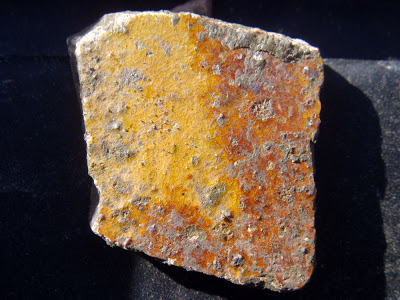
As I wrote in a previous blog regarding old photographs:

“It seems to me that I’m responding to these images kinaesthetically; my mind, memories and experience read them, which is why perhaps I find often these old colour photographs – while amazing – so unsettling. My mind reads them, my body feels them and yet when the image was taken, I did not exist.”

(There is, it seems, something analogous between the distant past as seen in a colour photograph and the colours in the shard of pottery (above). What that is, I don’t yet know…)

Old objects are mirrors, reflecting what Georg Lukács called the ‘not now and not here’ whether that be the past or the future. They have a power and are possessed of a supreme indifference to us the beholder. I’m reminded here of a passage in Max Beerbohm’s Zuleika Dobson:

“Strange that to-night it [Merton College Tower] would still be standing here, in all its sober and solid beauty—still be gazing, over the roofs and chimneys, at the tower of Magdalen, its rightful bride. Through untold centuries of the future it would stand thus, gaze thus. He winced. Oxford walls have a way of belittling us; and the Duke was loth to regard his doom as trivial.”

I know that wince. It’s the same as Barthes’ horrified observation. In the past the chances of me (and indeed everyone) ever existing were infinitesimally small. Now that I do exist, I wince because I know that death is certain.

In his book ‘Other People’s Countries’, Patrick McGuinness writes:

“Of course, when you try to imagine yourself somewhere you don’t know and have never been, you can’t do it — your mind slides off the surface of the images you conjure up like a finger on wet glass; can’t get any sort of purchase. It’s much easier to imagine the inverse: the place you know well without you. It hurts more that way around too, especially if you imagine the place you know without you while you’re still there — you darken the edges of your own vision, put a black border around your days and they become like leaves curling inwards, dying from the outside in. Even as you live them forwards, you’re looking at them from behind, seeing them as they would be if they were over. I spent most of my childhood with a foretaste of its pastness in my mouth.”

Filed Under: Uncategorized Tagged With: Georg Lukacs, Rilke, Roland Barthes

Sculpture

June 2, 2010 by Nicholas Hedges

I am not, at least as far as I’m aware, a sculptor, but I think that what I’m striving to articulate in my work has perhaps more to do with sculpture than anything else. The following statements, from the book ‘Figuring it Out,’ by archaeologist Colin Renfrew were made by the sculptor Antony Gormley.

“I want to confront existence. It is obviously going to mean more if I use my own body… I turn to the body in an attempt to find a language that will transcend the limitations of race, creed and language, but which will be about the rootedness of identity… The body is a moving sensor. I want the body to be a sensing mechanism, so your response to the work does not have to be pre-informed and does not necessarily encourage discourse… If my subject is being, somehow I have to manage to engage the whole being of the viewer.”

“My body contains all possibilities. What I am working towards is a total identification of all existence with my point of contact with the material world: my body… Part of my work is to give back immanence both to the body and art.”

The last sentence particularly resonates with me, for part of the purpose of my work is I think to give back immanence to the past and to history, something which I have come to realise can only come about through the immanence of the body – the ‘moving sensor,’ which I have otherwise described as being like the recording/playback head of a tape player.

We are all familiar with the body-casts of Pompeii; men, women and children frozen at the moment of their death almost 2000 years ago. Buried in ash, the spaces which had once contained their bodies remained after the bodies had decomposed, allowing archaeologists, to use them as moulds by pouring plaster into the cavities. It was whilst reading about the casts in Colin Renfrew’s book ‘Figuring it Out’ that I began to think of the process of casting in terms of what I’ve been researching these past few years.

If we stand in a place, for example a wood, we can try to imagine those who’ve been there before us. By being aware of the moment of our own experience, of the wind, the light, the sound of the trees and so on, we can try to see the past through the immanent lens of the present. In a previous entry ‘An Archaeology of the Moment,’ I mentioned the writing of Christopher Tilley and the concept of Other and whilst reading Colin Renfrew’s book I realised how the process of creating the casts in Pompeii shared something with what I’ve been researching, albeit metaphorically.

If we stand in a place, we are defined not only by the shape of our bodies (our physiognomy), but by everything around us. To recap, as Tilley writes: “The painter sees the tree and the trees see the painter… in a manner comparable to that in which the mirror ‘sees’ the painter: that is, the trees, like the mirror, let him become visible: they define a point of view on him which renders visible for him something that otherwise would remain invisible – his outside, his physiognomy, his carnal presence… The trees and mirror function as Other.”

Just as the trees function as ‘Other’ therefore, so must the sun, the stars, the clouds, hills, mountains, the sea, rivers, the wind, the rain and so on.

Imagine that all these things, in the place where once someone stood are – metaphorically speaking – like the ash of Pompeii, in that the shape of the person’s body is somehow sculpted by them. Of course this shape is fleeting, but imagine again that it remains, delineated by the world around it. In order to ‘see’ the shape, we must learn to fill it, not, of course, with plaster but with our own bodies or rather our presence.

At any given moment, we are sculpted by the world around us. We are both looking for and filling in the gaps left by others. We are therefore artists, artwork and viewer simultaneously.

Imagine these two situations: One, you are standing in a gallery in front of a landscape painting, a picture of a wood with no-one in it. Two, you are standing on a path in a wood that is empty and in this wood, the trees and the wind blowing through the branches, the feel of your feet upon the ground, the sound of the birds, the dappled light and shadows all act as ‘Other’ rendering your outside – your presence – visible. The gallery too is empty, but like the wood, you are far from alone, for just as the painting also acts as ‘Other’ in terms of rendering your presence visible, so the spaces left by those ‘rendered’ before are made visible again by your presence; not least the space left by the artist. And after the artist come the spaces left by everyone who’s seen the painting before you, and in the woods the same is true; although there maybe no-one else on the path, the spaces left by everyone who’s ever walked upon it are filled with your presence; the present fills the spaces of the past.

Having found Antony Gormley’s words so interesting, I read the transcript of an interview between himself (AG) and Ernst Gombrich (EG). The following are sections which I found to be particularly pertinent.

AG I want to start where language ends.
EG But you want in a sense to make me feel what you feel.
AG But I also want you to feel what you feel. I want the works to be reflexive. So it isn’t simply an embodiment of a feeling I once had.
EG It’s not the communication.
AG I think it is a communication, but it is a meeting of two lives.

In many respects this conversation above reflects precisely what I am trying to do: to feel the way people felt in the past by feeling what I myself am feeling. It is the meeting of two lives.

AG I would be interested to know whether you feel that it is possible to convey a notion of embodiment without mimesis, without having to describe , for instance, movement or exact physiognomy?
EG I have no doubt that not only is it possible but it happens in our response to mountains, for example, we lend them our bodies.

–

AG I can’t be inside anyone else’s body so it’s very important that I use my own. And each piece comes from a unique moment in time. The process is simply the vehicle by which the event is captured, but it is very important to me that it’s my body.

–

AG I am interested in something that one could call the collective subjective. I really like the idea that if something is intensely felt by one individual that intensity can be felt, even if the precise cause of the intensity is not recognised. I think that is to do with the equation I am trying to make between an individual, highly personal experience and the very objective thing – a thing in the world amongst other things.

–

AG Then I go into the second stage which is making a journey from this very particularised moment to a more universal one.

–

As I’ve written before: In a famous definition of the Metaphysical poets (a group of 17th century British poets including John Donne), Georg Lukács, philosopher and literary critic, described their common trait of ‘looking beyond the palpable’ whilst ‘attempting to erase one’s own image from the mirror in front so that it should reflect the not-now and not-here.’ Thinking in terms of the metaphor I have described above (the trees and mirror function as Other), we could say that this erasing of one’s image is an attempt to see the space left behind us. I have also written in the past how history necessitates the consideration of our own non-existence; this space also reflects that state.

Filed Under: Archaeology, Trees Tagged With: Antony Gormley, Archaeology, Art, Georg Lukacs, John Donne, Pompeii, Sculpture, Stars

© Nicholas Hedges 2024

  • Facebook
  • Instagram
  • Twitter
  • YouTube

Copyright © 2025 · Outreach Pro on Genesis Framework · WordPress · Log in