Nicholas Hedges

Art, Writing and Research

  • Amazon
  • Behance
  • Facebook
  • Instagram
  • Pinterest
  • YouTube
  • Art
    • Digital
    • Drawing
    • Grids
      • Correspondence
      • The Wall
      • The Tourist
    • Ink on paper
      • Shadow Calligraphy
    • Installation
      • Murder
      • Echo
    • Painting
    • Patterns
    • Mixed Media
    • Photographic installation
      • St. Giles Fair 1908
      • Cornmarket 1907
      • Headington Hill 1903
      • Queen Street 1897
    • Research/Sketches
    • Stitched Work
      • Missded 1
      • Missded 2
      • Missded 3
      • Missded 4
    • Text Work
  • Blogs
    • Family History
    • Goethean Observations
    • Grief
    • Light Slowed But Never Stilled
    • Lists
    • Present Empathy
    • Shadow Calligraphy
    • Trees
    • Time
    • Walking Meditations
  • Video
  • Photography
    • Pillars of Snow
    • Creatures
    • The Trees
    • Snow
    • St. Giles Fair 1908
    • Cornmarket 1907
    • Headington Hill 1903
    • Queen Street 1897
    • Travel
  • Illustration and Design
  • Music
  • Projects
    • Dissonance and Rhyme
    • Design for an Heirloom
    • Backdrops
    • Shadow Calligraphy
  • Exhibitions
    • A Line Drawn in Water
      • Artwork
    • A Line Drawn in Water (Blog)
    • Mine the Mountain 3
      • Artwork
    • Mine the Mountain 2
      • Artwork
      • The Wall
    • The Woods, Breathing
      • Artwork
    • Snow
      • Artwork
    • Echo
      • Artwork
    • Murder
      • Artwork
    • The Tourist
    • Dreamcatcher
    • Mine the Mountain
      • Artwork
      • The Tourist
    • M8
    • The Gate
    • Creatures
      • Artwork
    • Residue
      • Artwork
    • A visit to Auschwitz
      • Artwork
  • Me
    • Artist’s Statement

A Suicide in Cefn-y-Crib

July 24, 2008 by Nicholas Hedges

Back in the spring when I visited Hafodyrynys with my Dad and my girlfriend Monika, we found ourselves – whilst clambering over what my grandmother has always called the ‘Mountain’ – in the company of a farmer, who, with his two sheepdogs, took us on a short tour of his land overlooking the village. He was a man who having been brought up in the area knew that part of the world intimately, and who, as he traced the blue horizon with his hand, reeled off a list of villages resting amongst the hills and fields rolled out below. As we looked over towards the town of Llanhilleth, where my great-grandfather, Elias Jones, had worked as a miner, I couldn’t help but imagine him standing there 100 years before, looking at the same villages and reeling off the same names. Down below, in Rectory Road, he would see the house in which he lived, and in which also lived my grandmother as a child.
Elias Jones died of lung disease in 1929 at the age of 47, caused as a result of breathing in coal dust down the mine in which he worked. He was buried in the churchyard at Cefn-y-Crib, where his wife, Mary Jane, would be buried 40 years later. Also buried in the same churchyard, as we saw that day, was Elias Jones’ father, my great-great-grandfather, Henry, who died in 1889 at the age of 49 when Elias was just 7 years old.
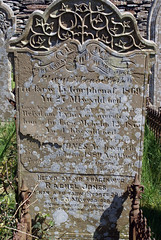
Hafodyrynys and Surrounds

We could see the churchyard from the brow of a hill as we stood in the company of the farmer and his dogs, and in between, a scattering of buildings, vivid and white against the green of the fields, made darker for a moment by the looming presence of clouds which gathered around us as if to experience a view which they would know for only a very short time.
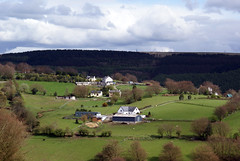
Hafodyrynys and Surrounds

It was as we looked that the farmer pointed to one of the buildings and explained how in December the previous year a young woman was found hanged inside. It was a story which seemed at odds with the beauty of the landscape – a landscape which, nevertheless, just as it had shaped the existence of my paternal family, had shaped the death of this young woman.

In amidst the fields, the seemingly empty barns and houses, and bordered by the forests which clung to the hills surrounding us, one could feel very small and insignificant. In a place such as this one’s awareness of self is augmented, or at least, one’s awareness of individuals. Indeed, of all the people I have researched so far, the two which to me are perhaps the most clearly defined are my great-grandfather, Elias, and my great-great-uncle, Jonah Rogers, who was killed in 1915 in the second battle of Ypres. Perhaps this is in part because of the place in which they lived (and in which that day I was standing), not so much because it’s changed so little, but because its shape, its beauty and its timelessness, serve to delineate the individual better than any city.

I’d always heard that one of my ancestors on the Welsh side of the family had been killed in a mining accident, but I’ve never found anything to even vaguely corroborate the story. Of course accidents were common as my grandmother recalled, remembering how blinds would be drawn in all the windows when another body was brought back up to the surface. Having seen Henry Jones’ grave, I decided to obtain a copy of his death certificate to see if perhaps he – having died young – had been killed in an accident of some kind. As it turned out, the truth was indeed tragic, but for altogether different reasons.
It took me a while to decipher the spider-like writing of the registrar, but suddenly it hit me; cause of death, “suicide while temporary insane,” place of death; Cefn-y-Crib.
Filed Under: Family History Tagged With: Death, Elias Jones, Family History, Family Jones, Hafodyrynys, Jonah Rogers, Jones

Waving on the Mountain

December 7, 2007 by Nicholas Hedges

Yesterday I visited my paternal Grandmother and over a period of about three hours, talked with her about her childhood in South Wales and her early years in Oxford. All too often these days we don’t allow the old to speak; too often we try to speak for them, to tell them what they know (what we think they know) talking as if they are foreign and speaking at them slowly and loudly, as if that will help them ‘understand.’ I was keen with my Grandmother (Nana) to get her to just talk, and for her to make connections without my trying to prompt or ask too many questions.

As we get older, our brains lose connections, but sometimes things that may seem forgotten simply require a different map, another means of finding them, the longer way round – a longer path. Talking through events, one often stumbles upon something that leads somewhere else, a new route is found and that which was lost is rediscovered. But if we prompt too much things will remain obscured; forgotten.

Talking with my Grandmother was a very special experience and I wondered as I listened, when it was that she last spoke at length about her past? From memories of her father (who died in 1928), her Grandmother (born in 1864), to her own retirement, she took me on a journey from the mountains of Wales, to a public school in Cheltenham and on to the houses of Oxford, where she worked as a maid in the late 1920s and early 30s. But it was her reminiscences of her father which were particularly moving.

Through researching my family tree, I’ve got to know many of the names of family members, back as far as the beginning of the nineteenth century, but that, along with a few dates is all I know. My Grandmother wasn’t sure she’d be of any use to me in my research, but as I pointed out, her memories are worth their weight in gold. I can find names and dates, but it’s who these people were that matters most, and the only person who could help me was her.

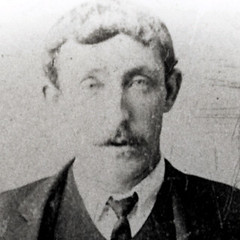
Below is a photograph of my Grandmother’s father (my Great Grandfather), Elias Jones.

Elias Jones

Born in Trevethin, Monmouthshire in 1882, he worked as a miner in the pit at Llanhilleth, a short distance away from where he lived with his wife Mary Jane and their five children, Ruth, Lillian (my Grandmother), Doll, Ray and George (one girl, Florence or Flossie, died aged 2 c.1918). With just a photograph, a name, dates and occupation, it’s difficult to surmise what he might have been liked. One tends to assume (unfairly) that miners in those days must have been – due to the harshness of their work – rather dour or surly people, but talking to my Grandmother, it became clear that as regards Elias, this couldn’t have been further from the truth. Below are a couple of extracts from our conversation.

On his walking to work:
“I can see him now, because he went up our garden over the road and the mountain started from there up… and he’d go so far up and he’d turn back and wave to us.”
On his being at home:
“I can remember now he would always help our Mam wash our hair on a Friday night… our Ruth would go first, she would wash it and our Dad would dry it and mine next…”
On his death:
“I can always remember the doctor in the room when we realised he wasn’t going to come through, he said ‘don’t grieve for him Mrs Jones, you know what he said to me, “if I can’t work for my wife and children I don’t want to stay.”‘ And he just passed away. “

Just these few, brief extracts tell me a great deal about the man in the photograph; a man who clearly loved his family and who through his working in the mines, succumbed to a disease of the lungs (possibly pneumoconiosis or ‘black lung disease’) at the age of just 42. And the image of him turning on the mountain to wave at his children below is one which will not only stay with me forever, but one I which would like to ‘explore’ in my forthcoming work. I had wanted to draw the outline of the mountain, but I also think it will be necessary to follow the route Elias Jones took, from his house, over the mountain to the pit at Llanhilleth.
Deaths in the mines (as well as deaths as a consequence of working them) were sadly nothing exceptional. And as my Grandmother poignantly explained:

“…when there was a death you know every blind in that street would be drawn, we knew directly we heard of a death the women would draw their blinds down and they would nearly all turn out to a funeral down there… Kind of almost took it in our stride you know, oh dear there’s another one gone, killed in the mines.”

Filed Under: Family History Tagged With: Elias Jones, Family History, Family Jones, Hafodyrynys, Jones, Nana

© Nicholas Hedges 2024

  • Facebook
  • Instagram
  • Twitter
  • YouTube

Copyright © 2025 · Outreach Pro on Genesis Framework · WordPress · Log in