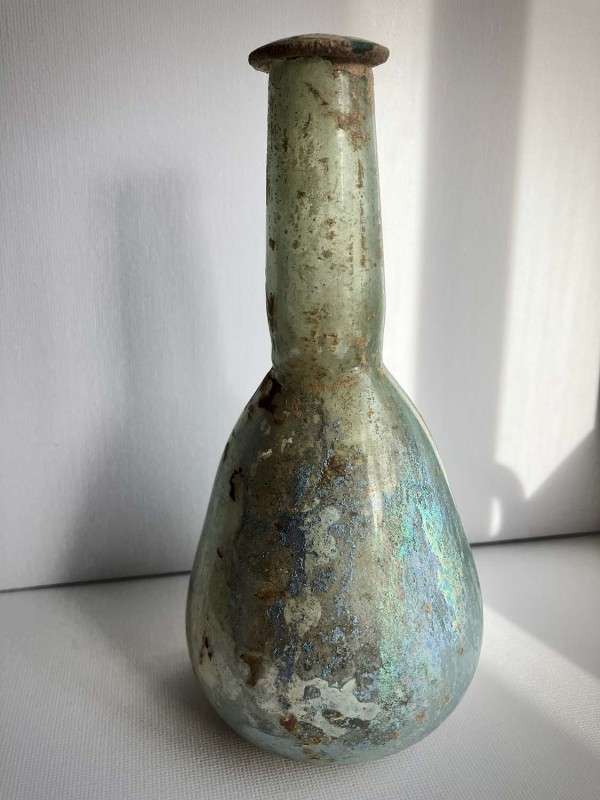
I recently purchased a beautiful Roman Unguentarium (2nd or 3rd century AD) and have undertaken a Goethean observation of it. For information on this process, please see below.
1
This is a bottle about a hand’s length in height. It has a bulblike shape tapering to a neck which is short of half the bottle’s height. Its base is flat allowing it to stand on the table. It is clearly an object designed to be held.
It is not perfectly shaped and is uneven in its symmetry. It has a lip at the top covered with a brown encrustation, which also runs a little down the neck from the rim.
It looks like glass, but the glass is not entirely transparent. It looks almost like marble with veins of colour running its length. It is a blue green colour with patches of silvery grey and gold-brown. Turning the bottle around, I can see the patches cover its surface but there are small patches where the glass is clear.
In the light of the lamps in my room, the bottle shimmers with iridescent hues of turquoise and purple-blues. Holding the object in my hand, I am struck by how light it is and how thin I suppose the glass is. As I turn in my hands, I can hear it against my skin. It almost rings when my hands turn it, and as I do so, I am more aware of the unevenness of its shape.
Picking it up. I look down inside the neck. All I see is the cloudy mottled glass, flecked here and there with brown. It is clearly a very fragile object, and picking up again. I can feel its cool surface. I see the lights reflected on its surface. It almost has the feel of a lightbulb, but its surface is much less smooth. Running my thumbs over its surface. I can feel that in small parts, it is rough, in others very smooth. This is where the glass is almost completely transparent.
2
This bottle is almost 2000 years old, and the fact it has remained intact all that time is remarkable. It is a blown piece of glass, meaning that in the second or third century A.D. someone blew to make it shape. The fact that its shape is slightly irregular lends it a very human quality. Someone’s breath – the act of breathing out 1800 years ago – gave it its shape and with its beautiful iridescent surface, I think of a bubble, albeit one which is not a perfect sphere. This bottle has the fragility of a bubble; one which, after so many centuries still hasn’t burst. It’s as if the breath which made it is somehow contained within and with that sense of exhalation comes the expectation of a breath about to be taken; a breathing in to compliment the breathing out.
I now become aware of the life of its maker. Their breathing in and out; something they did – like we all do – without thinking. I’m aware of their heart beating, aware that it has long since stopped. And yet, in this bottle, the memory of a pulse remains.
It’s almost the opposite of my mum‘s final breath, when she breathed in and passed away. This bottle, instead, contains a breath exhaled, but with both my mother’s last breath and the breath of the bottle’s maker, there is the expectation of another. With my mum it never came. Now this bottle too seems to be waiting. It’s as if the bottle has been breathed out slowly over the course of 18 or 19 centuries. Picking it up. It’s like holding a breath, but one breathed out nearly 2 millennia ago.
I think about that moment when it was first breathed into existence, when it would have glowed white hot. Who made it? What was it like where it was made? Obviously it would have been hot, a stark contrast to its cool surface. Now I think of whoever made it watching its shape form, before setting it down to cool with the others they had made that day.
Once cooled and finished it would’ve been sold, I presume, and I wonder who bought it. Who used it? I know it was used to hold unguent. But what exactly did it contain? I imagine it being lifted and whatever was inside poured out. I find myself doing the action of pouring. It would have felt different then heavier with the liquid inside.
Back then it was just a bottle sitting on a shelf or a table witnessing a world which seems to us impossibly remote. What reflections found their way to its surface? Did it have a stopper – a piece of fabric perhaps? What did it smell like inside? It doesn’t smell of much now of course
I look at its shadow cast by my modern lamp; its harsh outline, and I wonder about its shadows all those years ago – shadows made by the sun which might also have pricked its surface as my lightbulb does this evening. Or perhaps the soft glow of a flame. Then its shadow would not be still and on its surface the flames would shift.
It was an everyday object, and yet it speaks now of many centuries. The person who made it those who owned it and used it have long since gone, their memory lost to the past. Generations of their descendants have also followed, and yet this insignificant, everyday and very fragile object has outlived them all. Yet, despite its age, it is vulnerable. It is therefore a curious mixture of extreme vulnerability and strength.
In its fragility, it has held the breath of whosoever made it for hundreds and hundreds of years. With that held breath comes the ‘possibility’ of its breathing. It has the feel and look of a living thing. The breath exhaled by the maker becomes the inhalation of the bottle.
Patches of iridescence break to reveal patches of clear glass, through which, when the glass was untarnished, we might imagine one could see the unguent inside. The iridescence is caused by the deterioration of the glass, which draws a beautiful veil over its distant past. I wonder where the object has lain for so many years, where it has been, and how it could survive intact all those hundreds of years. Will the iridescence continue to cover its surface, cocooning it? Will the encrustation on the lip of the bottle and a part of the neck continue to grow, to cover this long-held breath.
Before the bottle was even a bottle, it was the sand, the soda and lime, from which it was made, and the intention of the maker. The sand, perhaps part of a beach – an ancient shoreline on which the waves lapped just as they do today. But then they would come loaded with mystery. Back then there were lands still undiscovered and fantastical creatures beyond the horizon; creatures as ‘real’ as the sand on the beach. That sand would, in time, be gathered and used to make the glass. Sand which itself had been millions of years in the making. Its origins extend to a time before there were people people to imagine such fantastical creatures; a time when people were just as absent from the real world, as we now know these creatures to be. Reason is a clarity like glass which we can see through. Glass is the way we see beyond our own world, both at the ‘impossibly’ big universe to the ‘impossibly’ small realm of the particle.
On that ancient shoreline, the sand would’ve been gathered, and with the other ingredients turned into glass by the skill of the glassmaker; a skill which would’ve been learned over many years. The bottle is there for a mix, not only of the raw materials needed to make the glass, but also the skill of the glassmaker, learned and perfected over many years. In his hands, with his actions and his breath, the glass bottle would have come into existence.
The bottle is almost like the memory of a moment; the moment when it was made; the memory of the maker, his actions, his breath, the hour of the bottle’s production. The memory was clear and then it became clouded, changing from what really was to a distorted version. Whoever owned the bottle (maybe it was several people) died and was buried. Perhaps the bottle was buried with them and for hundreds of years it lay in the dark, quiet of the ground, unseen by anyone until it’s rediscovery. Underground it underwent a change; chemical changes caused by water in the soil leached out the salt from the glass and over hundreds of years thin layers were built up on the surface of the glass. Only when the glass saw light again did that process reveal itself through the iridescence of its surface.
It’s almost as if the bottle, whilst underground, ceased to be a bottle (it’s only a bottle in the mind of someone looking at it instead it became a process.
3
A breath given.
A breath held.
Held by the bottle.
Held in my hand.
Fragility and strength.
Air inside a bubble, its surface slipping with iridescence.
4
I find myself inside the bottle, looking out through the patches of clear glass, out at the room in which I stand. I see the room and everything in it. It’s rather vague, like my shadow cast by the candles and lamps. Now, all these centuries later, I am an object in my own right rather than a mere vessel for whatever I once contained. It’s as if my eyes have been turned in on myself. My shape is not that of the liquid I once contained. I have now become the shape.
The shape of the breath that made me.
The breath I hold which to exhale would see me break.
All the while I hold it, I can remember.
When I breathe out, then I will forget.