Nicholas Hedges

Art, Writing and Research

  • Amazon
  • Behance
  • Facebook
  • Instagram
  • Pinterest
  • YouTube
  • Art
    • Digital
    • Drawing
    • Grids
      • Correspondence
      • The Wall
      • The Tourist
    • Ink on paper
      • Shadow Calligraphy
    • Installation
      • Murder
      • Echo
    • Painting
    • Patterns
    • Mixed Media
    • Photographic installation
      • St. Giles Fair 1908
      • Cornmarket 1907
      • Headington Hill 1903
      • Queen Street 1897
    • Research/Sketches
    • Stitched Work
      • Missded 1
      • Missded 2
      • Missded 3
      • Missded 4
    • Text Work
  • Blogs
    • Family History
    • Goethean Observations
    • Grief
    • Light Slowed But Never Stilled
    • Lists
    • Present Empathy
    • Shadow Calligraphy
    • Trees
    • Time
    • Walking Meditations
  • Video
  • Photography
    • Pillars of Snow
    • Creatures
    • The Trees
    • Snow
    • St. Giles Fair 1908
    • Cornmarket 1907
    • Headington Hill 1903
    • Queen Street 1897
    • Travel
  • Illustration and Design
  • Music
  • Projects
    • Dissonance and Rhyme
    • Design for an Heirloom
    • Backdrops
    • Shadow Calligraphy
  • Exhibitions
    • A Line Drawn in Water
      • Artwork
    • A Line Drawn in Water (Blog)
    • Mine the Mountain 3
      • Artwork
    • Mine the Mountain 2
      • Artwork
      • The Wall
    • The Woods, Breathing
      • Artwork
    • Snow
      • Artwork
    • Echo
      • Artwork
    • Murder
      • Artwork
    • The Tourist
    • Dreamcatcher
    • Mine the Mountain
      • Artwork
      • The Tourist
    • M8
    • The Gate
    • Creatures
      • Artwork
    • Residue
      • Artwork
    • A visit to Auschwitz
      • Artwork
  • Me
    • Artist’s Statement

Search Results for: texts/iris_brook.htm

Goethean Observation: Japanese Scroll

May 31, 2024 by Nicholas Hedges

The process of 'Goethean Observation'

Introduction

There are many different interpretations of the Geothean (a method of observing as described by Johann Wolfgang von Goethe (1749 – 1832)) method, but the one I prefer to use is that described by Iris Brook in her paper, “Goethean Science as a Way to Read Landscape,” which is, basically, as follows:

1. exact sense perception [bare facts: perception]
2. exact sensorial fantasy [time-life of object: imagination]
3. seeing in beholding [heartfelt getting to know – inspiration]
4. being one with the object [intuition]

1. Exact Sense Perception [Perception]

Now the observer attempt to approach the object from a clearer, more objective standpoint.. This stage was called by Goethe, exact sense perception and is characterised by a detailed observation of all the ‘bare facts’ of the phenomenon that are available to our ordinary senses. It is an attempt to see what is present with as little personal judgement and evaluation as possible.

An example of trying to let the facts speak for themselves from Goethe’s own work is his extraordinarily detailed observations of colour phenomena. Rather than draw hypotheses or work from a theory his investigations involve colour as experienced by himself, as used by artists, as created by dyers, as used symbolically, as seen in animals and plants and so on.

For the student attempting to carry out this stage with their own phenomenon, drawing can be a useful tool, because in drawing our attention is brought to previously unnoticed detail or patterns.

Another tool used is to ignore some knowledge, for example the names of things… Attempting to find another word to describe the part you are indicating to someone else often leads to a looking again.”

2. Exact Sensorial Fantasy [imagination]

“The second stage of looking at the phenomenon is what Goethe called ‘exact sensorial fantasy’ (Exact sinnliche Phantasie). An aspect of this activity is to perceive the time-life of the phenomenon, that is to see the phenomenon in time. This means no longer seeing the thing in an objective frozen present as prompted by the first stage, but as a thing with history. That history can be drawn from the phenomenon with the use of an imaginative faculty that cultivates temporal and physical relationships…

The shift between the two modes of seeing is a small one, but the world does look very different when seen in a state of flux.

In this phase the imagination can be used as a tool to vary what is seen and attempt to imagine it otherwise. The obvious link to the phenomenology here is with the use of free imaginative variation. First suggested by Husserl, this is a means of deriving the essence of a phenomenon by pushing the eidos of the thing beyond what can be imagined. The second stage could be seen as a training of the imaginative faculty in two directions: firstly to free up the imagination and then to constrain it within the realms of what is possible for the phenomenon being studied.”

3. Seeing in Beholding [Inspiration]

The first two stages of Goethean method could be characterised as an engagement with the phenomena, first by seeing its outer static appearance objectively and then by experiencing something of its inner processes. In the third stage one attempts to still active perception to allow the thing to express itself through the observer. We attempt to step outside of what has gone before and make space for the thing to articulate in its own way.

The detailed information is somehow transcended, but just as exact sensorial fantasy requires exact sense perception to anchor its dream-like activity, seeing in beholding needs the content and the preparation of the other two stages if the researcher is to articulate the thing. Goethe terms the changes necessary to our everyday consciousness as the development of ‘new organs of perception’.

To experience the being of a phenomenon requires a human gesture of ‘self-disspation’. This effort is a holding back of our own activity – a form of receptive attentiveness that offers the phenomenon a chance to express its own gesture.”

4. Being One with the Object [Intuition]

“The first three stages of the Goethean method involve different activities and ways of thinking and these could be characterised as first using perception to see the form, second using imagination to perceive its mutability, and, third, inviting inspiration to reveal the gesture. The fourth stage uses intuition both to combine and go beyond the previous stages.

Being one with the object in this fourth stage allows the human ability to conceptualise to serve the thing: we lend it this human capacity. When the phenomenon being explored does not have the ability to think, it is the most participatory part of Goethean observation.

Our ability to think creatively and to initiate future action is the faculty being used here and thus the dangers of abstract creation not tied to the phenomenon are great.

Being one with the object allows an appreciation of the content or meaning of the form as well as the form itself… At this stage of the process of Goethean observation it is acknowledged that the phenomenon is at its least independent of human reason.”

1

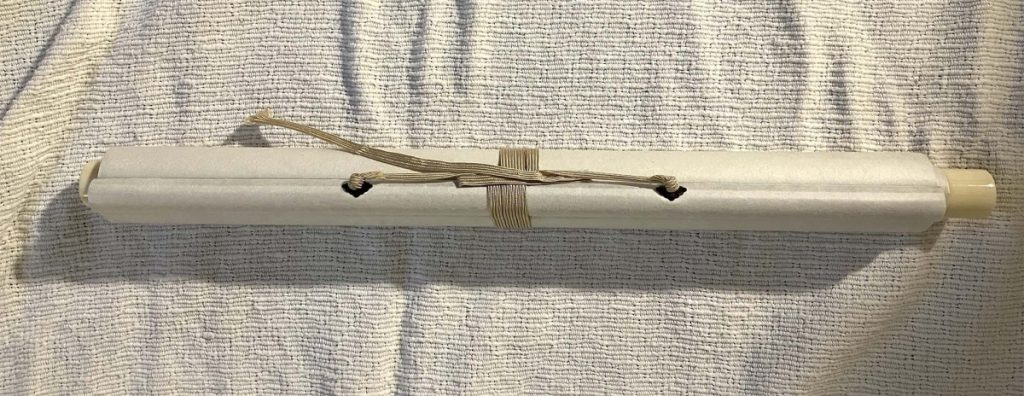
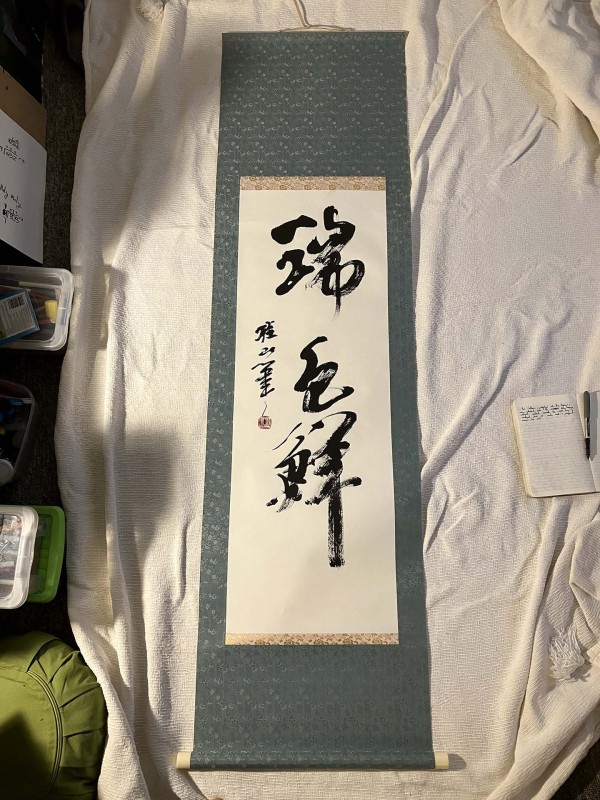
The object is long, perhaps two feet in length. It is off-white in colour and comprises a rod around which a white material is wrapped, bound with a pale gold braid. The object feels nice to hold; it has a nice weight with a texture that is both smooth and rough to the touch. The gold braid is attached to a wooden, half-moon shaped rod of wood around which the top of the scroll is fixed. The braid is wrapped around the circumference of the scroll and as I unwind it, the scroll seems almost to relax. Once unfastened, I begin to unroll the scroll from the top and at once I’m presented with the dark turquoise material patterned with small flowers in gold. It’s a little difficult in the artificial light to be sure of the exact colours. This section of material extends about 18 inches as I continue to unroll it, whereupon it meets another section of material which, centred on the turquoise backing, extends 3/4 of the width of the scroll. It is just over an inch high and again comprises a pattern of flowers, again in gold, but with a cream coloured background. 
As I continue to unroll the scroll I see that this small section of material sits at the top of a section of paper on which the characters of the scroll are painted. The first character extends about 12 inches, comprising four distinct sections of brush work. Obviously I can’t read what it says, and as I unroll the scroll down further, smaller characters appear on the left next to a slightly larger one. Underneath these three smaller characters is a red, printed icon. Underneath the larger character beside these three small characters are two more larger ones. As I continue to unroll the scroll, the paper section ends with another small strip of material matching the one at the top but narrower. The dark turquoise material extends beneath this another 10 inches and as I continue to unroll I reach the bottom where the scroll is wrapped around the heavier, ivory coloured rod. There’s a lovely, defined feel to this action, where the end is reached.
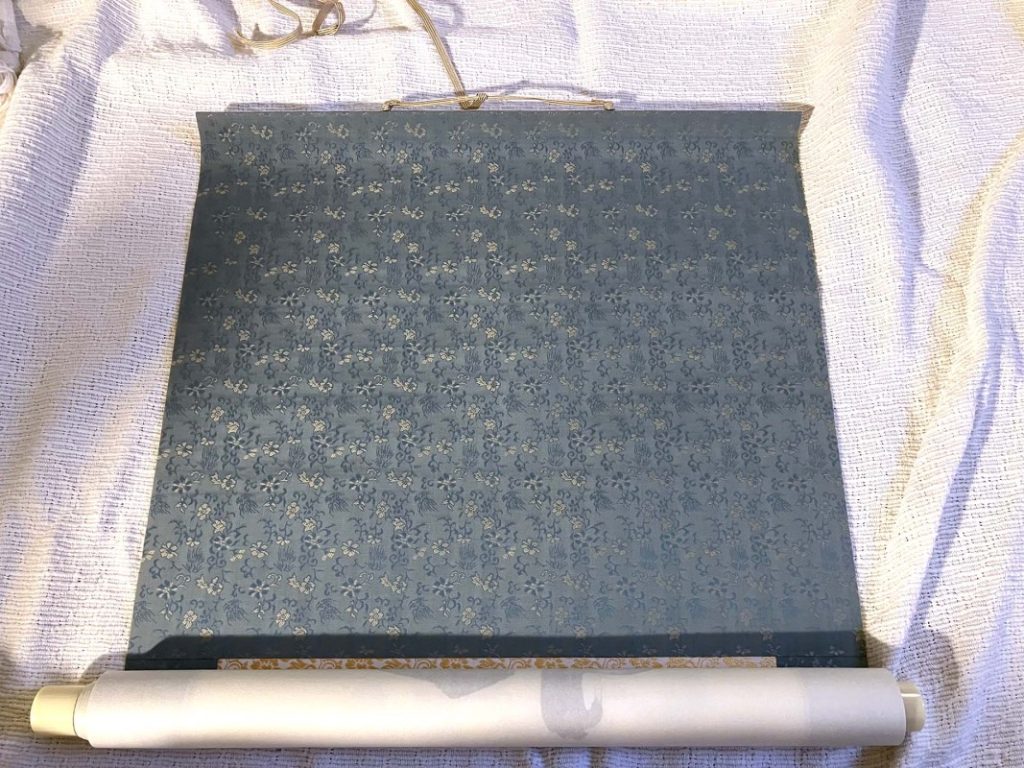
Looking at the characters, I can see that they obviously have meaning, that they are painted with an obvious purpose. I can see where the ink is heavier and where it has bled into the paper and also where the brush is dryer. Here I notice the ink is streaked. Even though I cannot read what it says, I can read the gesture of the calligrapher as he or she moves down the paper. As I look at the characters, I can see that along with the gold flowers patterning the dark background there are also flowers in a darker, turquoise colour. The gold of the two strips at the top and the bottom of the paper part of the scroll match the hanging braid at the top of the scroll which in turn picks out the gold flowers of the background giving the whole scroll a sense of unity. Overall the scroll is just over 1m 60cm in length and just over 45cm wide
2

The scroll obviously comprises different parts; the backing material and strips of fabric, the wooden rod at the top, the plastic one at the bottom, the gold braid for tying and hanging and of course the paper section with on which the characters have been written. I can imagine the mind of the calligrapher, how as they wrote these characters, they might have sounded the words in their head. I can almost hear the sound of their thinking along with that of the brush being dipped in the ink and then scraped across the paper. To someone who doesn’t read that language, these words are mute, but because of that I can almost hear their sound in the mind of the calligrapher, perhaps because mine is quiet. I read the scroll by following the gestures. The words become a language of the moment in which they were made.

The sound of the brush on the paper is different where the density of the ink is different. I can almost hear the fullness of the brush touching the surface of the paper and as the ink is released from the brush into the paper and as the brush loses the ink I can hear the sound of the brush change from a slide to scrape, like rolling waves, falling to scrape on the shingle of the beach. I can also read the pauses between the characters where the calligrapher loads the brush once more with ink to make the second character. Here , the sounds of the place in which the words were painted find a way in. Again, there is the same change from the full sound of the loaded brush to the scrape of the ink as it’s lost. 

The parts where the brush is dry, where I can hear it scrape across the paper, is where I can see the gesture of the artist most clearly. 

Once made the paper would be cut to size and mounted on the material. Was the material chosen specifically for this text? Does it add to the meaning? That I can’t say, but I like the contrast between the precision of the background (the straight edges of the material) and the fluidity of the brush work. Where I can hear the sound of the brush work I can almost hear the sound of the scissors cutting the straight edges of the material, the strips and the paper. 

As I roll the scroll back up, it’s as if the scroll is rolling itself, as if it has spoken long enough and needs to rest again. As I roll, I’m aware of the change where the dark material and the text changes to the off-white reverse of the backing material. This plain, off-white material is silent, unlike its interior, where the pattern and the text have spoken. I can just see the text through the material as I roll it, whispering as it’s gradually rolled away. 

Did the scroll hang anywhere or was it always rolled up? Was it gift for someone? Did the text have any significant meaning for whoever gave it or received it?

Having rolled the scroll up its full length, it is once more the coiled scroll. I pick it up and I’m aware of the difference between the rolled scroll (quiet, portable, weighted) and the unrolled scroll (which speaks in the sounds both of it making and its meaning) which is light and different to hold.

There are then two very different states of the scroll and as I coil the braid around it, I feel as if I’m in control, whereas when it’s unrolled, I tread around it very carefully. In its unrolled state it is fragile but large, in contrast to its rolled state.

Having rolled the scroll up and tied the braid, it’s as if I am silencing the scroll for a while, knowing that it will speak again. It certainly feels like it has a life of its own and is waiting to be awakened.

3

Rolled up it’s silent, but is thinking – it has something to say; it’s as if the actions and the thoughts of the calligrapher are contained within; as if the moment of its making is waiting to be sounded with its unwinding.  As I loosen the braids the scroll breathes. There is a sense of ceremony, waiting for that moment to be revealed in this moment, as if the moment contained within will become one with the moment in which we, ourselves, are contained. 

As I unroll the scroll, it’s as if the scroll is taking a breath, as if the pattern is an intake of breath ready to speak that which is on the paper. 

As I continue to unroll, it begins to speak. The painted brushstrokes are words of a language, not only in the sense of one spoken by a particular group of people, but the language of the moment in which it was made, the ambient sounds, the brush work on the paper. 

The backing is the breath. 

As it remains in its unrolled state, it breathes. It is a thing all of its own. That moment in time delineated by the sound by the fluid brushstrokes and the precision of the material in which it is framed. As long as it’s open, unrolled, the moment of its making plays in the present.

4

The solidity and tightness of the rolled state – the past hidden.
The untying.
The unrolling and revelation.
The fragility and expanse of the unrolled state – the past revealed.
Then as now.
Delineated.
Breathing.
Defined.
Sounds.
The re-rolling and hiding.
Quiet.
Ceremony and calmness.
Past and present as one.
Filed Under: Goethean Observations, Shadow Calligraphy, The Leaves Are Singing Still

Roman Bottle

November 1, 2023 by Nicholas Hedges

I recently purchased a beautiful Roman Unguentarium (2nd or 3rd century AD) and have undertaken a Goethean observation of it. For information on this process, please see below.

The process of 'Goethean Observation'

Introduction

There are many different interpretations of the Geothean (a method of observing as described by Johann Wolfgang von Goethe (1749 – 1832)) method, but the one I prefer to use is that described by Iris Brook in her paper, “Goethean Science as a Way to Read Landscape,” which is, basically, as follows:

1. exact sense perception [bare facts: perception]
2. exact sensorial fantasy [time-life of object: imagination]
3. seeing in beholding [heartfelt getting to know – inspiration]
4. being one with the object [intuition]

1. Exact Sense Perception [Perception]

Now the observer attempt to approach the object from a clearer, more objective standpoint.. This stage was called by Goethe, exact sense perception and is characterised by a detailed observation of all the ‘bare facts’ of the phenomenon that are available to our ordinary senses. It is an attempt to see what is present with as little personal judgement and evaluation as possible.

An example of trying to let the facts speak for themselves from Goethe’s own work is his extraordinarily detailed observations of colour phenomena. Rather than draw hypotheses or work from a theory his investigations involve colour as experienced by himself, as used by artists, as created by dyers, as used symbolically, as seen in animals and plants and so on.

For the student attempting to carry out this stage with their own phenomenon, drawing can be a useful tool, because in drawing our attention is brought to previously unnoticed detail or patterns.

Another tool used is to ignore some knowledge, for example the names of things… Attempting to find another word to describe the part you are indicating to someone else often leads to a looking again.”

2. Exact Sensorial Fantasy [imagination]

“The second stage of looking at the phenomenon is what Goethe called ‘exact sensorial fantasy’ (Exact sinnliche Phantasie). An aspect of this activity is to perceive the time-life of the phenomenon, that is to see the phenomenon in time. This means no longer seeing the thing in an objective frozen present as prompted by the first stage, but as a thing with history. That history can be drawn from the phenomenon with the use of an imaginative faculty that cultivates temporal and physical relationships…

The shift between the two modes of seeing is a small one, but the world does look very different when seen in a state of flux.

In this phase the imagination can be used as a tool to vary what is seen and attempt to imagine it otherwise. The obvious link to the phenomenology here is with the use of free imaginative variation. First suggested by Husserl, this is a means of deriving the essence of a phenomenon by pushing the eidos of the thing beyond what can be imagined. The second stage could be seen as a training of the imaginative faculty in two directions: firstly to free up the imagination and then to constrain it within the realms of what is possible for the phenomenon being studied.”

3. Seeing in Beholding [Inspiration]

The first two stages of Goethean method could be characterised as an engagement with the phenomena, first by seeing its outer static appearance objectively and then by experiencing something of its inner processes. In the third stage one attempts to still active perception to allow the thing to express itself through the observer. We attempt to step outside of what has gone before and make space for the thing to articulate in its own way.

The detailed information is somehow transcended, but just as exact sensorial fantasy requires exact sense perception to anchor its dream-like activity, seeing in beholding needs the content and the preparation of the other two stages if the researcher is to articulate the thing. Goethe terms the changes necessary to our everyday consciousness as the development of ‘new organs of perception’.

To experience the being of a phenomenon requires a human gesture of ‘self-disspation’. This effort is a holding back of our own activity – a form of receptive attentiveness that offers the phenomenon a chance to express its own gesture.”

4. Being One with the Object [Intuition]

“The first three stages of the Goethean method involve different activities and ways of thinking and these could be characterised as first using perception to see the form, second using imagination to perceive its mutability, and, third, inviting inspiration to reveal the gesture. The fourth stage uses intuition both to combine and go beyond the previous stages.

Being one with the object in this fourth stage allows the human ability to conceptualise to serve the thing: we lend it this human capacity. When the phenomenon being explored does not have the ability to think, it is the most participatory part of Goethean observation.

Our ability to think creatively and to initiate future action is the faculty being used here and thus the dangers of abstract creation not tied to the phenomenon are great.

Being one with the object allows an appreciation of the content or meaning of the form as well as the form itself… At this stage of the process of Goethean observation it is acknowledged that the phenomenon is at its least independent of human reason.”

1

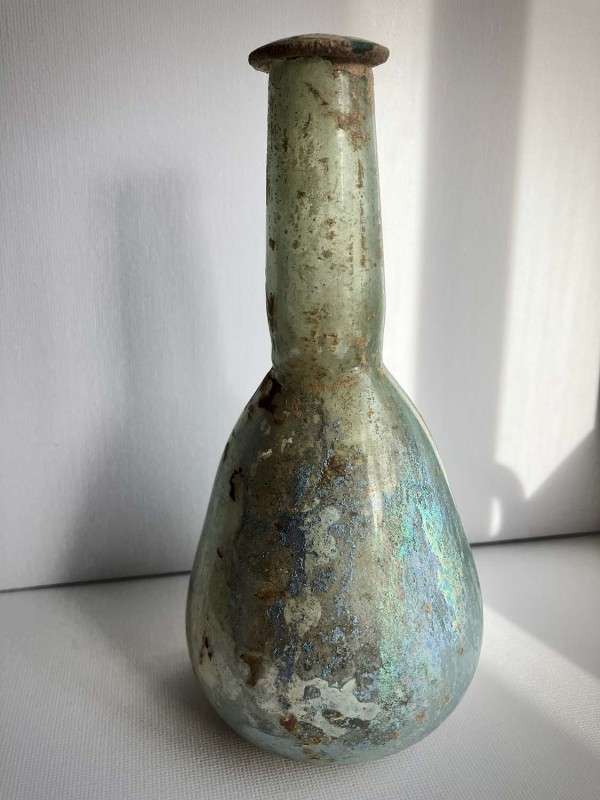
This is a bottle about a hand’s length in height. It has a bulblike shape tapering to a neck which is short of half the bottle’s height. Its base is flat allowing it to stand on the table. It is clearly an object designed to be held.

It is not perfectly shaped and is uneven in its symmetry. It has a lip at the top covered with a brown encrustation, which also runs a little down the neck from the rim.

It looks like glass, but the glass is not entirely transparent. It looks almost like marble with veins of colour running its length. It is a blue green colour with patches of silvery grey and gold-brown. Turning the bottle around, I can see the patches cover its surface but there are small patches where the glass is clear.

In the light of the lamps in my room, the bottle shimmers with iridescent hues of turquoise and purple-blues. Holding the object in my hand, I am struck by how light it is and how thin I suppose the glass is. As I turn in my hands, I can hear it against my skin. It almost rings when my hands turn it, and as I do so, I am more aware of the unevenness of its shape.

Picking it up. I look down inside the neck. All I see is the cloudy mottled glass, flecked here and there with brown. It is clearly a very fragile object, and picking up again. I can feel its cool surface. I see the lights reflected on its surface. It almost has the feel of a lightbulb, but its surface is much less smooth. Running my thumbs over its surface. I can feel that in small parts, it is rough, in others very smooth. This is where the glass is almost completely transparent. 

2

This bottle is almost 2000 years old, and the fact it has remained intact all that time is remarkable. It is a blown piece of glass, meaning that in the second or third century A.D. someone blew to make it shape. The fact that its shape is slightly irregular lends it a very human quality. Someone’s breath – the act of breathing out 1800 years ago – gave it its shape and with its beautiful iridescent surface, I think of a bubble, albeit one which is not a perfect sphere. This bottle has the fragility of a bubble; one which, after so many centuries still hasn’t burst. It’s as if the breath which made it is somehow contained within and with that sense of exhalation comes the expectation of a breath about to be taken; a breathing in to compliment the breathing out.

I now become aware of the life of its maker. Their breathing in and out; something they did – like we all do – without thinking. I’m aware of their heart beating, aware that it has long since stopped. And yet, in this bottle, the memory of a pulse remains.

It’s almost the opposite of my mum‘s final breath, when she breathed in and passed away. This bottle, instead, contains a breath exhaled, but with both my mother’s last breath and the breath of the bottle’s maker, there is the expectation of another. With my mum it never came. Now this bottle too seems to be waiting. It’s as if the bottle has been breathed out slowly over the course of 18 or 19 centuries. Picking it up. It’s like holding a breath, but one breathed out nearly 2 millennia ago.

I think about that moment when it was first breathed into existence, when it would have glowed white hot. Who made it? What was it like where it was made? Obviously it would have been hot, a stark contrast to its cool surface. Now I think of whoever made it watching its shape form, before setting it down to cool with the others they had made that day.

Once cooled and finished it would’ve been sold, I presume, and I wonder who bought it. Who used it? I know it was used to hold unguent. But what exactly did it contain? I imagine it being lifted and whatever was inside poured out. I find myself doing the action of pouring. It would have felt different then heavier with the liquid inside.

Back then it was just a bottle sitting on a shelf or a table witnessing a world which seems to us impossibly remote. What reflections found their way to its surface? Did it have a stopper – a piece of fabric perhaps? What did it smell like inside? It doesn’t smell of much now of course

I look at its shadow cast by my modern lamp; its harsh outline, and I wonder about its shadows all those years ago – shadows made by the sun which might also have pricked its surface as my lightbulb does this evening. Or perhaps the soft glow of a flame. Then its shadow would not be still and on its surface the flames would shift.

It was an everyday object, and yet it speaks now of many centuries. The person who made it those who owned it and used it have long since gone, their memory lost to the past. Generations of their descendants have also followed, and yet this insignificant, everyday and very fragile object has outlived them all. Yet, despite its age, it is vulnerable. It is therefore a curious mixture of extreme vulnerability and strength.

In its fragility, it has held the breath of whosoever made it for hundreds and hundreds of years. With that held breath comes  the ‘possibility’ of its breathing. It has the feel and look of a living thing. The breath exhaled by the maker becomes the inhalation of the bottle.

Patches of iridescence break to reveal patches of clear glass, through which, when the glass was untarnished, we might imagine one could see the unguent inside. The iridescence is caused by the deterioration of the glass, which draws a beautiful veil over its distant past. I wonder where the object has lain for so many years, where it has been, and how it could survive intact all those hundreds of years. Will the iridescence continue to cover its surface, cocooning it? Will the encrustation on the lip of the bottle and a part of the neck continue to grow, to cover this long-held breath. 

Before the bottle was even a bottle, it was the sand, the soda and lime, from which it was made, and the intention of the maker. The sand, perhaps part of a beach – an ancient shoreline on which the waves lapped just as they do today. But then they would come loaded with mystery. Back then there were lands still undiscovered and fantastical creatures beyond the horizon; creatures as ‘real’ as the sand on the beach. That sand would, in time, be gathered and used to make the glass. Sand which itself had been millions of years in the making. Its origins extend to a time before there were people people to imagine such fantastical creatures; a time when people were just as absent from the real world, as we now know these creatures to be. Reason is a clarity like glass which we can see through. Glass is the way we see beyond our own world, both at the ‘impossibly’ big universe to the ‘impossibly’ small realm of the particle.

On that ancient shoreline, the sand would’ve been gathered, and with the other ingredients turned into glass by the skill of the glassmaker; a skill which would’ve been learned over many years. The bottle is there for a mix, not only of the raw materials needed to make the glass, but also the skill of the glassmaker, learned and perfected over many years. In his hands, with his actions and his breath, the glass bottle would have come into existence. 

The bottle is almost like the memory of a moment; the moment when it was made; the memory of the maker, his actions, his breath, the hour of the bottle’s production. The memory was clear and then it became clouded, changing from what really was to a distorted version. Whoever owned the bottle (maybe it was several people) died and was buried. Perhaps the bottle was buried with them and for hundreds of years it lay in the dark, quiet of the ground, unseen by anyone until it’s rediscovery. Underground it underwent a change; chemical changes caused by water in the soil leached out the salt from the glass and over hundreds of years thin layers were built up on the surface of the glass. Only when the glass saw light again did that process reveal itself through the iridescence of its surface.

It’s almost as if the bottle, whilst underground, ceased to be a bottle (it’s only a bottle in the mind of someone looking at it instead it became a process. 

3

A breath given.
A breath held.
Held by the bottle.
Held in my hand.
Fragility and strength.
Air inside a bubble, its surface slipping with iridescence.

4

I find myself inside the bottle, looking out through the patches of clear glass, out at the room in which I stand. I see the room and everything in it. It’s rather vague, like my shadow cast by the candles and lamps. Now, all these centuries later, I am an object in my own right rather than a mere vessel for whatever I once contained. It’s as if my eyes have been turned in on myself. My shape is not that of the liquid I once contained. I have now become the shape. 

The shape of the breath that made me. 

The breath I hold which to exhale would see me break.

All the while I hold it, I can remember.

When I breathe out, then I will forget.

Filed Under: Goethean Observations

Goethean Observation: Diffuser

March 13, 2023 by Nicholas Hedges

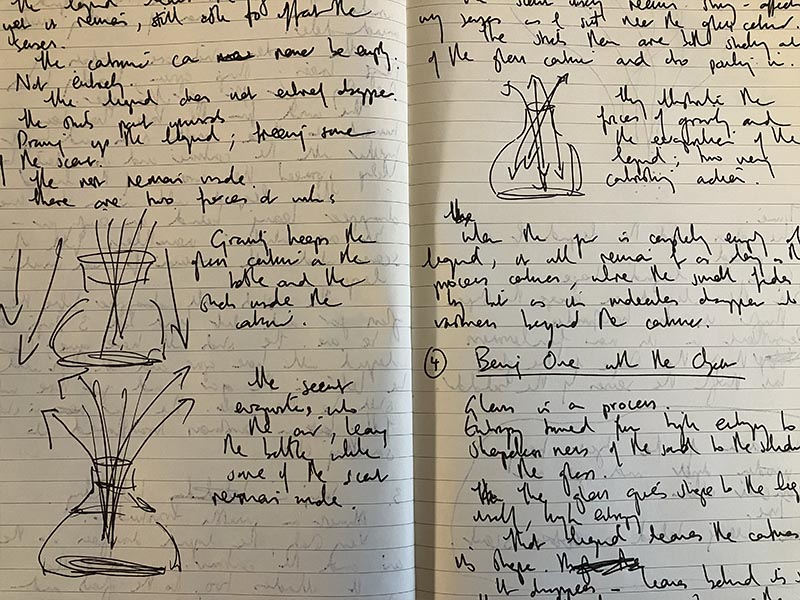
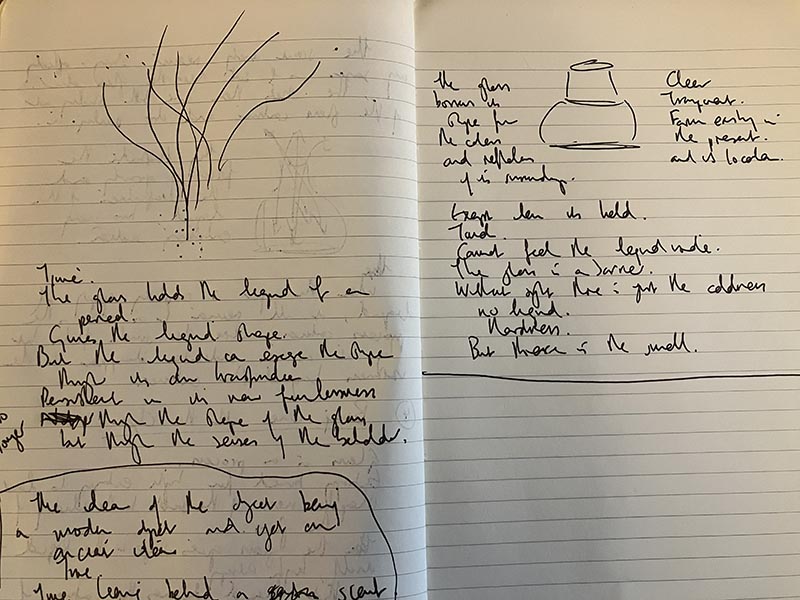
After writing about the empty diffusers I found in  my late mum’s house, I’ve been wondering about how I might use them in a work. One of the strategies I learned on my MA (2006-08) was Goethean observation; a process I have used many times before and which I decided to use again with these objects. The method of observation can be found below.

The process of 'Goethean Observation'

Introduction

There are many different interpretations of the Geothean (a method of observing as described by Johann Wolfgang von Goethe (1749 – 1832)) method, but the one I prefer to use is that described by Iris Brook in her paper, “Goethean Science as a Way to Read Landscape,” which is, basically, as follows:

1. exact sense perception [bare facts: perception]
2. exact sensorial fantasy [time-life of object: imagination]
3. seeing in beholding [heartfelt getting to know – inspiration]
4. being one with the object [intuition]

1. Exact Sense Perception [Perception]

Now the observer attempt to approach the object from a clearer, more objective standpoint.. This stage was called by Goethe, exact sense perception and is characterised by a detailed observation of all the ‘bare facts’ of the phenomenon that are available to our ordinary senses. It is an attempt to see what is present with as little personal judgement and evaluation as possible.

An example of trying to let the facts speak for themselves from Goethe’s own work is his extraordinarily detailed observations of colour phenomena. Rather than draw hypotheses or work from a theory his investigations involve colour as experienced by himself, as used by artists, as created by dyers, as used symbolically, as seen in animals and plants and so on.

For the student attempting to carry out this stage with their own phenomenon, drawing can be a useful tool, because in drawing our attention is brought to previously unnoticed detail or patterns.

Another tool used is to ignore some knowledge, for example the names of things… Attempting to find another word to describe the part you are indicating to someone else often leads to a looking again.”

2. Exact Sensorial Fantasy [imagination]

“The second stage of looking at the phenomenon is what Goethe called ‘exact sensorial fantasy’ (Exact sinnliche Phantasie). An aspect of this activity is to perceive the time-life of the phenomenon, that is to see the phenomenon in time. This means no longer seeing the thing in an objective frozen present as prompted by the first stage, but as a thing with history. That history can be drawn from the phenomenon with the use of an imaginative faculty that cultivates temporal and physical relationships…

The shift between the two modes of seeing is a small one, but the world does look very different when seen in a state of flux.

In this phase the imagination can be used as a tool to vary what is seen and attempt to imagine it otherwise. The obvious link to the phenomenology here is with the use of free imaginative variation. First suggested by Husserl, this is a means of deriving the essence of a phenomenon by pushing the eidos of the thing beyond what can be imagined. The second stage could be seen as a training of the imaginative faculty in two directions: firstly to free up the imagination and then to constrain it within the realms of what is possible for the phenomenon being studied.”

3. Seeing in Beholding [Inspiration]

The first two stages of Goethean method could be characterised as an engagement with the phenomena, first by seeing its outer static appearance objectively and then by experiencing something of its inner processes. In the third stage one attempts to still active perception to allow the thing to express itself through the observer. We attempt to step outside of what has gone before and make space for the thing to articulate in its own way.

The detailed information is somehow transcended, but just as exact sensorial fantasy requires exact sense perception to anchor its dream-like activity, seeing in beholding needs the content and the preparation of the other two stages if the researcher is to articulate the thing. Goethe terms the changes necessary to our everyday consciousness as the development of ‘new organs of perception’.

To experience the being of a phenomenon requires a human gesture of ‘self-disspation’. This effort is a holding back of our own activity – a form of receptive attentiveness that offers the phenomenon a chance to express its own gesture.”

4. Being One with the Object [Intuition]

“The first three stages of the Goethean method involve different activities and ways of thinking and these could be characterised as first using perception to see the form, second using imagination to perceive its mutability, and, third, inviting inspiration to reveal the gesture. The fourth stage uses intuition both to combine and go beyond the previous stages.

Being one with the object in this fourth stage allows the human ability to conceptualise to serve the thing: we lend it this human capacity. When the phenomenon being explored does not have the ability to think, it is the most participatory part of Goethean observation.

Our ability to think creatively and to initiate future action is the faculty being used here and thus the dangers of abstract creation not tied to the phenomenon are great.

Being one with the object allows an appreciation of the content or meaning of the form as well as the form itself… At this stage of the process of Goethean observation it is acknowledged that the phenomenon is at its least independent of human reason.”

Observation: Diffuser

1. Exact Sense Perception [Perception]

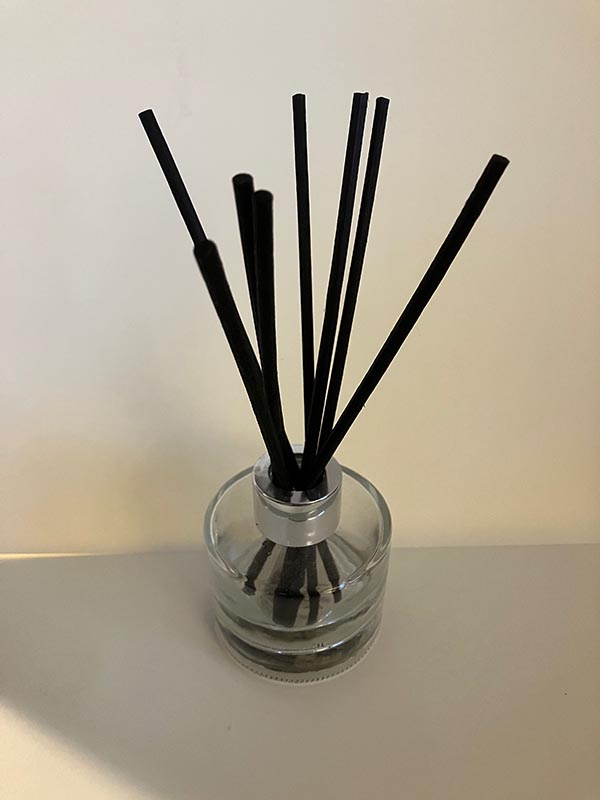
On first seeing the object it becomes apparent there are two main parts to it. One, a glass jar/container and second, eight black wooden sticks. The sticks are placed inside the container and protrude from the top several inches.

The glass container is approximately 3 inches in height and inside is a liquid; not much – just a few millimetres. The bottom of the sticks rest on the bottom of the container and in the liquid which coats the bottom of the sticks. There is some writing on the glass container which includes a description of the obvious scent coming from the container.

Placing my nose near the opening at the top of the container, the smell is very strong and quite overpowering.

I can see the lights of the room I am sitting in and that from the window reflected in the silver stopper at the top of the jar and in the glass; with highlights on the shoulder of the glass container  and again in the stopper.

I can feel my nose – full of the scent which becomes increasingly strong; almost too much.

I can hold the container in my hand. Looking at it from below I can see the viscous liquid move about the base. It is goldish in colour and syrupy.

Holding one of the sticks they are about 12cm long. One end is wet with the liquid, the other dry but there is a dry kind of stickiness to it. When I place the stick back in the glass container I can feel something on my finger. It smells like the scent from the bottle.

There are lots of reflections in the jar and the stopper; the brown of the table, the lights I’ve already mentioned; reflections of the sticks in the silver surface of the stopper.

I can see the base of the sticks through the glass of the jar, their shape distorted especially at the shoulder of the container.

Leaning back I can see the liquid on the base of the sticks catching the light in the room and from the window. The sticks form a random pattern as they stick out of the container, like fingers reaching out.

2. Exact Sensorial Fantasy [imagination]

Looking at the objectI think of its two parts; the glass container and the wooden sticks standing inside. To begin, I take the sticks out of the jar ad place them on the table beside me.

These two materials then are quite different entities. And there is the liquid too, created in a factory somewhere from all kinds of different scents – only some of it remaining in the bottom of the jar. The jar, as it stands on the table before e, looks empty – reflecting just the room round it. Only when I pick it up is the liquid apparent.

The liquid then must have once filled the container; the liquid created by people who could smell when the recipe was right, when a satisfying smell had been created.

The smell lingers; remaining strong even though so much of the liquid has gone; evaporated through the same hole through which it was poured before being sealed up.

The glass itself comprises ingredients mixed together to create the material. Although the object exists now, the method itself is ancient.

As is the idea of scented oil. There is something ancient about the glass jar – the idea of the container and the scented oil. The smell I can smell is strong and in that sense is something equally ancient.

The glass container and the liquid inside are a version of something much older,

The wooden sticks are products of trees; things grown, reaching toward the sky, year after year after year.

The wood from the tree has been turned into these small sticks and brought together with the container and its contents to help spread the aroma of the liquid.

The liquid will, in a short time, disappear leaving behind an empty jar – but one which is nevertheless full of scent which will remain for much longer.

The sticks will disappear before the glass jar and what had been 3 things will be one. The sticks will have gone; the liquid will have gone and all that will be left is the jar – and yet there will still be the scent. The jar is still full – and yet there will still be the scent. The jar is still full; an emptiness transformed into something else.

Goethean Observation notes

3. Seeing in Beholding [Inspiration]

An almost invisible transformation

Very slowly the liquid disappears into the air around the container.

It attached too to the glass and the sticks

The liquid leaves the jar and yet it remains, still able to affect the senses.

The container can never be empty.

Not entirely.

The liquid does not entirely disappear.

The sticks point upwards, drawing up the liquid; freeing some of the scent.

The rest remains inside.

There are two forces at work. Gravity keeps the glass container on the table and the sticks inside the jar. The scent evaporates into the air leaving the bottle while some of the scent remains inside.

Te scent itself remains strong – affecting my senses as I sit near the glass container. The sticks then are both sticking out of the glass container ad also pointing in.

They illustrate the forces of gravity and the evaporation of the liquid; two very contrasting actions.

When the jar is completely empty of liquid, it will remain for as long as the process continues, when the smell fades bit by bit as its molecules disappear into te vastness beyond the container.

4. Being One with the Object [Intuition]

Glass is a process.

Entropy.

Turned from high entropy to low.

Shapelessness of the smell to the solidity of the glass.

The glass gives shape to the liquid – itself high entropy.

That liquid becomes the confines of its shape.

It disappears and leaves behind its smell.

That smell forms a shape in the mind.

Time.

The glass holds the liquid for a period.

The shape of time.

Gives the liquid shape.

The liquid escapes the shape through its own transformation.

Resilient in its new formlessness.

The glass itself borrows its shape from the colours and reflections of its surroundings.

Clear.

Transparent.

Its form borrowing from the present and its location.

Except when its held.

Touch.

Cannot feel the liquid inside.

The glass is a barrier.

Without sight there is just the coldness.

No liquid.

Hardness.

But there is the smell.

Filed Under: Goethean Observations

© Nicholas Hedges 2024

  • Facebook
  • Instagram
  • Twitter
  • YouTube

Copyright © 2025 · Outreach Pro on Genesis Framework · WordPress · Log in