Nicholas Hedges

Art, Writing and Research

  • Amazon
  • Behance
  • Facebook
  • Instagram
  • Pinterest
  • YouTube
  • Art
    • Digital
    • Drawing
    • Grids
      • Correspondence
      • The Wall
      • The Tourist
    • Ink on paper
      • Shadow Calligraphy
    • Installation
      • Murder
      • Echo
    • Painting
    • Patterns
    • Mixed Media
    • Photographic installation
      • St. Giles Fair 1908
      • Cornmarket 1907
      • Headington Hill 1903
      • Queen Street 1897
    • Research/Sketches
    • Stitched Work
      • Missded 1
      • Missded 2
      • Missded 3
      • Missded 4
    • Text Work
  • Blogs
    • Family History
    • Goethean Observations
    • Grief
    • Light Slowed But Never Stilled
    • Lists
    • Present Empathy
    • Shadow Calligraphy
    • Trees
    • Time
    • Walking Meditations
  • Video
  • Photography
    • Pillars of Snow
    • Creatures
    • The Trees
    • Snow
    • St. Giles Fair 1908
    • Cornmarket 1907
    • Headington Hill 1903
    • Queen Street 1897
    • Travel
  • Illustration and Design
  • Music
  • Projects
    • Dissonance and Rhyme
    • Design for an Heirloom
    • Backdrops
    • Shadow Calligraphy
  • Exhibitions
    • A Line Drawn in Water
      • Artwork
    • A Line Drawn in Water (Blog)
    • Mine the Mountain 3
      • Artwork
    • Mine the Mountain 2
      • Artwork
      • The Wall
    • The Woods, Breathing
      • Artwork
    • Snow
      • Artwork
    • Echo
      • Artwork
    • Murder
      • Artwork
    • The Tourist
    • Dreamcatcher
    • Mine the Mountain
      • Artwork
      • The Tourist
    • M8
    • The Gate
    • Creatures
      • Artwork
    • Residue
      • Artwork
    • A visit to Auschwitz
      • Artwork
  • Me
    • Artist’s Statement

Goethean Observation: Diffuser

March 13, 2023 by Nicholas Hedges

After writing about the empty diffusers I found in  my late mum’s house, I’ve been wondering about how I might use them in a work. One of the strategies I learned on my MA (2006-08) was Goethean observation; a process I have used many times before and which I decided to use again with these objects. The method of observation can be found below.

The process of 'Goethean Observation'

Introduction

There are many different interpretations of the Geothean (a method of observing as described by Johann Wolfgang von Goethe (1749 – 1832)) method, but the one I prefer to use is that described by Iris Brook in her paper, “Goethean Science as a Way to Read Landscape,” which is, basically, as follows:

1. exact sense perception [bare facts: perception] 2. exact sensorial fantasy [time-life of object: imagination] 3. seeing in beholding [heartfelt getting to know – inspiration] 4. being one with the object [intuition]

1. Exact Sense Perception [Perception]

Now the observer attempt to approach the object from a clearer, more objective standpoint.. This stage was called by Goethe, exact sense perception and is characterised by a detailed observation of all the ‘bare facts’ of the phenomenon that are available to our ordinary senses. It is an attempt to see what is present with as little personal judgement and evaluation as possible.

An example of trying to let the facts speak for themselves from Goethe’s own work is his extraordinarily detailed observations of colour phenomena. Rather than draw hypotheses or work from a theory his investigations involve colour as experienced by himself, as used by artists, as created by dyers, as used symbolically, as seen in animals and plants and so on.

For the student attempting to carry out this stage with their own phenomenon, drawing can be a useful tool, because in drawing our attention is brought to previously unnoticed detail or patterns.

Another tool used is to ignore some knowledge, for example the names of things… Attempting to find another word to describe the part you are indicating to someone else often leads to a looking again.”

2. Exact Sensorial Fantasy [imagination]

“The second stage of looking at the phenomenon is what Goethe called ‘exact sensorial fantasy’ (Exact sinnliche Phantasie). An aspect of this activity is to perceive the time-life of the phenomenon, that is to see the phenomenon in time. This means no longer seeing the thing in an objective frozen present as prompted by the first stage, but as a thing with history. That history can be drawn from the phenomenon with the use of an imaginative faculty that cultivates temporal and physical relationships…

The shift between the two modes of seeing is a small one, but the world does look very different when seen in a state of flux.

In this phase the imagination can be used as a tool to vary what is seen and attempt to imagine it otherwise. The obvious link to the phenomenology here is with the use of free imaginative variation. First suggested by Husserl, this is a means of deriving the essence of a phenomenon by pushing the eidos of the thing beyond what can be imagined. The second stage could be seen as a training of the imaginative faculty in two directions: firstly to free up the imagination and then to constrain it within the realms of what is possible for the phenomenon being studied.”

3. Seeing in Beholding [Inspiration]

The first two stages of Goethean method could be characterised as an engagement with the phenomena, first by seeing its outer static appearance objectively and then by experiencing something of its inner processes. In the third stage one attempts to still active perception to allow the thing to express itself through the observer. We attempt to step outside of what has gone before and make space for the thing to articulate in its own way.

The detailed information is somehow transcended, but just as exact sensorial fantasy requires exact sense perception to anchor its dream-like activity, seeing in beholding needs the content and the preparation of the other two stages if the researcher is to articulate the thing. Goethe terms the changes necessary to our everyday consciousness as the development of ‘new organs of perception’.

To experience the being of a phenomenon requires a human gesture of ‘self-disspation’. This effort is a holding back of our own activity – a form of receptive attentiveness that offers the phenomenon a chance to express its own gesture.”

4. Being One with the Object [Intuition]

“The first three stages of the Goethean method involve different activities and ways of thinking and these could be characterised as first using perception to see the form, second using imagination to perceive its mutability, and, third, inviting inspiration to reveal the gesture. The fourth stage uses intuition both to combine and go beyond the previous stages.

Being one with the object in this fourth stage allows the human ability to conceptualise to serve the thing: we lend it this human capacity. When the phenomenon being explored does not have the ability to think, it is the most participatory part of Goethean observation.

Our ability to think creatively and to initiate future action is the faculty being used here and thus the dangers of abstract creation not tied to the phenomenon are great.

Being one with the object allows an appreciation of the content or meaning of the form as well as the form itself… At this stage of the process of Goethean observation it is acknowledged that the phenomenon is at its least independent of human reason.”

Observation: Diffuser

1. Exact Sense Perception [Perception]

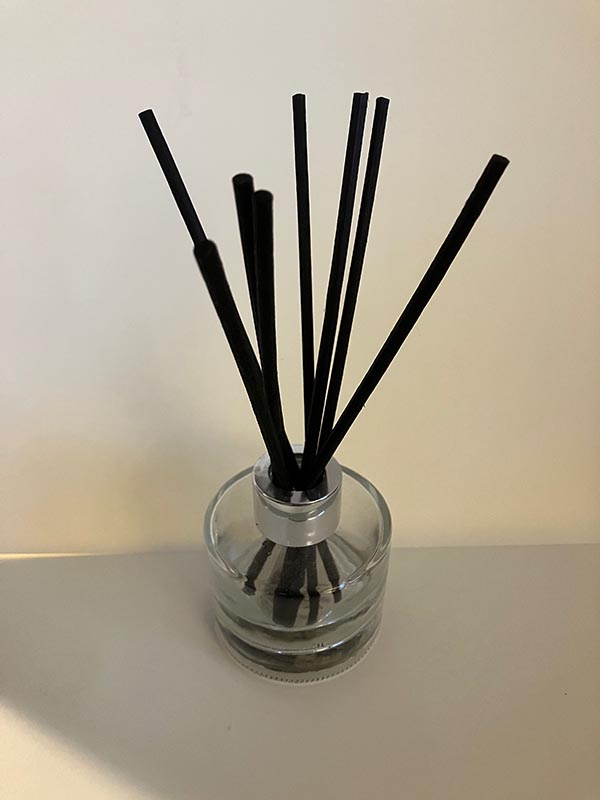
On first seeing the object it becomes apparent there are two main parts to it. One, a glass jar/container and second, eight black wooden sticks. The sticks are placed inside the container and protrude from the top several inches.

The glass container is approximately 3 inches in height and inside is a liquid; not much – just a few millimetres. The bottom of the sticks rest on the bottom of the container and in the liquid which coats the bottom of the sticks. There is some writing on the glass container which includes a description of the obvious scent coming from the container.

Placing my nose near the opening at the top of the container, the smell is very strong and quite overpowering.

I can see the lights of the room I am sitting in and that from the window reflected in the silver stopper at the top of the jar and in the glass; with highlights on the shoulder of the glass container  and again in the stopper.

I can feel my nose – full of the scent which becomes increasingly strong; almost too much.

I can hold the container in my hand. Looking at it from below I can see the viscous liquid move about the base. It is goldish in colour and syrupy.

Holding one of the sticks they are about 12cm long. One end is wet with the liquid, the other dry but there is a dry kind of stickiness to it. When I place the stick back in the glass container I can feel something on my finger. It smells like the scent from the bottle.

There are lots of reflections in the jar and the stopper; the brown of the table, the lights I’ve already mentioned; reflections of the sticks in the silver surface of the stopper.

I can see the base of the sticks through the glass of the jar, their shape distorted especially at the shoulder of the container.

Leaning back I can see the liquid on the base of the sticks catching the light in the room and from the window. The sticks form a random pattern as they stick out of the container, like fingers reaching out.

2. Exact Sensorial Fantasy [imagination]

Looking at the objectI think of its two parts; the glass container and the wooden sticks standing inside. To begin, I take the sticks out of the jar ad place them on the table beside me.

These two materials then are quite different entities. And there is the liquid too, created in a factory somewhere from all kinds of different scents – only some of it remaining in the bottom of the jar. The jar, as it stands on the table before e, looks empty – reflecting just the room round it. Only when I pick it up is the liquid apparent.

The liquid then must have once filled the container; the liquid created by people who could smell when the recipe was right, when a satisfying smell had been created.

The smell lingers; remaining strong even though so much of the liquid has gone; evaporated through the same hole through which it was poured before being sealed up.

The glass itself comprises ingredients mixed together to create the material. Although the object exists now, the method itself is ancient.

As is the idea of scented oil. There is something ancient about the glass jar – the idea of the container and the scented oil. The smell I can smell is strong and in that sense is something equally ancient.

The glass container and the liquid inside are a version of something much older,

The wooden sticks are products of trees; things grown, reaching toward the sky, year after year after year.

The wood from the tree has been turned into these small sticks and brought together with the container and its contents to help spread the aroma of the liquid.

The liquid will, in a short time, disappear leaving behind an empty jar – but one which is nevertheless full of scent which will remain for much longer.

The sticks will disappear before the glass jar and what had been 3 things will be one. The sticks will have gone; the liquid will have gone and all that will be left is the jar – and yet there will still be the scent. The jar is still full – and yet there will still be the scent. The jar is still full; an emptiness transformed into something else.
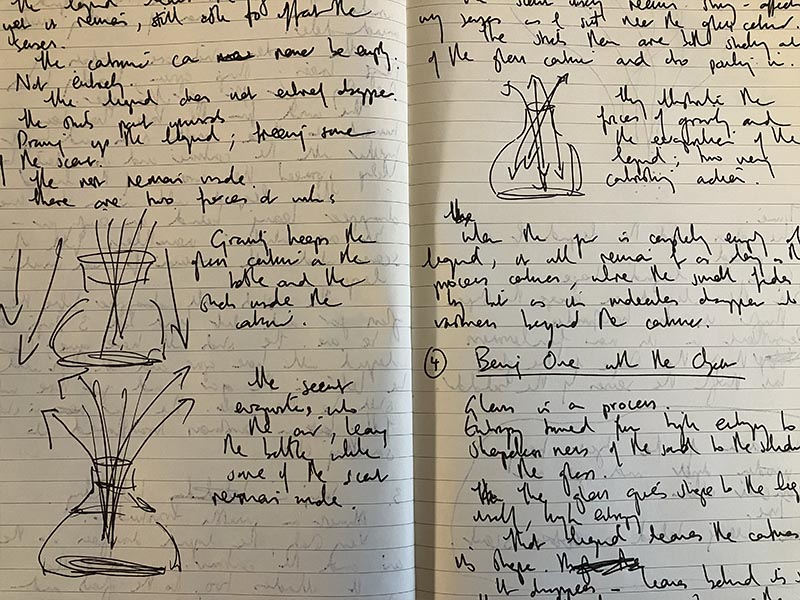
Goethean Observation notes

3. Seeing in Beholding [Inspiration]

An almost invisible transformation

Very slowly the liquid disappears into the air around the container.

It attached too to the glass and the sticks

The liquid leaves the jar and yet it remains, still able to affect the senses.

The container can never be empty.

Not entirely.

The liquid does not entirely disappear.

The sticks point upwards, drawing up the liquid; freeing some of the scent.

The rest remains inside.

There are two forces at work. Gravity keeps the glass container on the table and the sticks inside the jar. The scent evaporates into the air leaving the bottle while some of the scent remains inside.

Te scent itself remains strong – affecting my senses as I sit near the glass container. The sticks then are both sticking out of the glass container ad also pointing in.

They illustrate the forces of gravity and the evaporation of the liquid; two very contrasting actions.

When the jar is completely empty of liquid, it will remain for as long as the process continues, when the smell fades bit by bit as its molecules disappear into te vastness beyond the container.
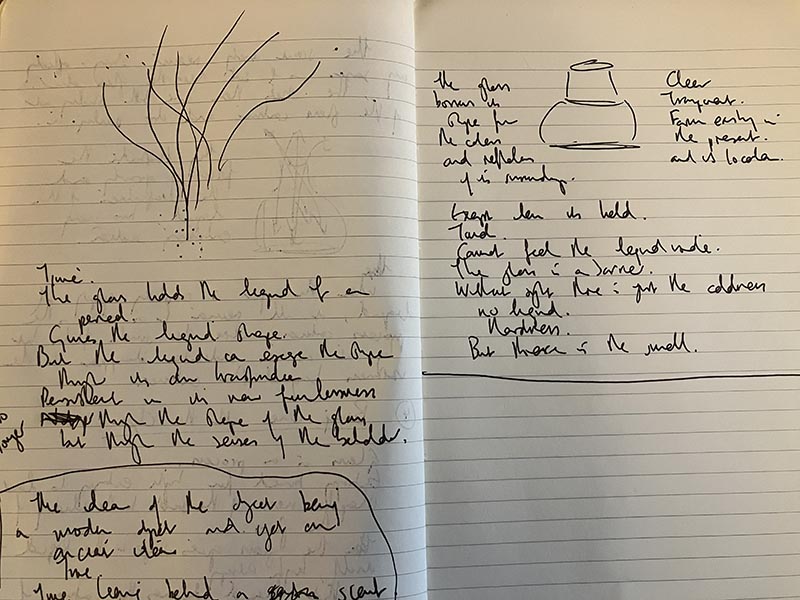
4. Being One with the Object [Intuition]

Glass is a process.

Entropy.

Turned from high entropy to low.

Shapelessness of the smell to the solidity of the glass.

The glass gives shape to the liquid – itself high entropy.

That liquid becomes the confines of its shape.

It disappears and leaves behind its smell.

That smell forms a shape in the mind.

Time.

The glass holds the liquid for a period.

The shape of time.

Gives the liquid shape.

The liquid escapes the shape through its own transformation.

Resilient in its new formlessness.

The glass itself borrows its shape from the colours and reflections of its surroundings.

Clear.

Transparent.

Its form borrowing from the present and its location.

Except when its held.

Touch.

Cannot feel the liquid inside.

The glass is a barrier.

Without sight there is just the coldness.

No liquid.

Hardness.

But there is the smell.

Filed Under: Goethean Observations

© Nicholas Hedges 2024

  • Facebook
  • Instagram
  • Twitter
  • YouTube

Copyright © 2025 · Outreach Pro on Genesis Framework · WordPress · Log in