The paintings I made at Shotover, using ink, rice paper and calligraphy brushes, are like written characters from an unknown language; a language which is created then lost the moment it is written down.
It is the language of the present, which comes and goes in the blink of an eye; a series of ‘nows’ renewed and discarded second by second (‘Forever is composed of nows’ – Emily Dickinson).
A friend of mine recently mounted one of these paintings as a scroll and, framed in this way, that sense of the paintings being part of a language is enhanced, causing the viewer to ask, not so much ‘what does it mean?’ (as an artwork), but rather, ‘what does it say?’ (as a word).
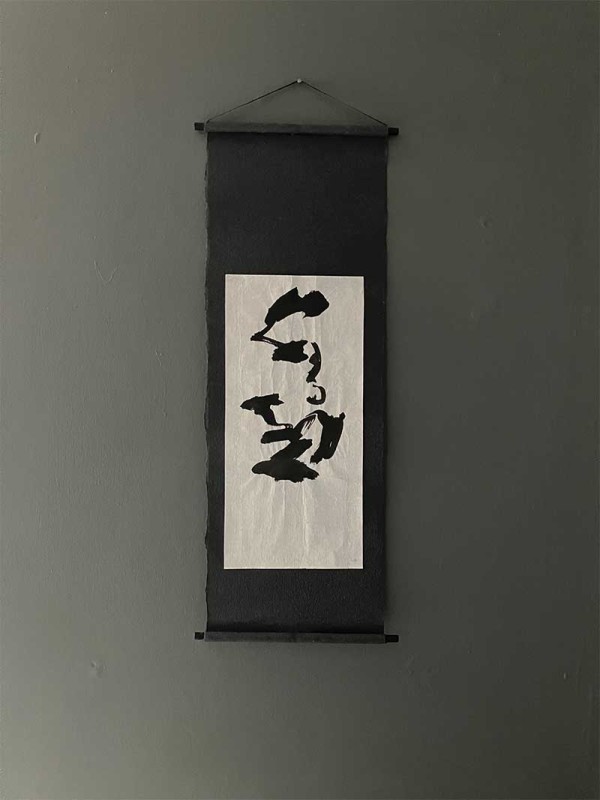
Because it is saying something. We just can’t read it.
The only way we can engage with it on that level – the only way we can read it, is by following the gesture of the marks themselves; following with our eyes the strokes of the brush – perhaps even going so far as to copy them onto paper. That way, we re-create, kinaesthetically, the moment, lost to time, in which they were made.
Whenever I’m in an historic place, whether a building or a part of the landscape, it’s my embodied imagination which helps bring me closer to the people who once walked and lived in those spaces. By tracing or copying the paths they took, I am able, in some small way, to connect with them.
The same is true of these works. The viewer can understand them only by following the marks; by recreating within their embodied imaginations the gestures I made as I painted them.
As I’ve said, the scroll confers on the marks the sense that they are part of a language. That the scroll is hung on a wall also tells us the marks are important, or at least worthy of display. Perhaps they are reminders that the present moment is important; that eventually, all our present moments will be reduced to this – however we live our lives; a single trace, like a fleeting shadow.
In terms of the paintings themselves, these marks are the tracings of shadows cast in a small part of the woods in which they were made. It is all that remains of me, my thoughts, my actions, the trees, the birds, the breeze, the light, the weather in that moment; everything that existed in that particular moment in time is reduced to his single character.
I haven’t titled these pieces, but I’m wondering whether, when I next go out to paint, I should make a note of a few words (as per the lists I’ve made when carrying out walking meditations) and use those. In that way, the viewer can perhaps use the gesture of the brush strokes to recreate the scene from which it was taken.