Nicholas Hedges

Art, Writing and Research

  • Amazon
  • Behance
  • Facebook
  • Instagram
  • Pinterest
  • YouTube
  • Art
    • Digital
    • Drawing
    • Grids
      • Correspondence
      • The Wall
      • The Tourist
    • Ink on paper
      • Shadow Calligraphy
    • Installation
      • Murder
      • Echo
    • Painting
    • Patterns
    • Mixed Media
    • Photographic installation
      • St. Giles Fair 1908
      • Cornmarket 1907
      • Headington Hill 1903
      • Queen Street 1897
    • Research/Sketches
    • Stitched Work
      • Missded 1
      • Missded 2
      • Missded 3
      • Missded 4
    • Text Work
  • Blogs
    • Family History
    • Goethean Observations
    • Grief
    • Light Slowed But Never Stilled
    • Lists
    • Present Empathy
    • Shadow Calligraphy
    • Trees
    • Time
    • Walking Meditations
  • Video
  • Photography
    • Pillars of Snow
    • Creatures
    • The Trees
    • Snow
    • St. Giles Fair 1908
    • Cornmarket 1907
    • Headington Hill 1903
    • Queen Street 1897
    • Travel
  • Illustration and Design
  • Music
  • Projects
    • Dissonance and Rhyme
    • Design for an Heirloom
    • Backdrops
    • Shadow Calligraphy
  • Exhibitions
    • A Line Drawn in Water
      • Artwork
    • A Line Drawn in Water (Blog)
    • Mine the Mountain 3
      • Artwork
    • Mine the Mountain 2
      • Artwork
      • The Wall
    • The Woods, Breathing
      • Artwork
    • Snow
      • Artwork
    • Echo
      • Artwork
    • Murder
      • Artwork
    • The Tourist
    • Dreamcatcher
    • Mine the Mountain
      • Artwork
      • The Tourist
    • M8
    • The Gate
    • Creatures
      • Artwork
    • Residue
      • Artwork
    • A visit to Auschwitz
      • Artwork
  • Me
    • Artist’s Statement

Lydia’s Garden, Dusk, 1764

February 15, 2026 by Nicholas Hedges

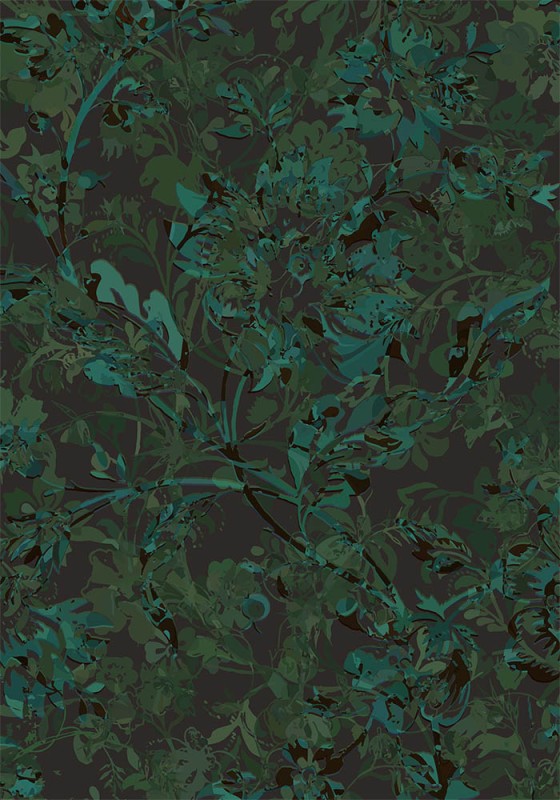
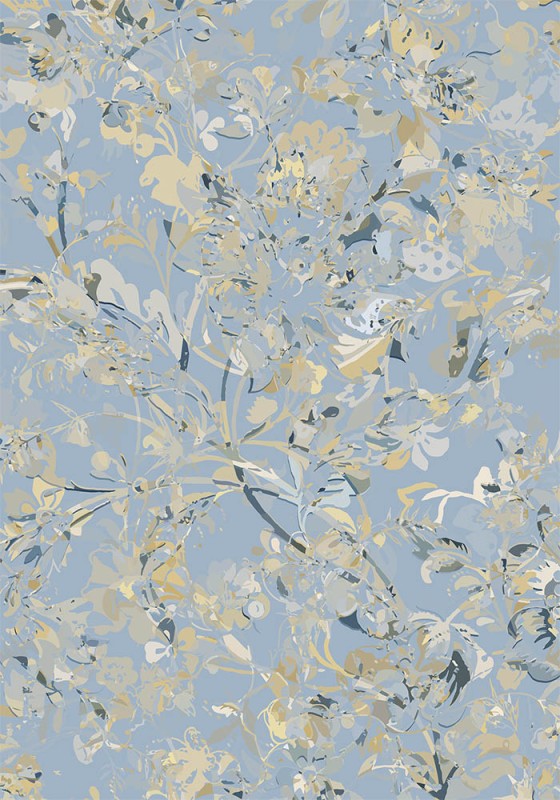
It’s taken a while to get to this stage, working out an image for a painting based on 18th century textile designs, but, at last, I’ve got there. The final design idea is shown below:
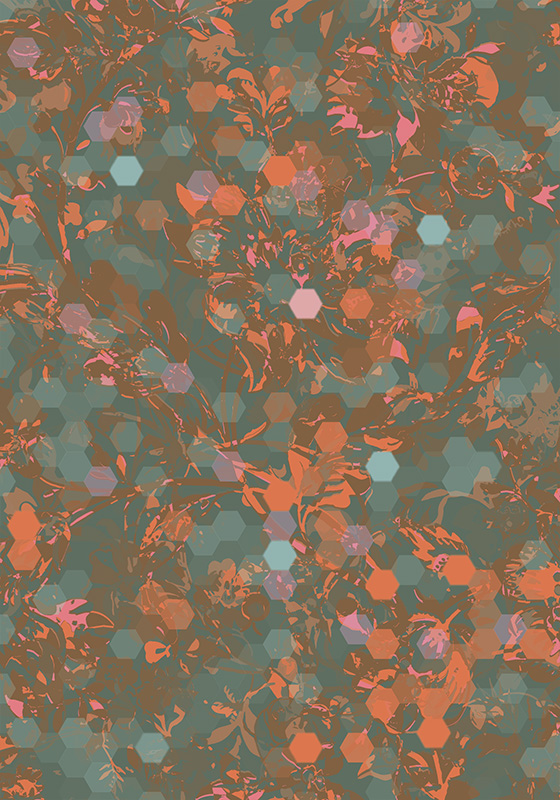
This design began with the images I created and described in my last blog, ‘Lost and Found in Translation‘. The image is titled ‘Dress Fabric for Lydia, 1764‘, Lydia being my 5x great-grandmother who was born in Oxford in 1734 and died in 1822.
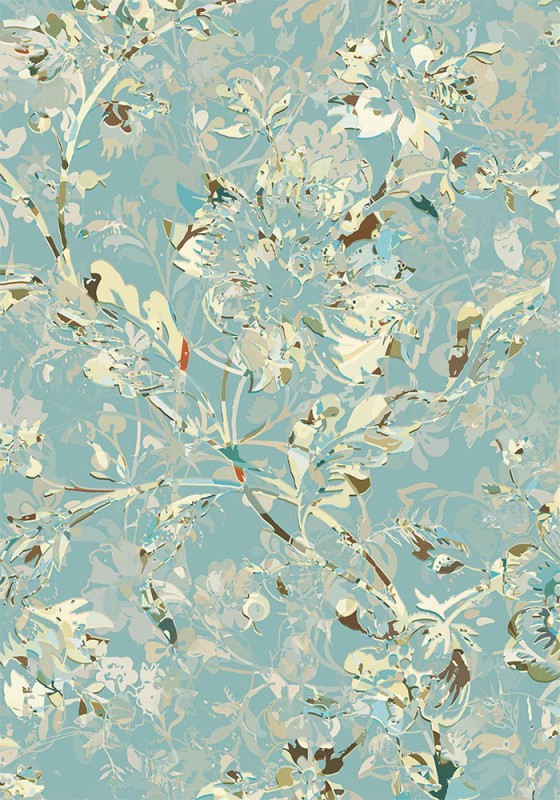
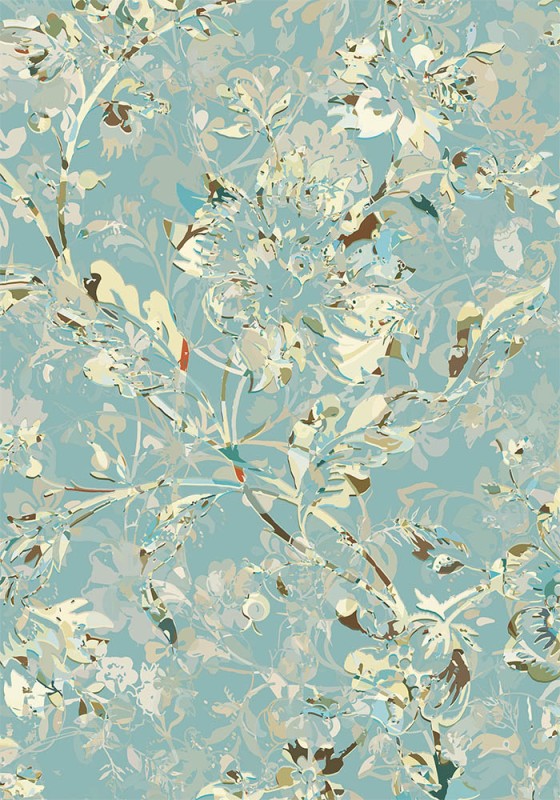
This image comprises 4 individual 18th century textiles which have been blended and recoloured to give them a fragmentary appearance. I wanted a way of increasing that fragmentation, of rendering the images, in parts, almost anonymous and impenetrable as so much of the past is.

The first thing I did was pixelate the image with some of the original pattern remaining visible.
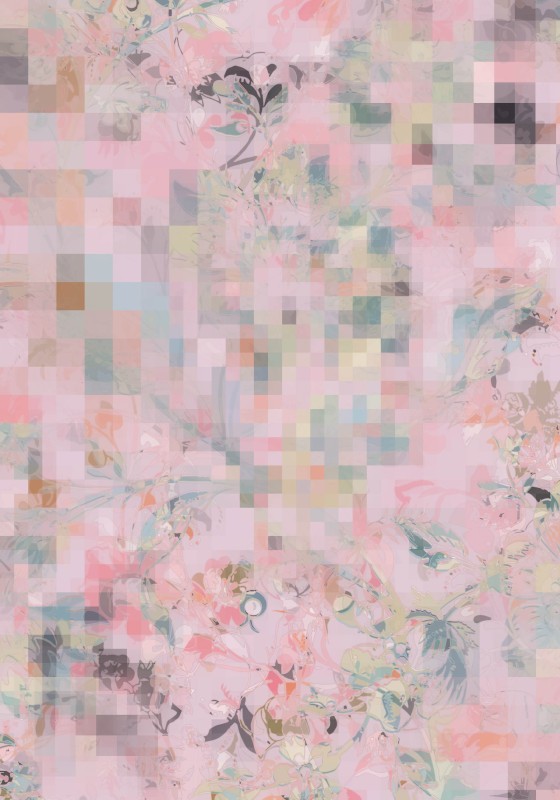
But while it did what I wanted, it looked too digital; too much of ‘this time’. So I decided to make the pixels into hexagons, alluding to the practice of mosaic patchwork (18th century term) and later English Paper Piecing.
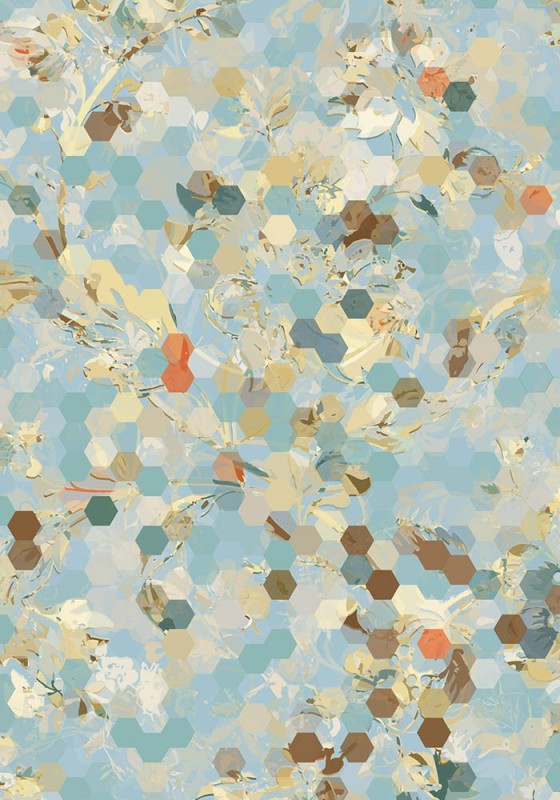
It was whilst playing around with the opacity and the colours that something suddenly became clear. The hexagons had the look of bokeh in a photograph and from there the image became about light, low light such as one might find at dusk in a garden. The end result was the image at the start of this post.
Filed Under: Patterns

Lost and Found in Translation

February 2, 2026 by Nicholas Hedges

I’ve been working on some designs for a new series of pieces exploring how we perceive the past. I have taken as my starting point the following text I wrote about my work in general:

My work is, in part, an attempt to know the past as a present-day, lived experience; to empathise with those who lived before me and see the natural world as they would have seen it, before so much was lost.

In 2018 I visited the Foundling Museum in London, established as The Foundling Hospital in 1739 to receive and care for abandoned children. It was an emotional experience, not least because of the scraps of fabric left by mothers with their babies; a means of identifying their child in the event they might reclaim them in the future. Amounting to over 5000 items, this sad catalogue is Britain’s largest collection of 18th century textiles.

When we attempt to engage with the past, often what is left  – whether a name, a ruin, an object or story – is like those scraps of fabric, and the dress from which the fabric was cut, the world from which they’re estranged. In our mind’s eye, we can take the scrap and attempt to extend its pattern to form a view of the world long gone; the dress from which it was cut, the woman who wore it, the streets down which she walked. Whether a name, a ruin, an object or story, the process is the same; we take a fragment and, in our imaginations, extend it. 

But in this endeavour we are always like a parent, claiming a child with a mismatched pattern, pointing out the parts that rhyme, aware of those which don’t.

I wanted to create a series of paintings exploring this idea. The paintings would be based on patterns contemporary with a specific time – in this case the mid to late 18th century. I imagined myself designing a pattern for a dress for one of my female ancestors and chose my 5x great-grandmother, Lydia Stevens (1734-1822) who lived, and died, in Oxford. Originally, I had thought of creating patterns from scratch, basing them on 18th century fabrics, but this didn’t really work. The point is, we base our ideas of what the past was like on extant things and it therefore followed that I should do the same.

And so I chose a number of 18th century patterns which I layered in Adobe Illustrator, traced, divided and randomly coloured using colours (mostly!) in use at the time. I wanted to create works which alluded to fabrics of the 18th century but which looked different and which could, possibly, be viewed as landscapes in some way, whether images of a garden or wood.

The results were complex and yet they did exactly what I was hoping the would. They fragmented the original patterns to the point where the images combined to form a kind of kaleidoscopic image, one in which we might look and seek out a pattern, using our own experience to deduce what that pattern might have been. We might find a branch, a leaf or parts of a flower head and trace a path to find the rest, only to lose ourselves in yet more fragments.

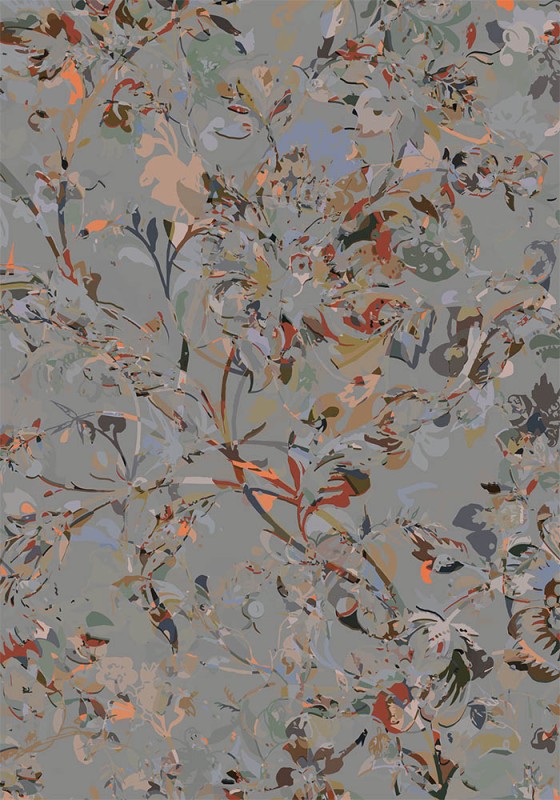
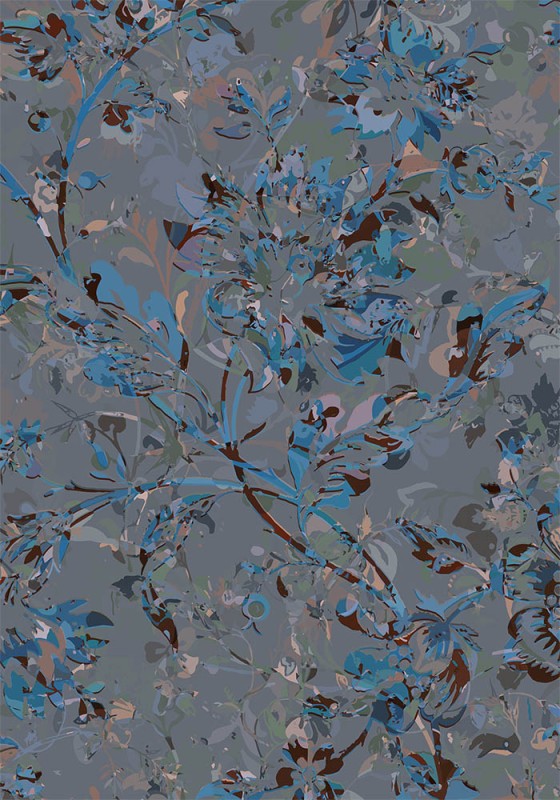
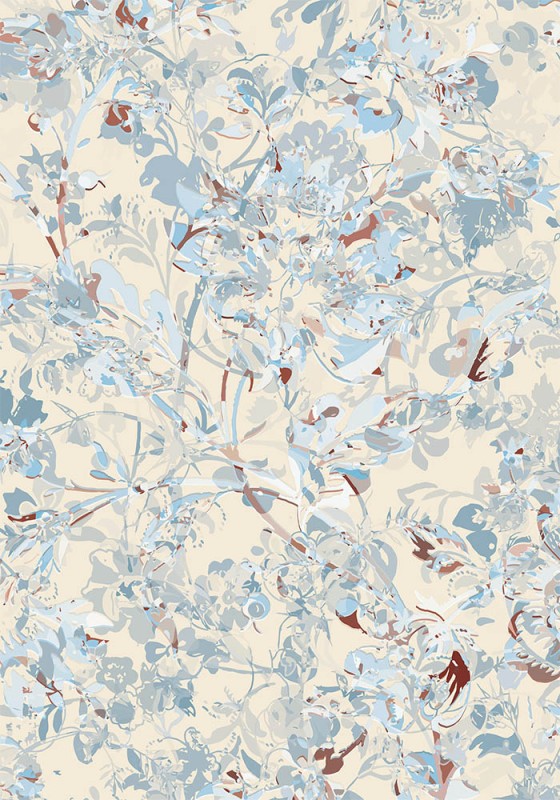
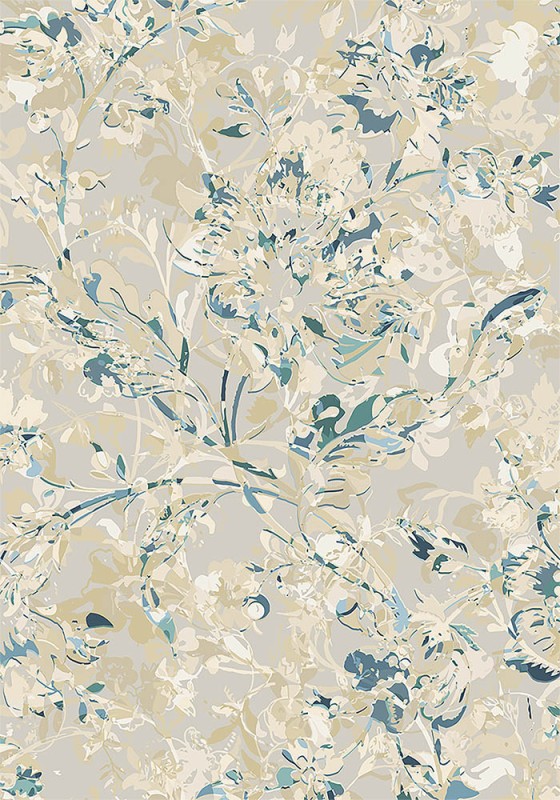
So, the first group of images are as follows:

This last image is my preferred one. I like the colours and it has the feel of an 18th century fabric whilst at the same time retaining the sense of fragmentation I’ve aspired to. This line, from what I wrote above, is important:

But in this endeavour we are always like a parent, claiming a child with a mismatched pattern, pointing out the parts that rhyme, aware of those which don’t.

In this image we can see the traces of a coherent pattern or patterns; fragmentary ghosts of something that was once whole. We see a kaleidoscope of gestures and traces, which, every now and then cohere to form an image; a flower head, a leaf or a stalk. Our eye might trace the rhymes and search for the pattern, before losing the thread and finding only dissonance once again.

Of course, these are digital images. The question now is how to render these onto canvas, how do I translate these images into paint? Obviously it will be almost impossible to replicate them as paintings, but that is not a problem. In fact it is completely in keeping with the ideas behind the work.

These digital images, created from overlaid patterns from the 18th century, reflect the way we see the past; kaleidoscopic, unknowable, fragmentary. By working with fragments, by joining the dots in the vast and impossible network that made the past ‘now’, we might arrive at a flash of recognition. Such moments might arise in places which have changed little over time, or with objects still in situ like something dug from the ground. In those moments, something aligns between us in the present and people in the past, a kind of occultation which, for a second creates something new and fleeting; not the past and not the present; neither existence or non-existence, but something other. One thinks of Baily’s Beads, when, during a solar eclipse (such as I saw in 1999) the moon’s terrain lets slip the sunlight just before the total phase of the eclipse.

It’s not the moon, it’s not the sun. It’s something else. Something which exists for the briefest of moments. A flaring like the moment of recognition when two bodies, years apart, align and spark.

When I paint these images, I will I’m sure, find myself searching out the connections as I paint. The end results will be either one twist of the kaleidoscope or another; one which reveals a pattern or one which is simply fragments.

Filed Under: Patterns

Rhopography, Gesture, and the Occulting Past

December 30, 2025 by Nicholas Hedges

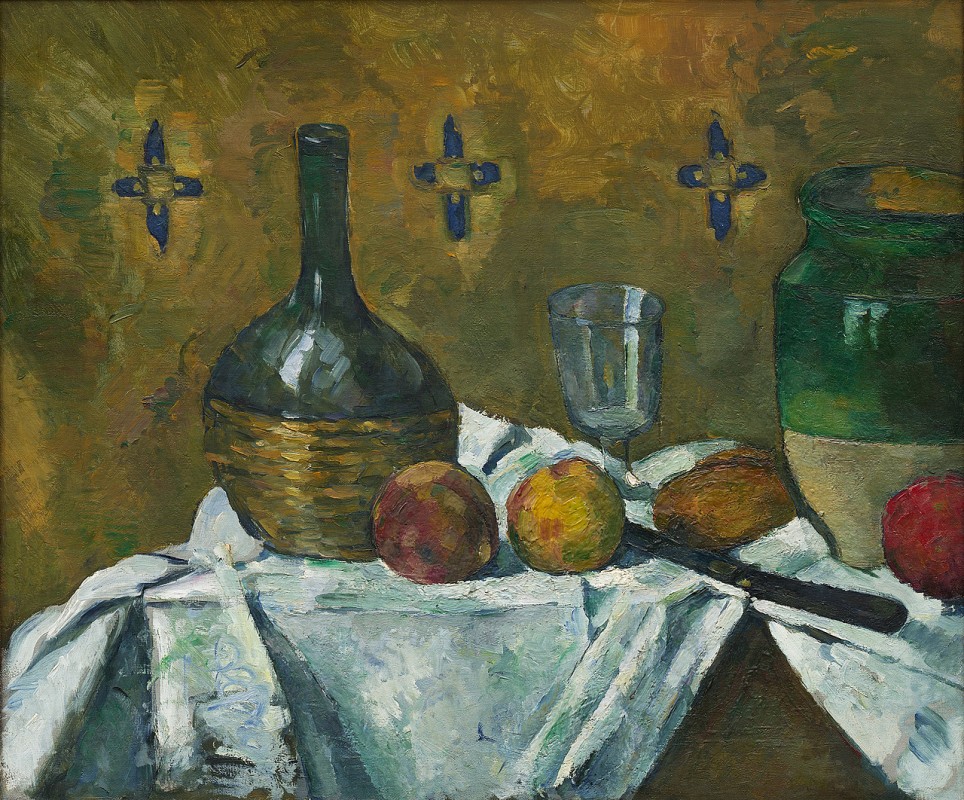
Still Life: Flask, Glass, and Jug
Paul Cezanne 1877
Solomon R. Guggenheim Museum, New York, Thannhauser Collection, Gift, Justin K. Thannhauser, 1978

Rhopography is an art historical term derived from the Greek rhopos (trifles, small wares) and graphia (writing or depiction). It refers to the representation of humble, overlooked, everyday things such as those in the still life above: a tablecloth, a knife, fruit, wine, a glass. In art history it is often contrasted with megalography — the depiction of grand subjects such as heroes, battles, gods, and monuments. 

In Cezanne’s painting, it’s not so much the subject which interests me as the brushwork. The visible strokes turn this from a painting of items arranged on a table to a record of traces – of the artist’s body in time – arrayed on a canvas. They are what we might describe as the painting’s gesture. 

Everything has a gesture; from bottles to glasses, jars to knives, paintings, letters and photographs, and for me, Cezanne’s still lifes – where objects are rendered with such visible strokes – are reminders of that fact. Within every object are equivalent strokes – gestures – retaining and revealing actions of manufacture and use; time-stamped with the – albeit invisible – marks of an ongoing moment.

A useful way to understand gesture is to think of an old, handwritten letter — imagine it was written in 1800 and that you’re reading it now. Back in 1800 the physical act of writing is quickly completed: the hand moves, the ink settles, the pen is raised. The action ends — but the gesture does not. Every stroke retains the movement that formed it: hesitations, pressures, accelerations — traces of a body and a mind in motion. When we read the letter centuries later, our eyes follow these strokes, effectively reanimating that original movement. In the act of reading, the past gesture becomes present again — and more than that, it begins to ‘rhyme’ with our own.

The gesture of the writer does not end with the writing. It unfolds with the first recipient, who in reading the words completes the movement the writer began. It continues again with every re-reading, even centuries later. Thus a gesture is a moment and a trajectory, carried forward through successive encounters, where each encounter becomes, cumulatively, available to the next. Handwriting becomes a conduit through which past and present meet and become, for a brief moment, entangled.

In this way , the letter behaves like all historical objects: their making may be complete, but the gestures that formed them – along with those arising from their use – persist as ongoing events, available to us through perception and imagination: what Merleau-Ponty would call the afterlife of perception and Tim Ingold the ongoing “trajectory” of the thing. 

To perceive an object as gesture is therefore to stand inside its ongoingness — to feel its past leaning forward into the moment of our encounter. Everything is an encounter; nothing exists independently. 

Cezanne’s still life is a composition, a pattern of sorts, where each thing he paints is an essential part of the whole. Without one, the painting wouldn’t work. Everything is in balance. The wine is dependent on the fruit; the fruit on the glass; the glass on the knife and so on.

In Buddhist philosophy, dependent co-arising teaches that phenomena manifest only in relation to other phenomena: there is no self-nature, no birth, no death — only continual transformation. Everything exists in an in-between. Objects such as those in the painting are events, animated by gesture, or as Doreen Massey puts it, “stories-so-far.” The present is our simultaneous encounter with these stories — the simultaneity of stories-so-far. Cezanne’s still life could be said to be an articulation in paint of that fact.

Every event, every gesture, is like a body in motion — and bodies in motion sometimes align, sometimes occlude, sometimes fall out of step, and sometimes, at the moment of encounter, create brief flashes of rhyme or recognition . Think of a solar eclipse. It occurs not because the moon or the sun acts upon the other, but because their trajectories momentarily align. The occultation is not a thing but a relationship in motion — a coincidence of paths.

Objects and their inherent gestures behave the same way. When the gesture of a past body — the writer’s (or painter’s) hand, the singer’s voice — comes into alignment with our own movements, a moment of partial occultation occurs. Not total. Never total. But partial — a fleeting alignment of gestures across time. This is a moment of kinaesthetic empathy. We and the past body are not the same, but for an instant our gestures rhyme. Both remain in motion, each with its own agency, and in this overlap produce a flash of recognition.

Around this rhyme is dissonance — not as separation, but as the space that preserves difference while making relation possible. The rhyme — that brief illumination — functions as orientation. And as the occulting beam of a lighthouse tells a ship its position in relation to land, the rhyme tells us where we are in time; where the past is in relation to our present.

One of the ways we perceive the arrow of time is through entropy: a natural drift toward disorder, away from particularity. The difference between past and future might be imagined as the difference between a sandcastle — low entropy, fixed and unchangeable — and a pile of sand, high entropy, capable of many possible configurations. The past, as a completed event, is very low entropy. Yet our encounter with the past is the opposite. When we attend to an object’s gesture — when we consider it not as a finished thing but as a movement still unfolding — imagination restores motion. The castle becomes a pile of sand from which many different castles might be built. As experience then, the past becomes high entropy: rich with possibility.

In White Holes, Carlo Rovelli writes: “the black hole does not end in a singularity, but tunnels into a white hole — a small, stable remnant, perhaps as tiny as a grain of dust, from which what fell in may one day emerge.” It does not end — just as the gestures of the past in our objects do not end. Like white holes, gestures appear almost invisible from the outside, but from within they stretch across vast distances. I imagine these white holes as filaments — fine threads connecting what was with what is — openings in a weave of stories and trajectories through which, via imagination, the past might still emerge.

Dissonance is another way of articulating entropy. Each simultaneous perception of stories-so-far (the moment which follows the moment etc.) differs subtly from the one before; these differences accumulate and grow over time, while the parts that rhyme become fewer and further between. Rhymes are recognisable continuities — that which persists and allows coherence. The further back we go, the fewer these rhymes become. The occulting light reduces from a steady beam to a brief flash, surrounded by expanding darkness.

When we look at an object, read a text, listen to an old recording, or examine a painting from before we were born, we may experience that flash of recognition — a moment of rhyme. Our gesture aligns with the gesture encoded in the object. For an instant, the vast weave of co-dependent trajectories – of which the gesture is a part –  lights up – the writer at her desk, the dress she wears, the ticking of a clock, the sounds beyond the window, the weather – and entropy is imaginatively restored. We find a way back into the past — not by collapsing it into the present or vice-versa, but by sensing the trajectory it still contains. 

A moment of rhyme is a moment of orientation — a brief, luminous occultation in which past and present meet without becoming one. Borrowing from quantum mechanics, we might say that in such moments the object and the viewer become entangled. In quantum physics, entanglement describes a condition in which two particles, once connected, remain linked even when separated by vast distances — their states no longer independent. When gestures rhyme, I think of them as becoming momentarily entangled: recognition accompanied by influence across time. In reading a letter written two centuries ago, it is as if, for a fleeting instant, I become its intended recipient — and as if, in that same instant, I briefly enter the mind of the one who wrote – is writing – it.

I began with rhopography — attention to what is small, intimate, and easily overlooked. Gesture resides most clearly in such things. It is in fragments, in minor objects, in traces of everyday life that the unfinished movements of the past remain most available to us, still leaning forward, still capable of encounter.

Empathy as Pattern-Work

My practice begins with the fragment — an object or trace that has survived the erosive forces of time. These fragments may take the form of found tokens from the Foundling Hospital, a pottery shard, a name, a photograph, a painting, or a ruin. Each fragment bears witness to a network of relations that once linked bodies, materials, and places. Rather than functioning as residue or supplement, the fragment is approached as a node: a site through which historical and affective patterns continue to exert force in the present.

This approach draws upon Walter Benjamin’s conception of Eingedenken (remembrance), a form of historical attention that resists narrative closure. As Benjamin observes, “memory traces the house in ruins rather than the intact dwelling” (Benjamin, 1999). The ruin is thus not a failure of history but its most ethically charged condition — a structure that holds together persistence and loss without resolving their tension. My practice takes this insight as a methodological and ethical foundation: the fragmentary, the weathered, and the incomplete are not deficiencies of recollection but its most truthful forms.

Engagement with fragments is therefore not an act of reconstruction but of resonance. This position aligns with phenomenological accounts of perception as embodied and relational. Following Maurice Merleau-Ponty, perception is understood not as detached observation but as an intercorporeal encounter, in which meaning arises through the entanglement of body, material, and world (Merleau-Ponty, 1962). The fragment is apprehended through texture, scale, weight, and surface — through the sensorium as much as through representation. Encounter becomes a reciprocal event rather than a unilateral act of interpretation.

This relational ontology is further informed by Tim Ingold’s concept of the “meshwork,” which understands materials not as static objects but as gatherings of lines — trajectories of movement, growth, and duration (Ingold, 2011). Within this framework, each fragment is a knot in a wider ecology of becoming. My practice of “pattern-work” extends these lines into the present, not in order to restore an original configuration, but to allow unfinished patterns to continue unfolding through contemporary gesture and attention.

Empathy, as it operates within this practice, is neither sentimental identification nor psychological projection. Rather, it functions as a form of structural correspondence — an alignment across temporal distance that remains partial and unresolved. This conception draws upon affect theory, particularly Elizabeth Grosz’s account of matter as generative and open-ended, and Brian Massumi’s understanding of affect as pre-personal intensity (Grosz, 2004; Massumi, 2002). Empathy emerges in the interval of “almost-recognition,” where patterns rhyme without coinciding, and where difference is not overcome but sustained.

Through this process, art becomes an act of re-weaving: a performative continuation of historical textures through embodied practice. Each painting, pattern, or gesture of attention constitutes a new crossing in the fabric of time. The work does not seek to heal rupture or restore coherence, but to dwell within incompleteness — allowing the fragment to remain open as a site of encounter, contingency, and ethical attention.

This process may be described, borrowing from botanical language, as inosculation: the point at which two trees grow together, their tissues interwoven yet distinct. The term’s etymology, from the Latin osculare (“to kiss”), evokes a form of contact that joins without erasure. In this sense, my practice proposes empathy not as fusion, but as attunement — an ethics of proximity that listens to the unfinished conversation between matter, memory, and time.


Benjamin, W. (1999) The Arcades Project. Translated by H. Eiland and K. McLaughlin. Cambridge, MA: Belknap Press.

Grosz, E. (2004) The Nick of Time: Politics, Evolution, and the Untimely. Durham, NC: Duke University Press.

Ingold, T. (2011) Being Alive: Essays on Movement, Knowledge and Description. London: Routledge.

Massumi, B. (2002) Parables for the Virtual: Movement, Affect, Sensation. Durham, NC: Duke University Press.

Merleau-Ponty, M. (1962) Phenomenology of Perception. Translated by C. Smith. London: Routledge.

Filed Under: Patterns

© Nicholas Hedges 2024

  • Facebook
  • Instagram
  • Twitter
  • YouTube

Copyright © 2026 · Outreach Pro on Genesis Framework · WordPress · Log in