“The world is not a collection of things, it is a collection of events… even the things that are most ‘thing-like’ are nothing more than long events.”
— Carlo Rovelli (b. 1956)
The past is not erased but enfolded into the present; objects, heirlooms, names on weathered graves — all are what Rovelli calls events and through imagination, these events, the times and people within, can be known to us — empathetically — through the mirror of our own lived experience.
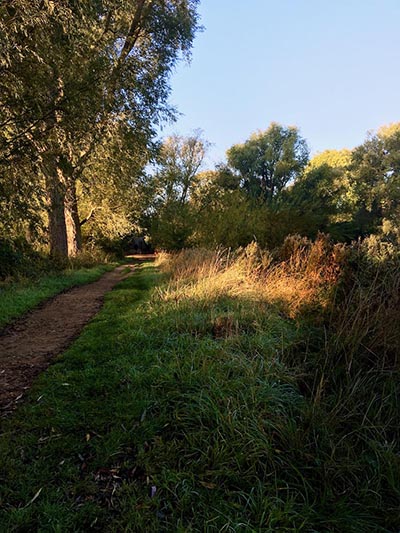
In nature, where our lived experience best aligns with people centuries past, walking becomes an act of unfolding: each step a way of bringing the past back to life. How we experience the natural world — the trees, the sky, the wind and rain — can connect us to those who lived long ago. Despite the dissonance between our worlds, they would have known these phenomena in much the same way. In these things our worlds start to rhyme.
“Thursday, April 15 1802. The wind was furious … The wind seized our breath. The lake was rough. …When we were in the woods beyond Gowbarrow Park we saw a few daffodils close to the water-side. … I never saw daffodils so beautiful … the rest tossed and reeled and danced and seemed as if they verily laughed with the wind that blew upon them over the lake.”
— Dorothy Wordsworth (1771–1855)
“Shortly after dusk, the lightning appeared in the south and western horizon, and soon became most vivid, blue sheets of lightning following each other in rapid succession, but unaccompanied by thunder.”
— Jackson’s Oxford Journal, 1842
In The Materiality of Stone – Explorations in Landscape Phenomenology, Christopher Tilley writes:
“If writing solidifies or objectifies speech into a material medium, a text which can be read and interpreted, an analogy can be drawn between a pedestrian speech act and its inscription or writing on the ground in the form of the path or track.”
When we walk, we enfold ourselves into the past. Each footprint left in our wake becomes a word, and, as Tilley writes, the path a kind of text; one that is ‘read’ with our feet and interpreted through our senses. Imagination is our sixth sense.
Similarly, words written on a page are gestures through which, for a moment, the whole of their making, as well as their meaning, unfolds: the writer, the room, the world outside the window. When I or anyone writes or paints, the whole of the present is, likewise, enfolded — rolled and bound like a scroll.
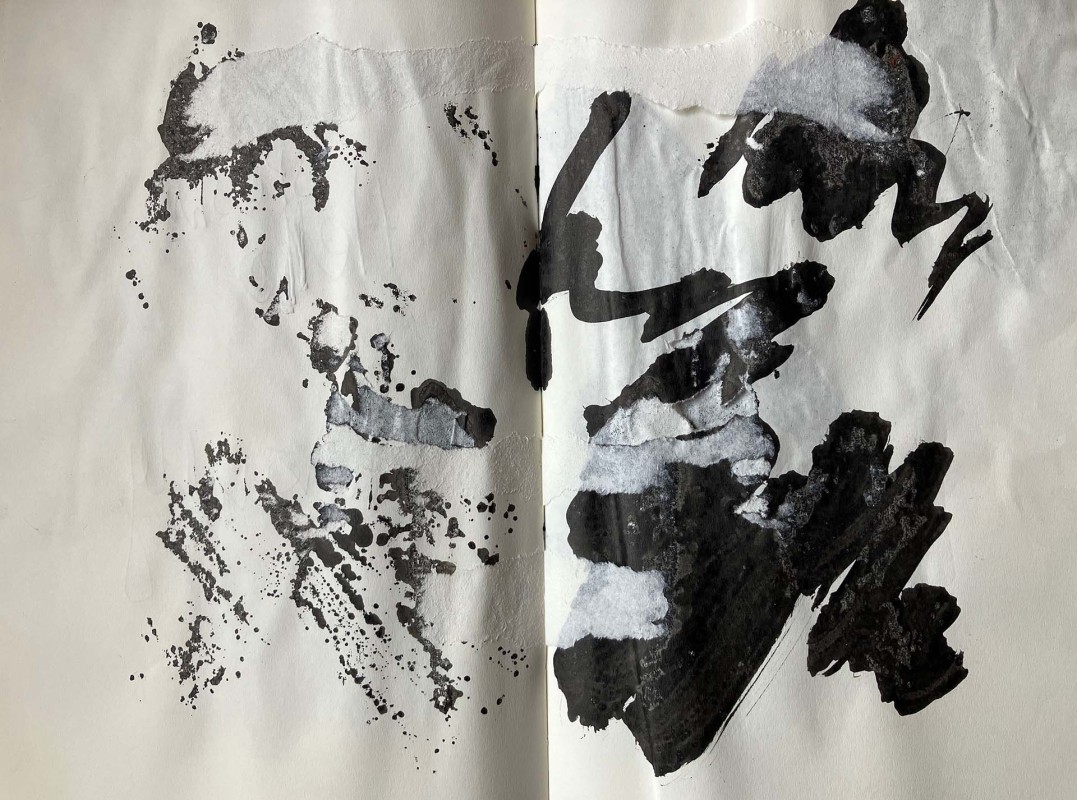
Such is why I’m drawn to the gestures of Chinese and Japanese calligraphy. The characters impart not only meaning — trees 木, sky 空, sun 太陽, wind 風 — but in their strokes the whole of the time in which they were made is contained — the writer, the room, the world outside the window…
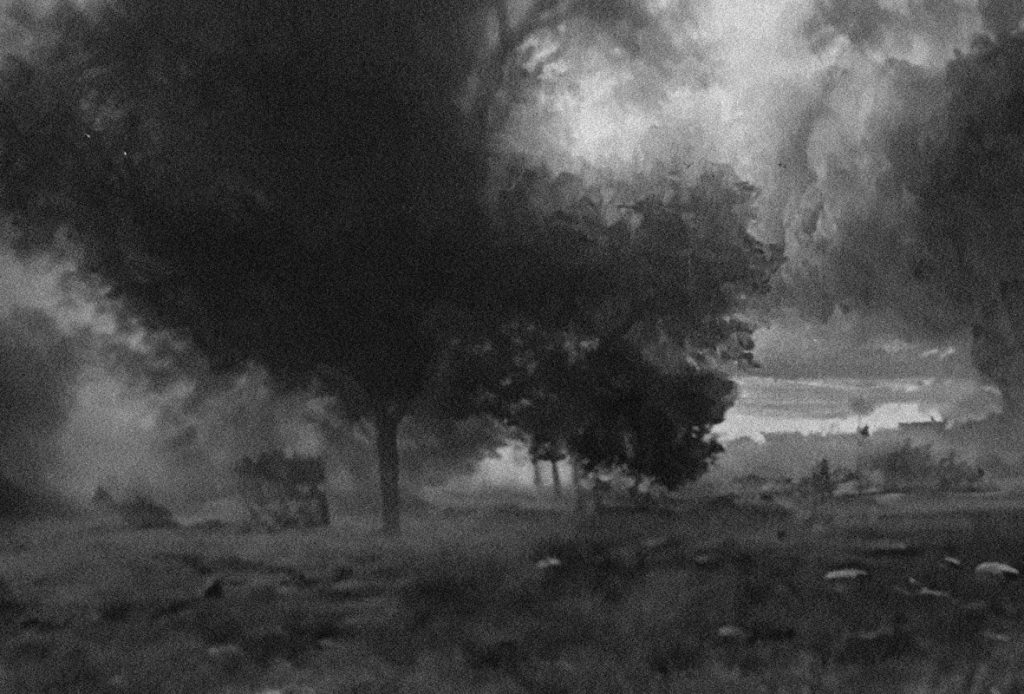
In my own work, I paint shadows directly in the woods with ink and calligraphy brushes. Each mark holds the instant of its making. The shadow becomes text, and the text enfolds the present into the past.
The painted shadow becomes like a language made, written, and read in the moment — then lost as soon as the moment has gone.
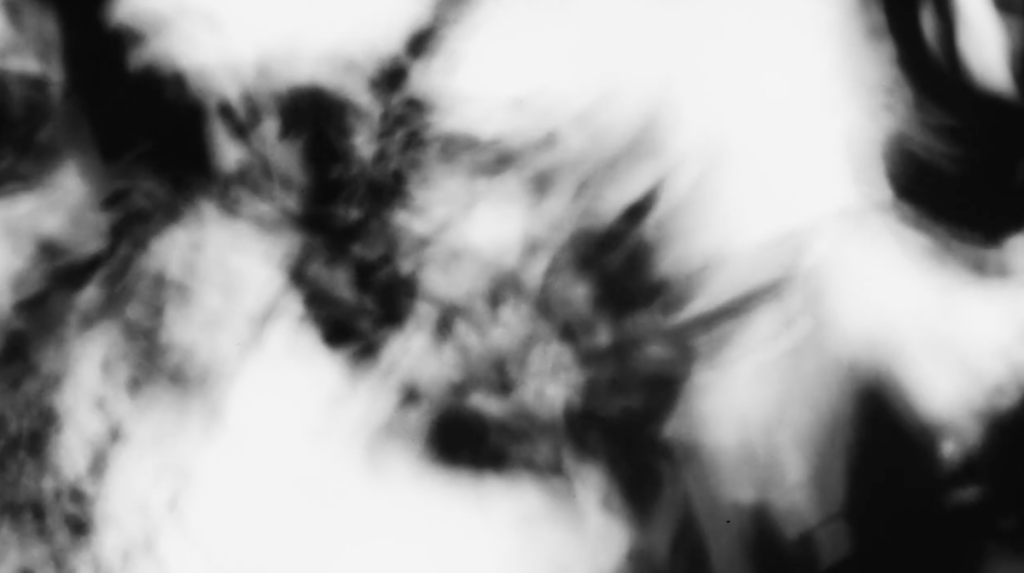
The videos I make of the shadows likewise become a poem spoken in this lost and silent tongue. We cannot hear it. We cannot speak it. All we can ‘see’ are the trees now gone; the moment that has passed.
To climb the peaks of our imagination and see a time long before we were born is, at the same time, to descend into the depths of our own non-existence, wherein which dark expanse, our imagination lights the dark as it does the paths that lead away from our deaths. Imagination and memory come together to blur the boundaries of our beginnings and ends, as if, like a book, the unseen words that might have been written before and after are suddenly revealed in all their infinite number.
— Author’s note, 2019
“No longer to be as we have always been, in those endlessly anxious hands – to leave even our name behind us as a child leaves off playing with a broken toy.”
— Rainer Maria Rilke (1875–1926)
Fragments, Patterns, and Memory
“The past is hidden somewhere outside the realm of the intellect, in some material object.”
— Marcel Proust (1871–1922)
“The light of the moon covers the earth, yet it can be contained in a single bowl of water.”
— Dōgen Zenji (1200–1253)
“It is more arduous to honour the memory of the nameless than that of the renowned.”
— Walter Benjamin (1892–1940)
“For the things of this world are their stories, identified not by fixed attributes but by their paths of movement in an unfolding field of relations. Each is the focus of ongoing activity. Thus in the storied world… things do not exist, they occur.”
— Tim Ingold
“In Ersilia, to establish the relationships that sustain the city’s life, the inhabitants stretch strings from the corners of the houses, white or black or gray or black-and-white according to whether they mark a relationship of blood, of trade, authority, agency… you come upon the ruins of the abandoned cities, without the walls which do not last, without the bones of the dead which the wind rolls away: spiderwebs of intricate relationships seeking a form.”
“In Chloe, a great city, the people who move through the streets are all strangers. At each encounter, they imagine a thousand things about one another… something runs among them, an exchange of glances like lines that connect one figure with another and draws arrows, stars, triangles, until all combinations are used up in a moment.”
“Also in Raissa, city of sadness, there runs an invisible thread that binds one living being to another for a moment, then unravels, then is stretched again between moving points as it draws new and rapid patterns so that every second the unhappy city contains a happy city unaware of its own existence.”
“The city does not consist of this but of relationships between the measurements of its space and the events of its past… The city, however, does not tell its past, but contains it like the lines of a hand.”
— Italo Calvino (1923-1985)
“The inhabitant is rather one who participates from within in the very process of the world’s continual coming into being and who, in laying a trail of life, contributes to its weave and texture.”
— Tim Ingold
“We have been living this same moment ever since we were conceived. It is memory, and to some extent sleep, that gives the impression of a life of discrete parts, periods or sections, of certain times or ‘highlights’.”
— Bill Viola (1951–2024)
The past exists in fragments. Each trace — a word, an object, a ruin, a name — is both presence and absence: a time returned to view, diminished like the point of a star set against the vast mass of its origin.
Our present day comprises fragments of the past; a night sky strewn with stars appearing as if now, each belying their own unfathomable age.
Geographer Doreen Massey describes space as “the dimension of multiple trajectories, a simultaneity of stories-so-far.” That is how I perceive the present.
Each fragment is a story-so-far: an entropic event, a life wound down to a name; ancient footsteps left in tesserae, ploughed up blinking in the earth. Fragments like the tokens left by mothers with their children at the Foundling Hospital, London — small pieces of fabric cut from larger garments, each carrying the memory of touch, the trace of identity, the hope of return.
The present then is our simultaneous perception of these stories-so-far; interconnected threads, with depth as well as surface. As Carlo Rovelli writes in Helgoland:
“The central thesis of Nāgārjuna’s book is simply that there is nothing that exists in itself, independently from something else. … ‘I’ is nothing other than the vast and interconnected set of phenomena that constitute it, each one dependent on something else.”
It’s by extending a fragment out into an imagined wider world then that we can begin to feel our way towards an empathetic response to the past. This can also be achieved however by breaking down an object or an image into its constituent parts, whether the brush stroke of an artist or calligrapher, or the details of a nineteenth-century photograph which I discuss later.
The following quotes allude to this sense of interconnection. First Barry Lopez:
“One must wait for the moment when the thing… ceases to be a thing and becomes something that knows we are there.”
And Christopher Tilley, in The Materiality of Stone – Explorations in Landscape Phenomenology:
“The trees ‘see’ the painter in a manner comparable to that in which the mirror ‘sees’ the painter: that is, the trees, like the mirror, let him become visible: they define a point of view on him which renders visible for him something that otherwise would remain invisible — his outside, his physiognomy, his carnal presence… The trees and mirror function as Other.”
Taking Carlo Rovelli’s quote, everything becomes ‘other’. It’s everything that makes us visible and vice-versa. When we work with the past, we work with fragments. When we look at the mothers’ tokens we see the fabric from which they were cut, the dress from which the fabric was made, the woman who wore it, the places where she walked. Every attempt to extend or unfold a pattern is to weave with a thread of light. It is an act of empathy, a reaching-out across the gap between what endures and what has vanished, just as a star endures in sight, untold years after it has gone.
In his book White Holes, Rovelli writes : “the black hole does not end in a singularity, but tunnels into a white hole — a small, stable remnant, perhaps as tiny as a grain of dust, from which what fell in may one day emerge.”
I love this image. From the outside, the white hole is almost pointlike — nearly invisible. From the inside, it can stretch across a vast duration and distance — like a long, thin bridge through spacetime. In my mind’s eye, I conflate the mote and the thread, and see these holes as filaments, fine hair-like threads, connecting what was with what is. They are the voids left in the wake of a death, grief spun with the years to forgotten, holes from which, through empathy, what was, might yet return. They are the stories-so-far; fragments containing the whole; threads with which the present is made.
Nature, the Medieval, and the Child’s Imagination
“There was a time when meadow, grove and stream, The earth, and every common sight, To me did seem Apparelled in celestial light.”
— William Wordsworth (1770–1850)
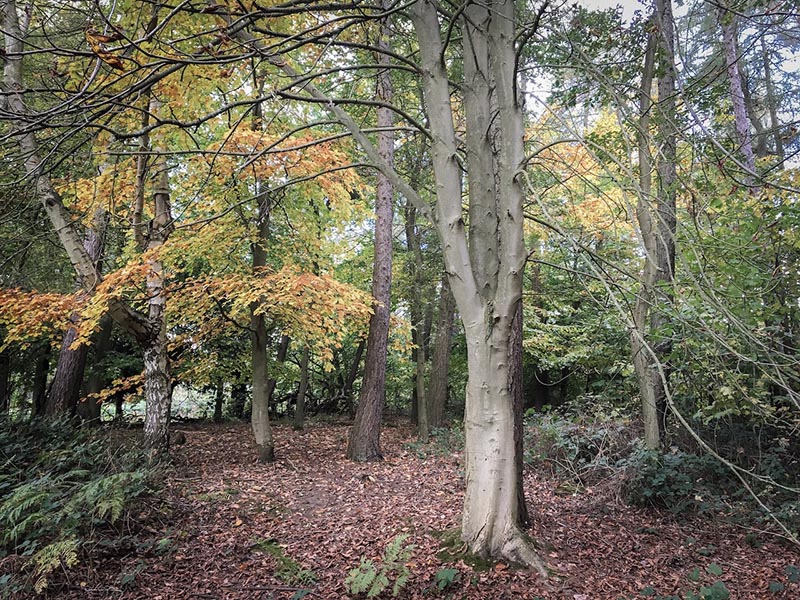
“Woods are poised between reality and imagination… they span many lifetimes.”
— Richard Hayman
“But who knows the temporal dimensions of the forest? History is not enough.”
— Gaston Bachelard (1884-1962)
“But forests reign in the past. I know, for instance, that my grandfather got lost in a certain wood. I was told this, and I have not forgotten it. It happened in a past before I was born. My oldest memories, therefore, are a hundred years old, or perhaps a bit more.”
— Gaston Bachelard (1884-1962)
In my childhood imagination, the medieval world lived on in the woods: knights passing through shafts of light, the sound of distant bells, the air heavy with myth.
The Middle Ages represented, for me, an ideal landscape — a childish vision of beauty, myth, and legend, enriched not by the possibility of, but by the reality of magic.
The young boy, beholden to wonder and enchantment, still exists; yet in adulthood that vision of beauty and magic has deepened, transformed. Enchantment has become something else. Imagination has become embodied, empathetic.
In The Subversive Stitch, Rozsika Parker observes that, from the perspective of the nineteenth century:
“The Middle Ages constituted an era that appeared to provide historical confirmation for the naturalness and rightness of the doctrine of separate spheres for the sexes.”
My work with pattern is not a commentary on these prejudices, but what compels me in Parker’s words is the boundary it describes — and how, in my work, that boundary begins to blur.
The woods of my childhood offered a freedom beyond such divisions: a space where identities could shift and merge, where magic fused with reality, where one could become a knight, moving between selves as if through shade and sunlight.
That sense of openness has become central to how I now explore the past — not as fixed, but as fluid, interwoven, and alive.
“And yet they, who passed away long ago, Still dwell in our blood, whispering.”
— Rainer Maria Rilke (1875–1926)
“The leaf has a song in it… and the leaf is singing still.”
— Mary Oliver (1935–2019)
“Is not all writing, all art, a response to a loss of some kind, an imaginative way of dealing with lack?”
— Carl Lavery
Grief, like remnants of the past, is both presence and absence. What is lost continues to exist — not as it was, but as an echo or memory; a vibration through time; a white hole where the raw and gaping void of loss is slowly spun to the shape of a mote, floating in some far-off year, within a shaft of sunlight.
When I was a child my mum would go out to sing. Before a concert, she and her friends — the women transformed in beautiful dresses, the men in tuxedos — would come to the house to rehearse. She would close the dining-room doors, their frosted glass patterned with leaves through which I could see their shapes as I listened to their voices.
Since her death, that memory has become an image of grief. When I listen to recordings of her singing, it’s like those rehearsals: I can hear her, transformed, but not reach her. The frosted pattern of leaves in the glass remains — doors closed between two worlds. They are a screen through which I can see her singing, but like summer recalled to winter trees, although I might remember her warmth, I cannot feel it anymore.
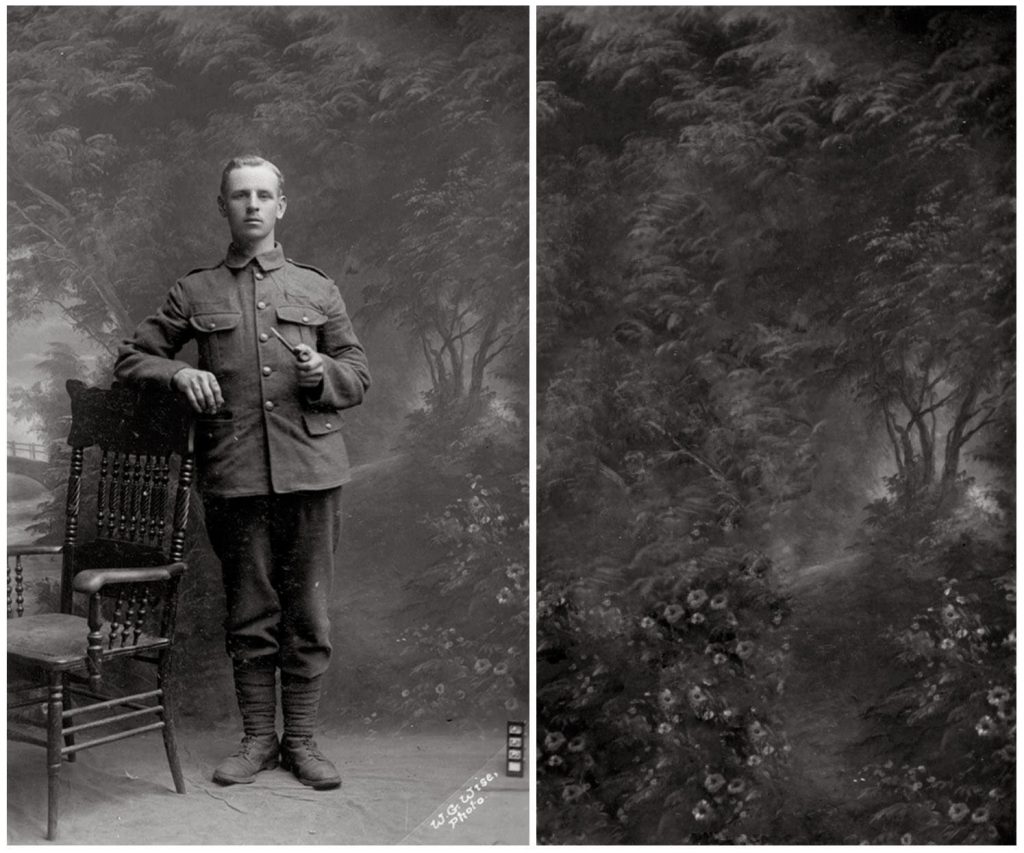
Another way I have examined grief is through a series of works which take as their source studio portraits of the late 19th and early 20th centuries. I’m particularly interested in the backdrops, in front of which the ‘sitters’ are placed to have their picture taken.
Often these feature scenes of nature – trees, bucolic landscapes, gardens – or images of idealised interiors. With these portraits, I remove the figures, and, using AI capabilities in Photoshop, extend the backdrops to become full landscapes or interiors. The results are often strange, unsettling images of absence and remind me of the backdrops one might find in a theatre when the actors have all left the stage. The fact my mum performed so much, in front of such backdrops, makes this sense of absence even more compelling.
There is a link here too with my childhood imaginings of medieval forests – that sense of an untouched, unspoiled landscape of the past. Wordsworth wrote in his Guide to the District of the Lakes, that we can only imagine, “the primeval woods shedding and renewing their leaves with no human eye to notice or human heart to regret or welcome the change.”
“To live is to crochet according to a pattern we were given.”
— Fernando Pessoa (1888–1935)
“We are, none of us, our own ideas of ourselves.”
— Adrienne Rich (1929–2012)
“And yet they, who passed away long ago, still exist in us,” writes Rilke, “as natural disposition, as burden on our destiny, as murmuring blood, and as gesture that rises up out of the depths of time.”
Rilke’s words capture what I feel most deeply about inheritance: that the past is not something behind us, but within us — alive in gesture, enfolded in thought, in the smallest movements of the body. We are made of continuities — a simultaneity of “stories-so-far.”
David Whyte, in Consolations, writes:
“Each one of us has a unique signature, inherited from our ancestors, our landscape, our language, and alongside it a half-hidden geology of our life as it has been lived… what blows through us is made up not only of the gifts and heartbreaks of our own growing but also of our ancestors and the stories consciously and unconsciously passed to us about their lives.”
I imagine this signature as a patchwork of patterns, each corresponding to an approximate ratio of DNA passed down my family tree through female lines.
Each pattern is distinct, yet shares a common thread with those around it. When combined, they form a landscape — my landscape, my interior: a wood, a room in a Victorian house with William Morris walls, the fabric of an eighteenth-century dress.
“The photograph of the missing being will touch me like the delayed rays of a star… a sort of umbilical cord links the body of the photographed thing to my gaze.”
— Susan Sontag (1933–2004)
Every act of creation begins at a boundary — a meeting point between worlds. In my work, that boundary might be between past and present, interior and exterior, masculine and feminine, imagination and reality. It might simply be the formal separation of colours on a canvas.
To cross a threshold is to enter another way of seeing while remaining oneself. Each movement between media, identities, or times becomes a kind of passage. Boundaries are not walls but invitations — places of interconnection, where the known world gives way to the unknown, where dissonance meets with rhyme.
I’m reminded here, however, of Carlo Rovelli: “‘I’ is nothing other than the vast and interconnected set of phenomena that constitute it, each one dependent on something else.” In a sense there is no boundary at all — only interconnections.
And we are always in the process of crossing whilst ourselves being made of these ambiguous thresholds.
Borrowing from the world of physics (and again the writing of Carlo Rovelli) and what I’ve gleaned about entropy, I can look at a past moment as something which has a very low entropy. The past is like the sandcastle as opposed to the pile of sand (but with far fewer possible configurations of state than the castle).
This is because the past moment has happened and therefore its form is fixed; there are no different configurations by which it can enter the next moment as the next moment has also already happened. If we think of the moment we are living now, then we can think of it as having very high entropy as there are countless possible configurations by which we, as people living in this particular moment, can enter the next and so on. We are like the pile of sand as opposed to the castle.
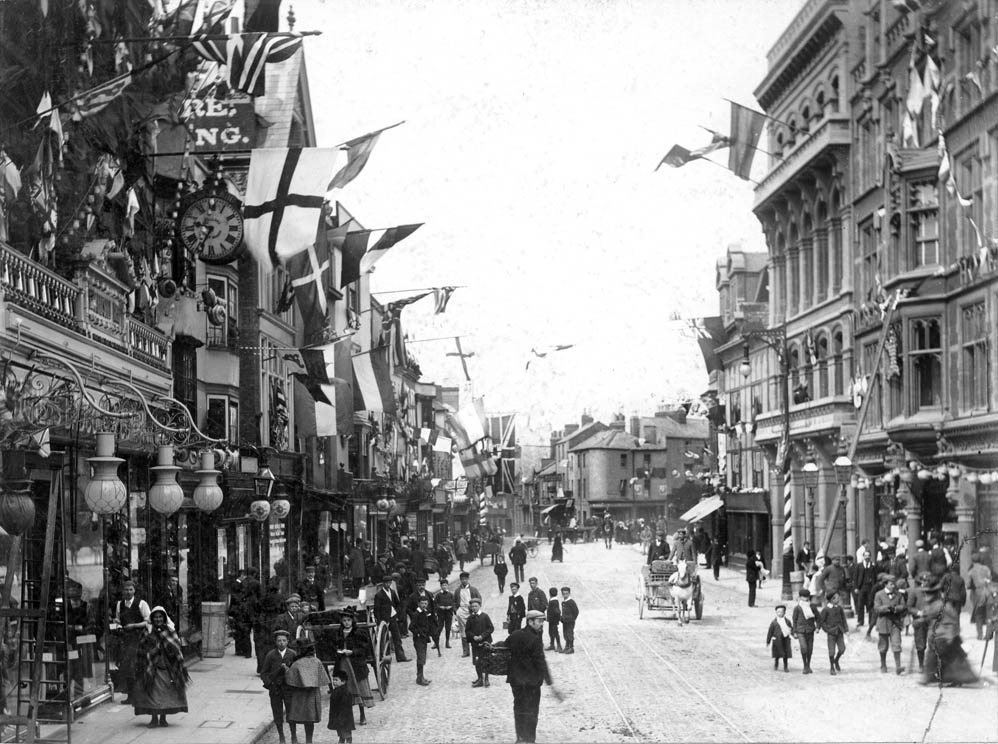
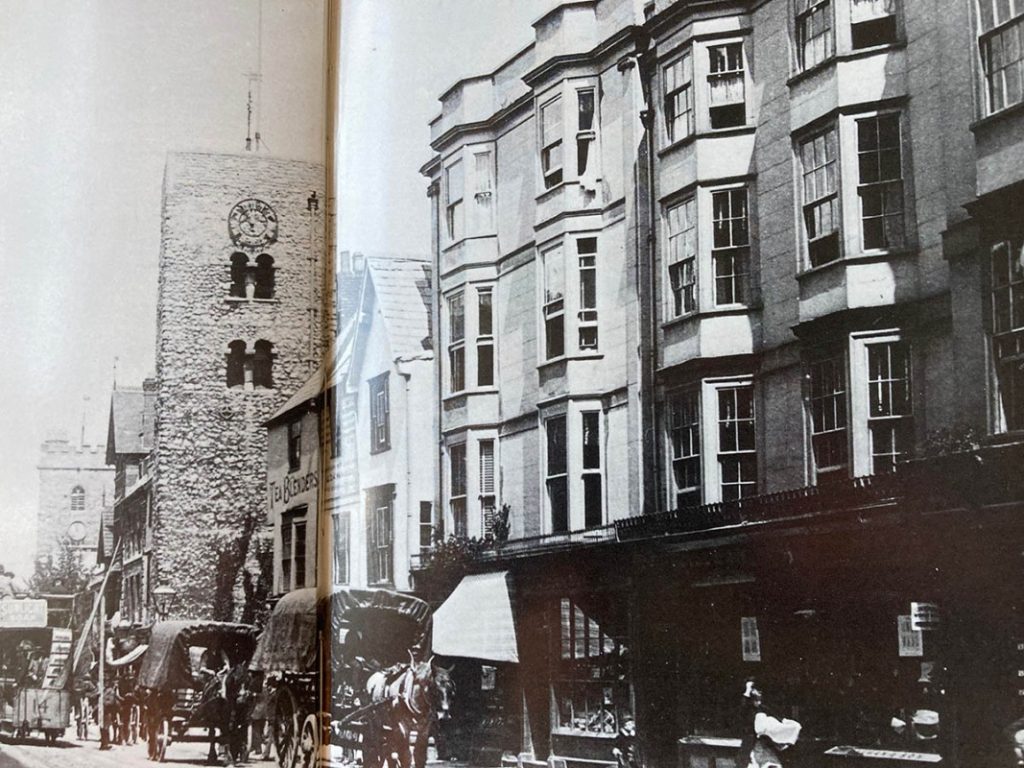
If we are going to try and recreate a past moment, we have to try and rethink that moment as it happens, not as it was. So, when I look at the image below, a photograph of a street full of people taken in 1897, I try to imagine the scene just before the image was taken and for a short while after.
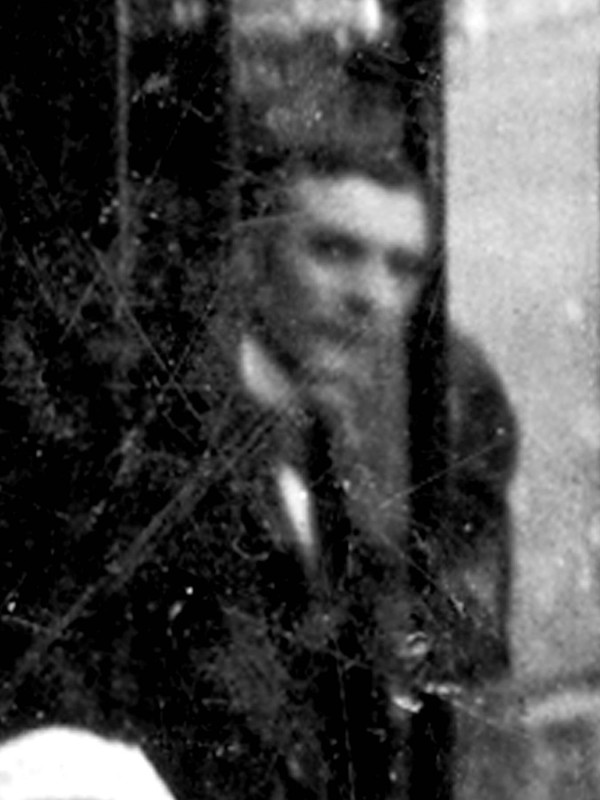
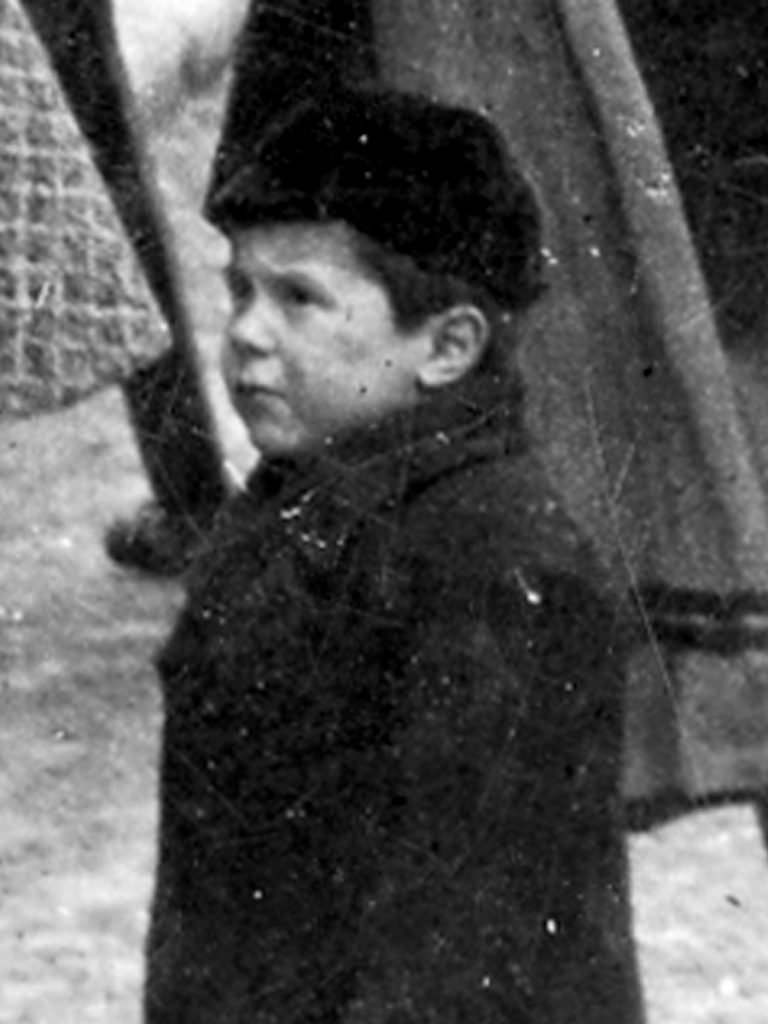
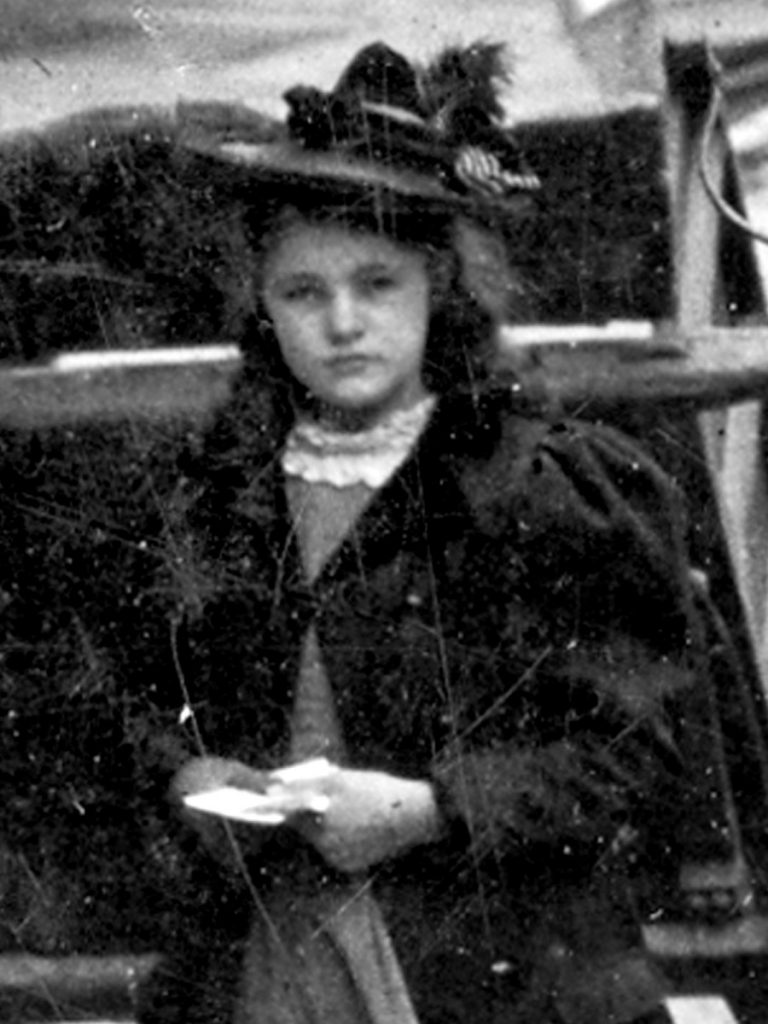
To do that, I might zoom in on a detail – one of the people – and imagine them moving. I imagine the noise of the scene, the sounds they might have heard and think about what they might have been saying.
One thing I find with photographs like this, is that it’s often those people who are in the background and who are completely oblivious to the picture being taken that allow me to animate the scene, to reintroduce a sense of entropy. People or details, such as open windows, are a particularly vivid way of achieving this.
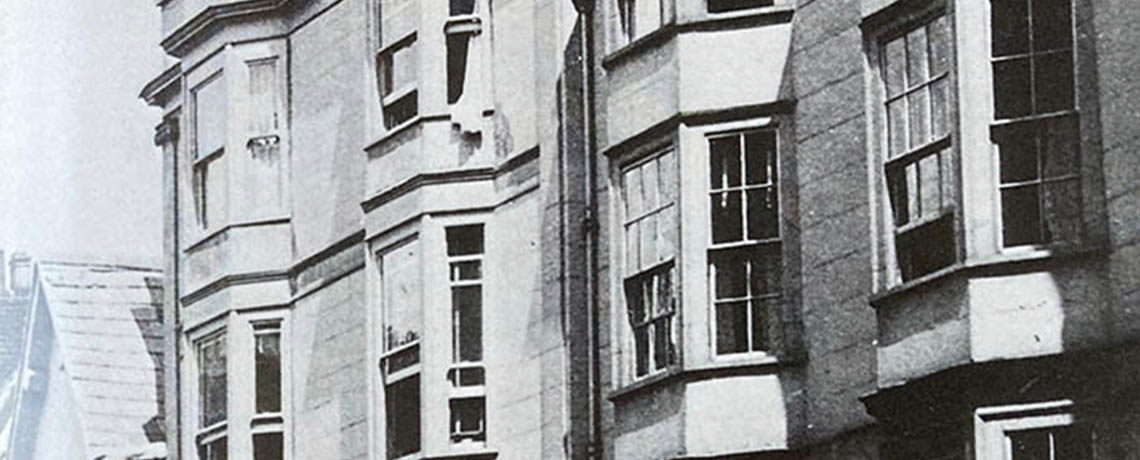
In the picture above, the horses and carts locate the photograph in the early 1900s but it’s the windows – the open windows – which help me locate myself in the time. Why? Because the rooms behind the windows are spaces outside the photograph; spaces oblivious to the photograph being taken. It’s as if they have escaped the moment frozen by the camera.
The open windows also speak of a time before the photograph was taken and therefore give the photograph a sense of duration which, like the rooms behind them, also extend the boundaries of the image. When the photographer took the photo, the windows had been open a while beforehand; people had opened them and I can begin to imagine those moments. I can imagine being in one of those rooms (I think of the wallpaper, the patterns, the dresses), looking out through the open window and seeing the horses down on the street and hearing the sounds of the city. These open windows therefore can help us see the past moment as it happens rather than as it was. They ascribe the picture a duration and give it flow.
In his book, The Order of Time, Carlo Rovelli writes: “The growth of entropy itself happens to open new doors through which entropy can increase further.” In the case of this image, Rovelli’s doors are our windows but the effect is the same. We begin to disorder time and locate among these details, pockets of potential. Instead of everything being fixed, there is room for manoeuvre, for change; entropy increases instead of everything being fixed, there is room for manoeuvre, for change; entropy increases.
“Each line is now the actual experience with its own innate history.”
— Cy Twombly (1928–2011)
“Rinsho is not imitation but conversation.”
— Tanimura Kishō (1922–2008)
When we attempt to engage with the past, often what is left — whether a name, a ruin, an object or story — is like those scraps of fabric. In our mind’s eye, we can take the scrap and attempt to extend its pattern to form a view of the world long gone: the dress from which it was cut, the woman who wore it, the streets down which she walked. Whether a name, a ruin, an object or story, the process is the same; we take a fragment and, in our imaginations, extend it.
But in this endeavour we are always like a parent, claiming a child with a mismatched pattern, pointing out the parts that rhyme, aware of those which don’t.
And it’s in the dissonance and rhyme that much of my work is located. Rinsho is the art of studying and copying the works of great calligraphers as a means of internalising their brush techniques, rhythm, and spirit.
By copying my own shadow texts, for example, I seek a way back to the moment of their making — to unfold what was, at the time of their making, enfolded. In some respects all my work is like the art of rinsho; not a copying of, but a rhyming with, the past.
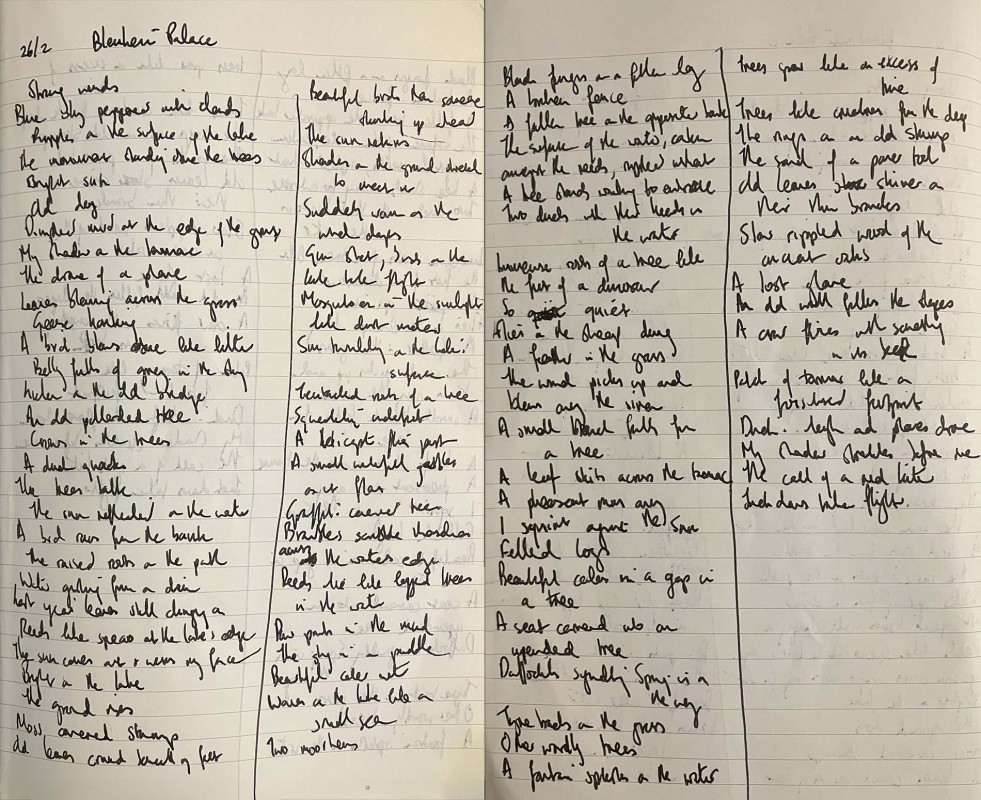
As part of my practice I sometimes walk, and whilst walking, I write down lists of things that I observe. For example, on a walk on 26 February 2024 I wrote:
The sun comes out and warms my face Bright on the lake The ground rises Moss-covered stump Old leaves crunch beneath my feet
When I read them back, days, weeks, months or years later, I pick up the thread and find myself back in those moments, tracing my path, just as I might copy the shadows painted in the woods. Reading the lists becomes a kind of rinsho.
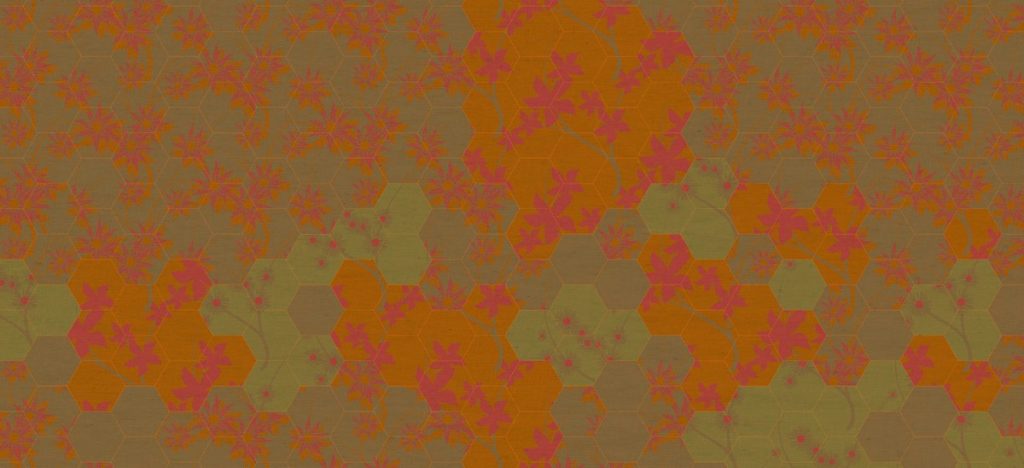
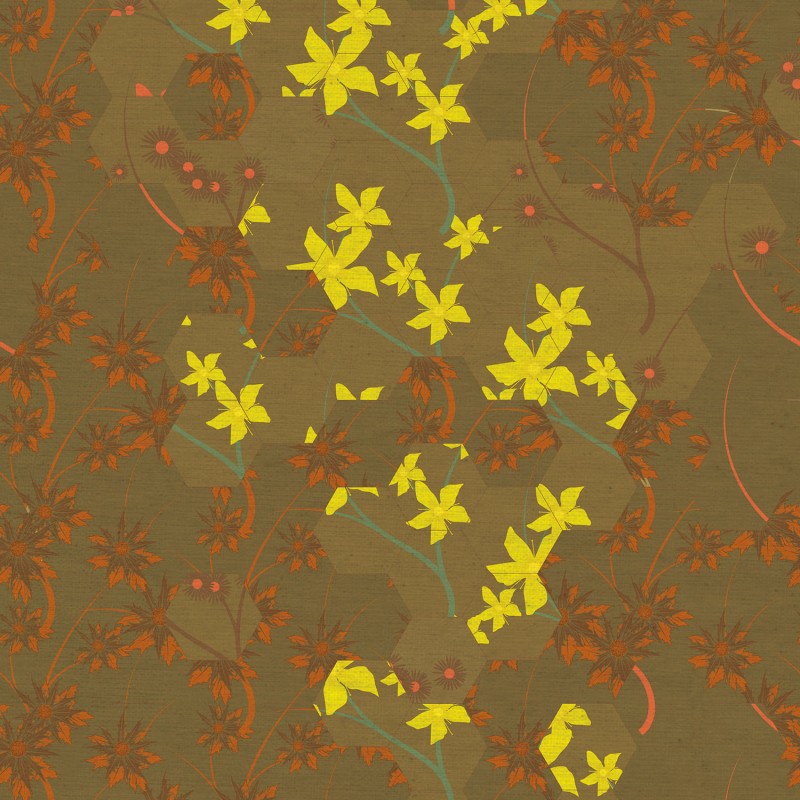
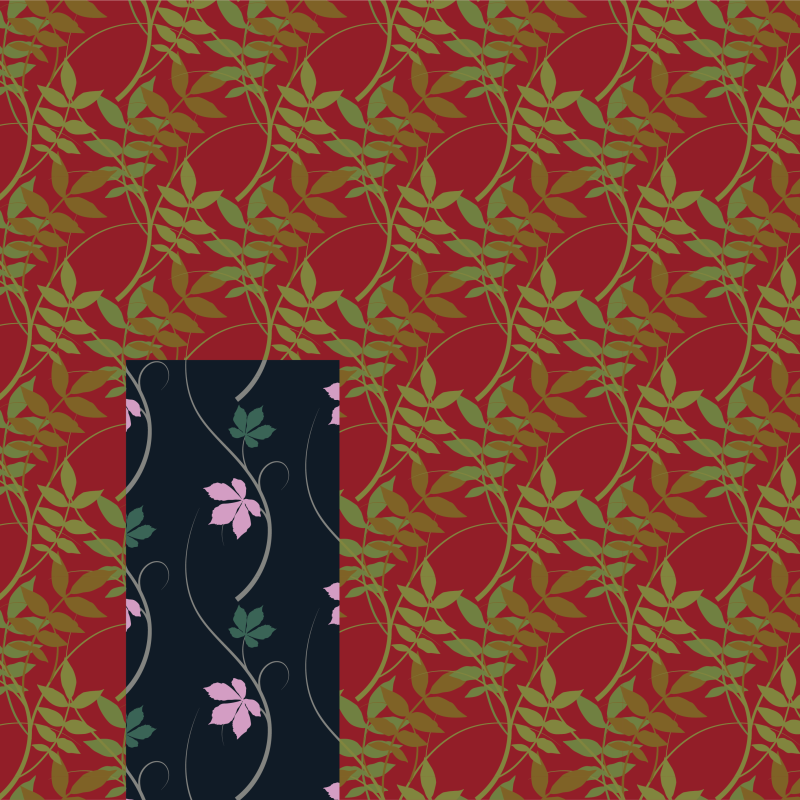
And it’s in those walks that I take inspiration for the patterns I design, each different but each with a common thread that links them together. In some works I juxtapose two contrasting patterns, each with a shared motif — a branch perhaps running seamlessly between. One pattern is small, the other many times larger. One is our contemporary world, one the world of the past. There is dissonance and rhyme, just as when, through our own experience, we imagine the lives of those who lived long ago. Our worlds are vastly different, they dissonate, but our experience — in natural phenomena — rhymes.
Once, at the Tower of London, I stood before a wall on which, in 1541, a prisoner, William Tyrell, had carved the following:
“Since Fortune has chosen that my hope should go to the wind to complain, I wish the time were destroyed; my planet being ever sad and ungracious.”
It’s one thing to read this and sympathise with William’s plight. It’s another to kneel down where he must have knelt to carve it; to glance through the window at the sky. Our worlds may be entirely different, but the sky is just the same and our knees can feel the same stone floor of the cell. It’s a small thing, but we can, kinaesthetically, empathise in some small way with William.
“Rinsho is the practice of matching one’s breath and step to that of the ancients.”
— Teshima Yūkei (1901–1987)
Is that not what we’re doing when we empathise? Matching our breath and step, if not with the ancients, then with those who went before us.
I have, in the past, made a lot of work on landscapes that have witnessed trauma, whether battlefield sites of World War One or sites of the Holocaust such as Auschwitz. I was struck when reading ‘Underland’ by Robert Macfarlane by this particular passage:
“Dissonance is produced by any landscape that enchants in the present but has been a site of violence in the past. But to read such a place only for its dark histories is to disallow its possibilities for future life, to deny reparation or hope – and this is another kind of oppression. If there is a way of seeing such landscapes, it might be thought of as occulting’: the nautical term for a light that flashes on and off, and in which the periods of illumination are longer than the periods of darkness.”
The landscapes I produce therefore also hark back to the work I have made in the past about these sites of violence. There is the rhyming of the natural world and the dissonance of experience.
I like too, the term ‘occulting light’ to describe that sense of thinking about the past, of reaching into the dark as a means of empathising with people in the past. The light of our present day experience shines, seeking out those parts, in the darkness of the past, where the pattern might rhyme with ours. But it’s only when the light is off, in the afterimage glowing in our eyes — and our imaginations — that we see where those connections lie.
“Attention is the rarest and purest form of generosity.”
— Simone Weil (1909–1943)
“The body is our general medium for having a world.”
— Maurice Merleau-Ponty (1908–1961)
Empathy is not only an act of imagination but, as described above, an act of embodied imagination — a means of perceiving and understanding phenomena through the whole of one’s being. It is akin to the mode of seeing described by Johann Wolfgang von Goethe (1749–1832). Goethean observation is a participatory method that moves from detached perception toward intimate understanding. Beginning with exact sense perception, the observer attends to a phenomenon’s visible details without judgement, letting the facts speak for themselves. Through exact sensorial fantasy, imagination is used to perceive the phenomenon in time — to sense its life, change, and movement. In seeing in beholding, the observer quiets their own activity so that the phenomenon may reveal its inner gesture or character. Finally, in being one with the object, perception and thought merge in an intuitive grasp of the phenomenon’s essence.
This process transforms observation from analysis into relationship: knowledge arises not by dissecting the world, but by entering into a living dialogue with it.
This method, which I often use, shares much with my wider practice. Goethean observation calls for the softening of boundaries between the observer and the observed — a reciprocal awareness, almost the moment Barry Lopez describes when “the thing ceases to be a thing and becomes something that knows we are there”.
“To cross a threshold is to enter another way of seeing while remaining oneself. Each movement between media, identities, or times becomes a kind of passage. Boundaries are not walls but invitations — places of interconnection, where the known world gives way to the unknown, where dissonance meets with rhyme.”
This is at the heart of Goethean observation. Through it we come to see the object as a story-so-far rather than a fixed or isolated thing. It becomes other. To borrow from Christopher Tilley, the object — whatever is being observed — “sees” the observer in a manner comparable to the way a mirror sees: it defines a point of view that renders us visible in return. We recognise that “nothing exists in itself, independently from something else.” We see it in the object, and we recognise it in ourselves.
And perhaps this is what enchantment truly is: the moment when the distance between things dissolves — when the world, for an instant, reveals itself as one continuous gesture.
In ‘Being Alive: Essays on Movement, Knowledge and Description‘, Tim Ingold recalls the Swedish geographer Torsten Hägerstrand’s idea that everything there is, launched in the current of time, follows a trajectory of becoming. Each thing is not a static entity moving through time but a line of continual motion — one thread among countless others in a woven texture of existence.
Another geographer, Doreen Massey, described space as “the simultaneity of stories-so-far” — not a surface on which events unfold, but the living intersection of these trajectories, each continuing, each still in motion. If Hägerstrand offers the vertical threads of duration (warp), Massey gives us the horizontal weave (weft) — the plane of encounter where stories coexist and entwine.
When I first wrote about durations, I imagined these lines of duration not as horizontal layers stacked like geological strata but as vertical, warp threads: each object, building, or landscape feature a line of uninterrupted existence, extending through the centuries.
When we empathise with people in the past, when we trace a thread back in time to one of those many entanglements, that is how we empathise with those who came before us. But what are these threads, and what is the pattern they make?
As I’ve already said, it is in nature where our lived experience best aligns with people centuries past. How we experience the natural world — the trees, the sky, the wind and rain — can connect us to those who lived long ago. Despite the dissonance between our worlds, they would have known these phenomena in much the same way. In these things our worlds start to rhyme.
That, therefore, is the fabric’s pattern: nature — the thing which binds us all together.
As I’ve also mentioned before, Richard Hayman writes how “woods are poised between reality and imagination… they span many lifetimes.” They are a threshold between now and then, being as they are neither fully present nor past. As Gaston Bachelard wrote: “…who knows the temporal dimensions of the forest?”
The forest too imitates the pattern of weft and warp. It is itself a tangle of trunks and branches, where, on occasion, those branches fuse together — inosculate — their forms interwoven yet distinct. The word, inosculate, comes from the Latin osculare: to kiss. Likewise, those encounters I described above, the momentary entanglements of stories-so-far, are like inosculations. And when we trace a thread back to one of a myriad number of knots, where we seek to empathise with a long-lost, nameless being, those entanglements become a kind of kiss — a tender embrace, where for a moment our forms, those of the absent being and ourselves, intertwine. Through an act of self-dissipation, we both become — like the forest — neither of past nor present. That is the essence of empathy.
This lends another layer of meaning to the video work I’ve made of shadows in the woods.
What of the threads themselves? How do I see those?
In part they are the filaments I described earlier, based on Carlo Rovelli’s white holes. As I wrote:
In my mind’s eye, I conflate the mote and the thread, and see these holes as filaments, fine hair-like threads, connecting what was with what is. They are the voids left in the wake of a death, grief spun with the years to forgotten, holes from which, through empathy, what was might yet return. They are the stories-so-far: fragments containing the whole, threads with which the present is made.
The present is our simultaneous perception of all these threads. Objects, when they are made, are like black holes in our fabric — spaces into which all that happens around them falls: a glance, a touch, a word. And as these holes extend through the passing of time, they stretch, connecting what was with what is. They become, as Rovelli wrote, “a small, stable remnant, perhaps as tiny as a grain of dust, from which what fell in may one day emerge.”
I have talked about fragments – a word, an object, a ruin, a name – and how we can build from these the worlds to which they have belonged, and in Rovelli’s description of white holes, we see that: from these remnants, what fell in — a glance, a touch, a memory — can, through empathy, emerge.
In any weave there are gaps — holes. They are as much a part of the fabric as the threads. Should I therefore be thinking of objects, places, and people as the gaps between threads rather than threads themselves? Or are they like black holes and white holes — a combination of the two?
Perhaps every object is an occulting form — a small black hole in the weave of being, drawing light and time into itself, holding the gestures of all that have passed before and around it. What we call empathy might then be the act of standing at the object’s ‘horizon’: the point where concealment and revelation meet, where what has fallen in begins, through observation with an embodied imagination, to emerge.
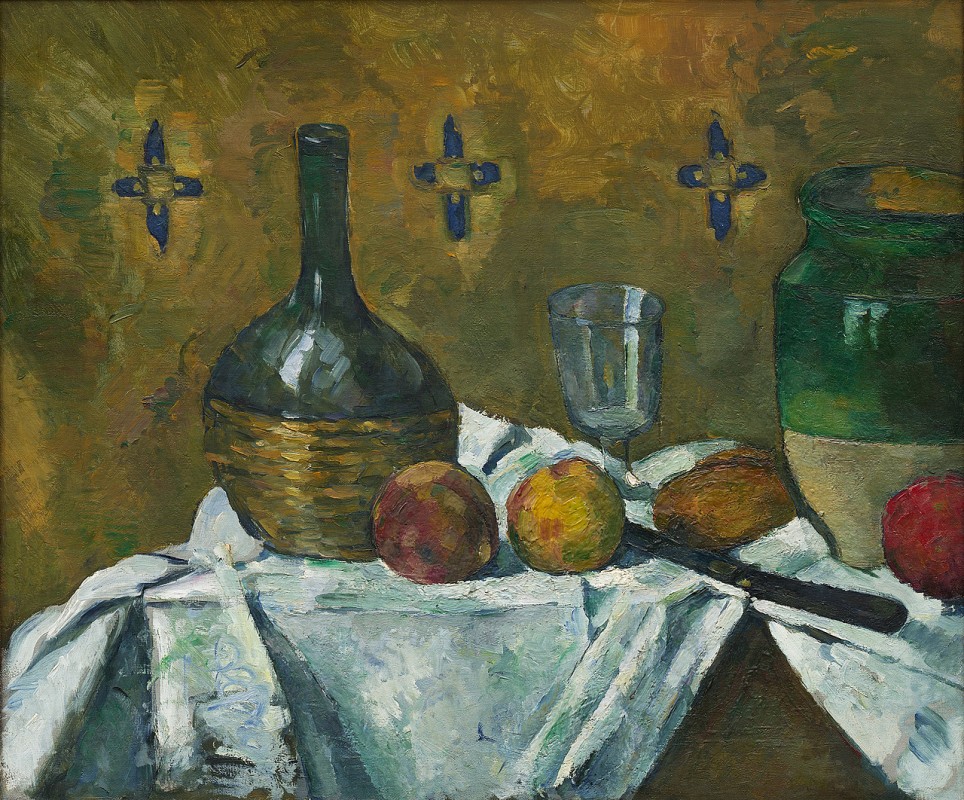
Still Life: Flask, Glass, and Jug Paul Cezanne 1877 Solomon R. Guggenheim Museum, New York, Thannhauser Collection, Gift, Justin K. Thannhauser, 1978
Rhopography is an art historical term derived from the Greek rhopos (trifles, small wares) and graphia (writing or depiction). It refers to the representation of humble, overlooked, everyday things such as those in the still life above: a tablecloth, a knife, fruit, wine, a glass. In art history it is often contrasted with megalography — the depiction of grand subjects such as heroes, battles, gods, and monuments.
In Cezanne’s painting, it’s not so much the subject which interests me as the brushwork. The visible strokes turn this from a painting of items arranged on a table to a record of traces – of the artist’s body in time – arrayed on a canvas. They are what we might describe as the painting’s gesture.
Everything has a gesture; from bottles to glasses, jars to knives, paintings, letters and photographs, and for me, Cezanne’s still lifes – where objects are rendered with such visible strokes – are reminders of that fact. Within every object are equivalent strokes – gestures – retaining and revealing actions of manufacture and use; time-stamped with the – albeit invisible – marks of an ongoing moment.
A useful way to understand gesture is to think of an old, handwritten letter — imagine it was written in 1800 and that you’re reading it now. Back in 1800 the physical act of writing is quickly completed: the hand moves, the ink settles, the pen is raised. The action ends — but the gesture does not. Every stroke retains the movement that formed it: hesitations, pressures, accelerations — traces of a body and a mind in motion. When we read the letter centuries later, our eyes follow these strokes, effectively reanimating that original movement. In the act of reading, the past gesture becomes present again — and more than that, it begins to ‘rhyme’ with our own.
The gesture of the writer does not end with the writing. It unfolds with the first recipient, who in reading the words completes the movement the writer began. It continues again with every re-reading, even centuries later. Thus a gesture is a moment and a trajectory, carried forward through successive encounters, where each encounter becomes, cumulatively, available to the next. Handwriting becomes a conduit through which past and present meet and become, for a brief moment, entangled.
In this way , the letter behaves like all historical objects: their making may be complete, but the gestures that formed them – along with those arising from their use – persist as ongoing events, available to us through perception and imagination: what Merleau-Ponty would call the afterlife of perception and Tim Ingold the ongoing “trajectory” of the thing.
To perceive an object as gesture is therefore to stand inside its ongoingness — to feel its past leaning forward into the moment of our encounter. Everything is an encounter; nothing exists independently.
Cezanne’s still life is a composition, a pattern of sorts, where each thing he paints is an essential part of the whole. Without one, the painting wouldn’t work. Everything is in balance. The wine is dependent on the fruit; the fruit on the glass; the glass on the knife and so on.
In Buddhist philosophy, dependent co-arising teaches that phenomena manifest only in relation to other phenomena: there is no self-nature, no birth, no death — only continual transformation. Everything exists in an in-between. Objects such as those in the painting are events, animated by gesture, or as Doreen Massey puts it, “stories-so-far.” The present is our simultaneous encounter with these stories — the simultaneity of stories-so-far. Cezanne’s still life could be said to be an articulation in paint of that fact.
Every event, every gesture, is like a body in motion — and bodies in motion sometimes align, sometimes occlude, sometimes fall out of step, and sometimes, at the moment of encounter, create brief flashes of rhyme or recognition . Think of a solar eclipse. It occurs not because the moon or the sun acts upon the other, but because their trajectories momentarily align. The occultation is not a thing but a relationship in motion — a coincidence of paths.
Objects and their inherent gestures behave the same way. When the gesture of a past body — the writer’s (or painter’s) hand, the singer’s voice — comes into alignment with our own movements, a moment of partial occultation occurs. Not total. Never total. But partial — a fleeting alignment of gestures across time. This is a moment of kinaesthetic empathy. We and the past body are not the same, but for an instant our gestures rhyme. Both remain in motion, each with its own agency, and in this overlap produce a flash of recognition.
Around this rhyme is dissonance — not as separation, but as the space that preserves difference while making relation possible. The rhyme — that brief illumination — functions as orientation. And as the occulting beam of a lighthouse tells a ship its position in relation to land, the rhyme tells us where we are in time; where the past is in relation to our present.
One of the ways we perceive the arrow of time is through entropy: a natural drift toward disorder, away from particularity. The difference between past and future might be imagined as the difference between a sandcastle — low entropy, fixed and unchangeable — and a pile of sand, high entropy, capable of many possible configurations. The past, as a completed event, is very low entropy. Yet our encounter with the past is the opposite. When we attend to an object’s gesture — when we consider it not as a finished thing but as a movement still unfolding — imagination restores motion. The castle becomes a pile of sand from which many different castles might be built. As experience then, the past becomes high entropy: rich with possibility.
In White Holes, Carlo Rovelli writes: “the black hole does not end in a singularity, but tunnels into a white hole — a small, stable remnant, perhaps as tiny as a grain of dust, from which what fell in may one day emerge.” It does not end — just as the gestures of the past in our objects do not end. Like white holes, gestures appear almost invisible from the outside, but from within they stretch across vast distances. I imagine these white holes as filaments — fine threads connecting what was with what is — openings in a weave of stories and trajectories through which, via imagination, the past might still emerge.
Dissonance is another way of articulating entropy. Each simultaneous perception of stories-so-far (the moment which follows the moment etc.) differs subtly from the one before; these differences accumulate and grow over time, while the parts that rhyme become fewer and further between. Rhymes are recognisable continuities — that which persists and allows coherence. The further back we go, the fewer these rhymes become. The occulting light reduces from a steady beam to a brief flash, surrounded by expanding darkness.
When we look at an object, read a text, listen to an old recording, or examine a painting from before we were born, we may experience that flash of recognition — a moment of rhyme. Our gesture aligns with the gesture encoded in the object. For an instant, the vast weave of co-dependent trajectories – of which the gesture is a part – lights up – the writer at her desk, the dress she wears, the ticking of a clock, the sounds beyond the window, the weather – and entropy is imaginatively restored. We find a way back into the past — not by collapsing it into the present or vice-versa, but by sensing the trajectory it still contains.
A moment of rhyme is a moment of orientation — a brief, luminous occultation in which past and present meet without becoming one. Borrowing from quantum mechanics, we might say that in such moments the object and the viewer become entangled. In quantum physics, entanglement describes a condition in which two particles, once connected, remain linked even when separated by vast distances — their states no longer independent. When gestures rhyme, I think of them as becoming momentarily entangled: recognition accompanied by influence across time. In reading a letter written two centuries ago, it is as if, for a fleeting instant, I become its intended recipient — and as if, in that same instant, I briefly enter the mind of the one who wrote – is writing – it.
I began with rhopography — attention to what is small, intimate, and easily overlooked. Gesture resides most clearly in such things. It is in fragments, in minor objects, in traces of everyday life that the unfinished movements of the past remain most available to us, still leaning forward, still capable of encounter.
Empathy as Pattern-Work
My practice begins with the fragment — an object or trace that has survived the erosive forces of time. These fragments may take the form of found tokens from the Foundling Hospital, a pottery shard, a name, a photograph, a painting, or a ruin. Each fragment bears witness to a network of relations that once linked bodies, materials, and places. Rather than functioning as residue or supplement, the fragment is approached as a node: a site through which historical and affective patterns continue to exert force in the present.
This approach draws upon Walter Benjamin’s conception of Eingedenken (remembrance), a form of historical attention that resists narrative closure. As Benjamin observes, “memory traces the house in ruins rather than the intact dwelling” (Benjamin, 1999). The ruin is thus not a failure of history but its most ethically charged condition — a structure that holds together persistence and loss without resolving their tension. My practice takes this insight as a methodological and ethical foundation: the fragmentary, the weathered, and the incomplete are not deficiencies of recollection but its most truthful forms.
Engagement with fragments is therefore not an act of reconstruction but of resonance. This position aligns with phenomenological accounts of perception as embodied and relational. Following Maurice Merleau-Ponty, perception is understood not as detached observation but as an intercorporeal encounter, in which meaning arises through the entanglement of body, material, and world (Merleau-Ponty, 1962). The fragment is apprehended through texture, scale, weight, and surface — through the sensorium as much as through representation. Encounter becomes a reciprocal event rather than a unilateral act of interpretation.
This relational ontology is further informed by Tim Ingold’s concept of the “meshwork,” which understands materials not as static objects but as gatherings of lines — trajectories of movement, growth, and duration (Ingold, 2011). Within this framework, each fragment is a knot in a wider ecology of becoming. My practice of “pattern-work” extends these lines into the present, not in order to restore an original configuration, but to allow unfinished patterns to continue unfolding through contemporary gesture and attention.
Empathy, as it operates within this practice, is neither sentimental identification nor psychological projection. Rather, it functions as a form of structural correspondence — an alignment across temporal distance that remains partial and unresolved. This conception draws upon affect theory, particularly Elizabeth Grosz’s account of matter as generative and open-ended, and Brian Massumi’s understanding of affect as pre-personal intensity (Grosz, 2004; Massumi, 2002). Empathy emerges in the interval of “almost-recognition,” where patterns rhyme without coinciding, and where difference is not overcome but sustained.
Through this process, art becomes an act of re-weaving: a performative continuation of historical textures through embodied practice. Each painting, pattern, or gesture of attention constitutes a new crossing in the fabric of time. The work does not seek to heal rupture or restore coherence, but to dwell within incompleteness — allowing the fragment to remain open as a site of encounter, contingency, and ethical attention.
This process may be described, borrowing from botanical language, as inosculation: the point at which two trees grow together, their tissues interwoven yet distinct. The term’s etymology, from the Latin osculare (“to kiss”), evokes a form of contact that joins without erasure. In this sense, my practice proposes empathy not as fusion, but as attunement — an ethics of proximity that listens to the unfinished conversation between matter, memory, and time.