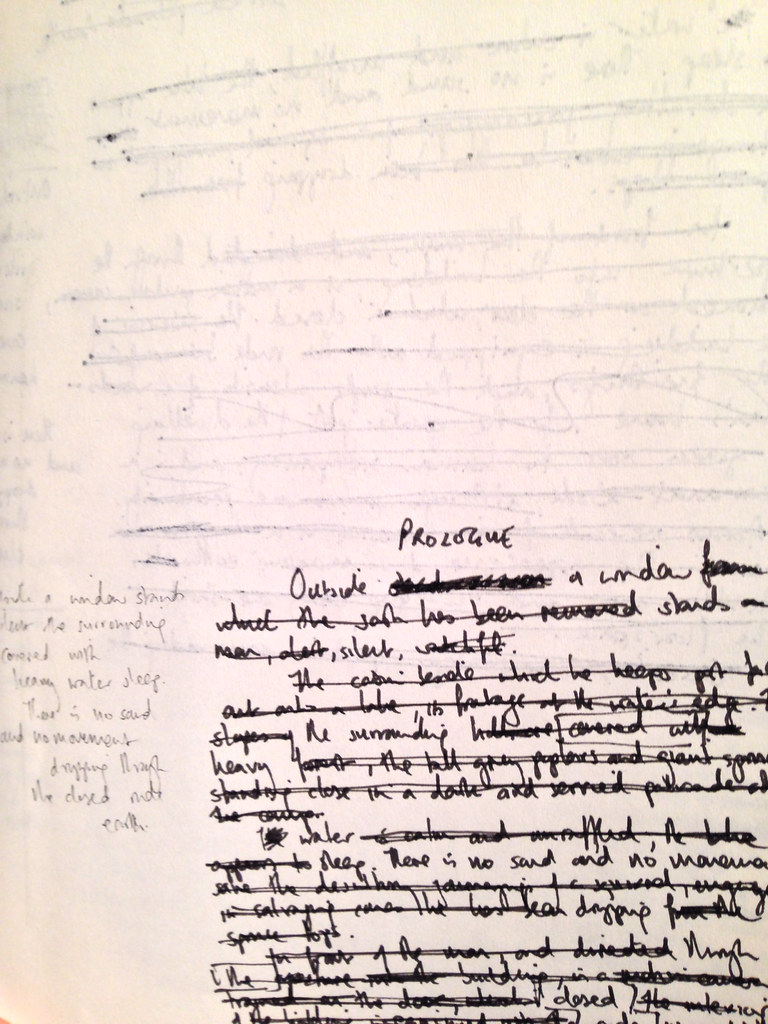
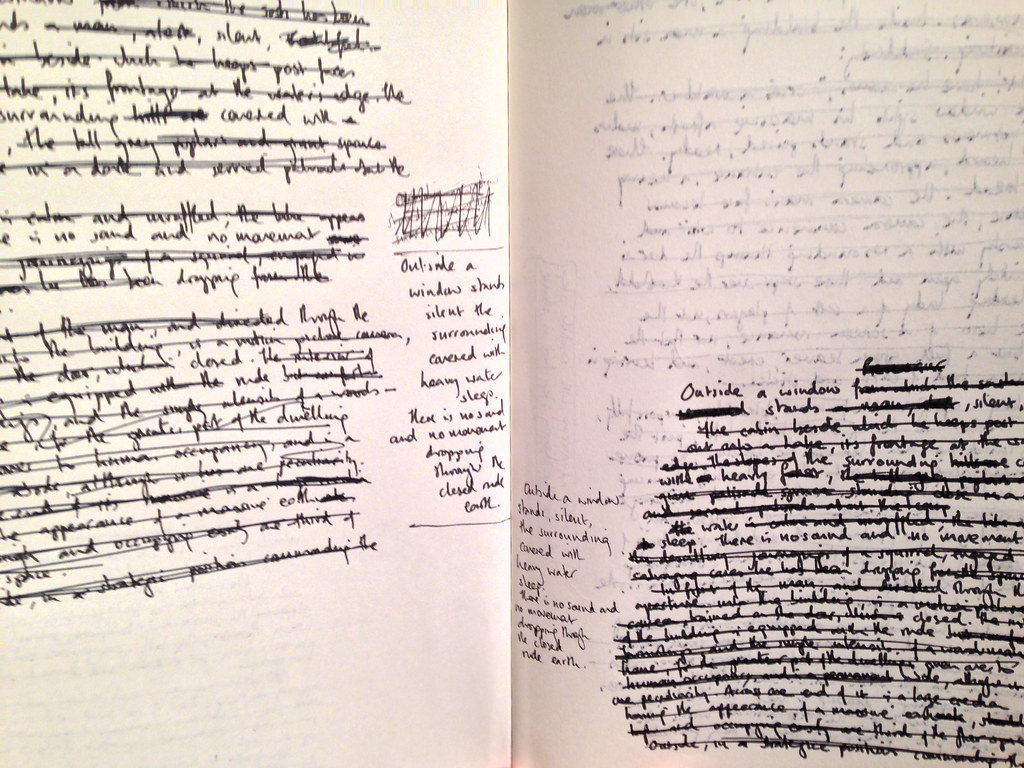
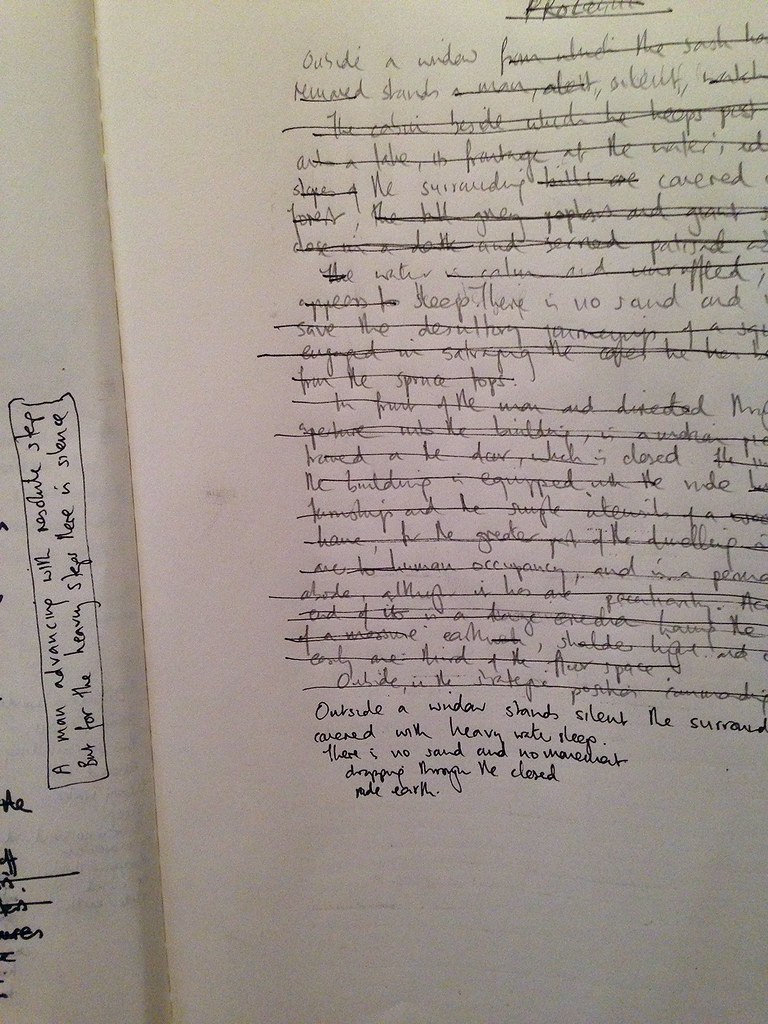
This afternoon I’ve been working on a new approach to my Heavy Water Sleep series. I’ve always loved the aesthetic of the notebook – the crossings out, the marginalia, the sense of time – not only its accumulation through the pages, but its nowness in the moments of writing.
In particular, I love the pages of Walter Benjamin’s notebooks, one of which can be seen below.

There is something too, about the way the words on the reverse of the page show through that I find particularly pleasing on the eye.
The images below show my first efforts using the first two pages of the source book ‘Pilgrims of the Wild’.
I was also interested when I looked at one of the blank pages and saw the impressions left by the writing.

I was reminded of a photograph I took recently of the holes left by railings removed during World War II…
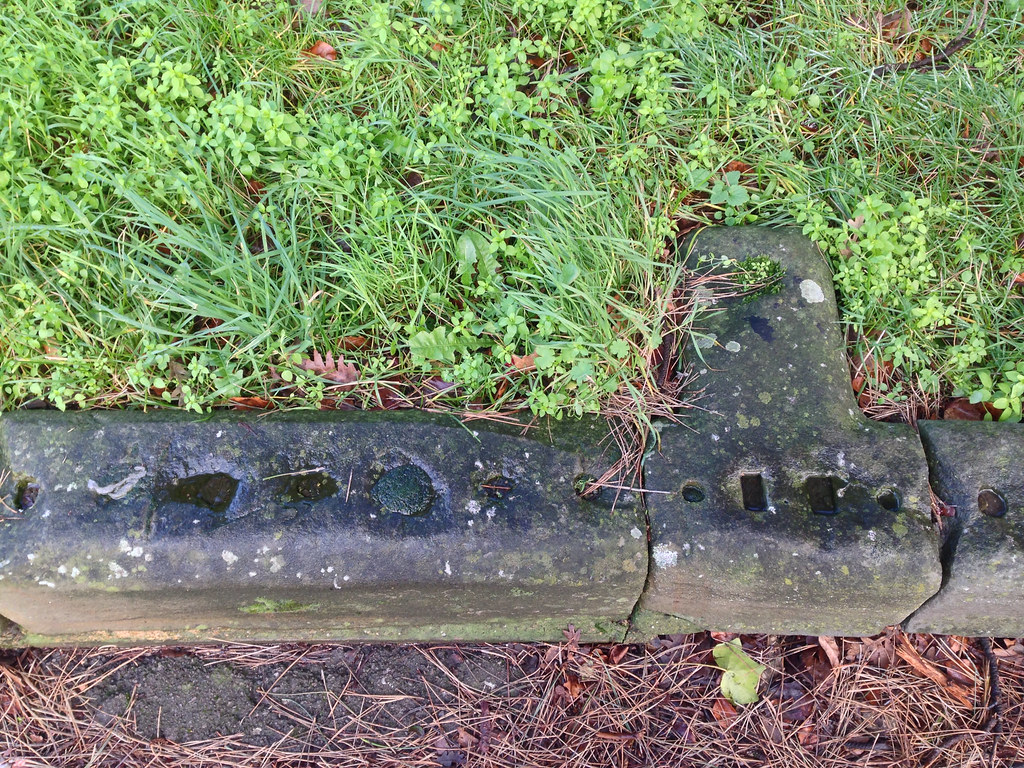
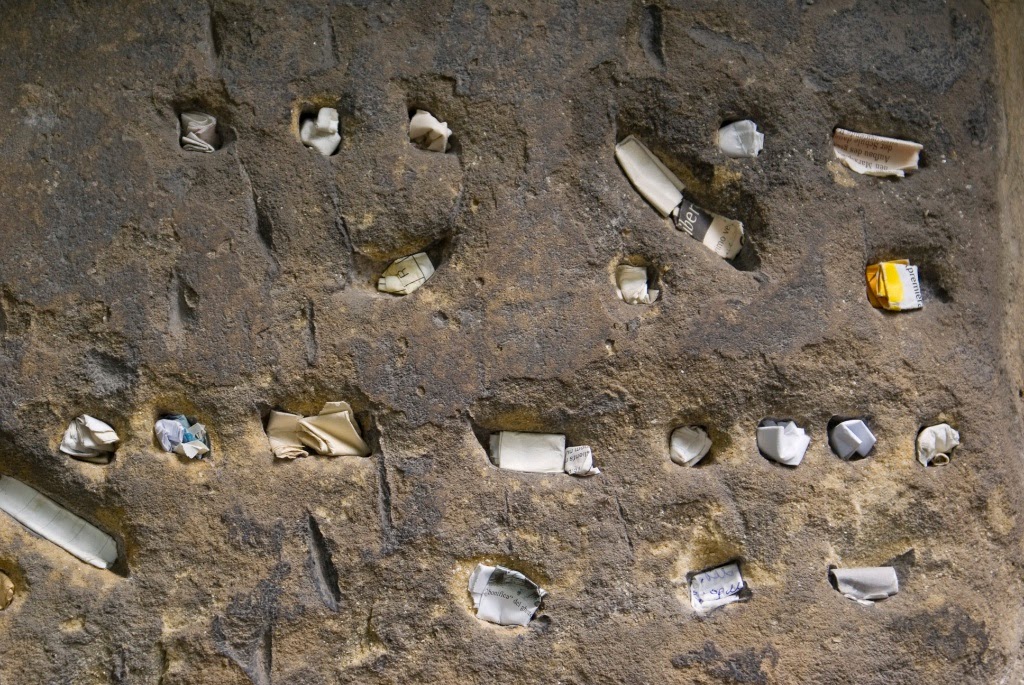
…which in turn reminded me of a photograph I took in a Jewish cemetery in Prague.
Returning to the Heavy Water Sleep series…
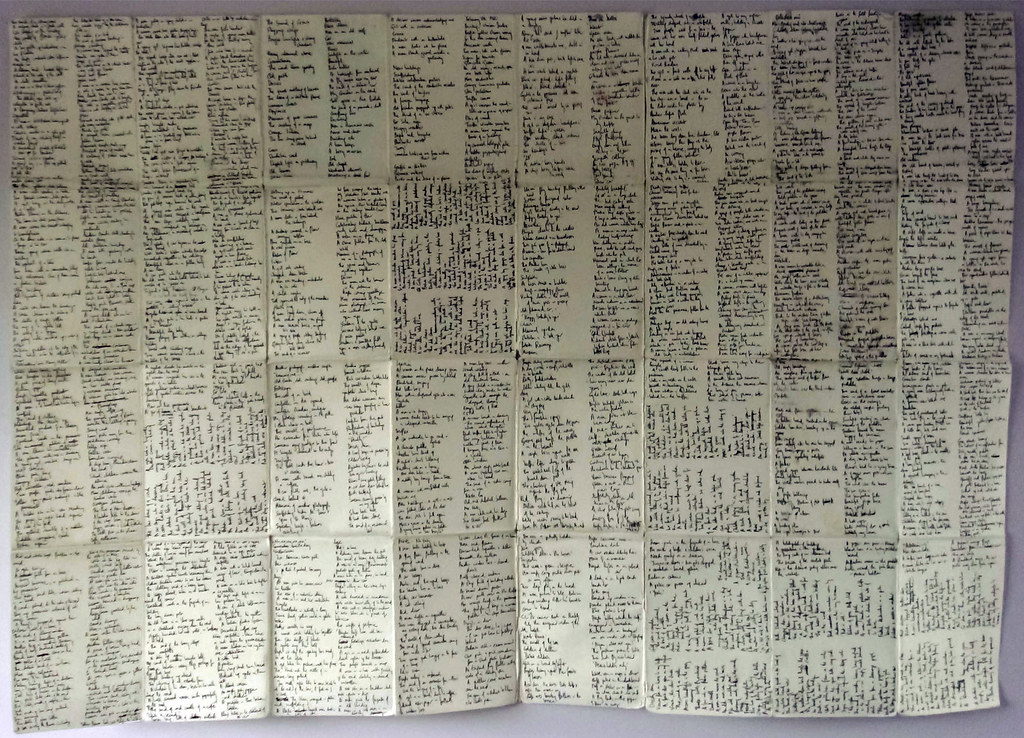
These text pieces called to mind the text maps I made last year.
So what could these pieces mean?
The idea behind them is that the book is a kind of map – the words like a trail leading through a vast landscape. Previously, I have used photocopies of the page, cutting the words out so as to make a new narrative whilst maintaining the integrity of the original. This ‘new’ narrative is in turn inspired by my reading of Adam Czerniakow’s diary.
There is another reader – or traveller; ‘Pat’, to whom the book was given at Christmas 1935.
Looking at Walter Benjamin’s notebook, I’ve listed its different aesthetic attributes:
crossings out
marginalia / annotations
reverse page words showing through
damage / wear of the pages
different text styles / colours
the archive stamp
This work will, in a sense, become an archive, one which reflects the archival nature of memory and the landscape, articulated through the metaphor of a book / map.
Is there any way of this book / map reflecting the text map structure as inspired by trench maps?
The Jewish cemetery image (above) is interesting as regards the placing of paper etc in the carved words of memorials. I’m not sure of the exact reason for this, but perhaps it has similar meaning to the placing of stones on graves? Why this custom exists isn’t entirely clear, but it could be to show that people have visited the grave or to keep the soul within. I like both these ideas in relation to my thinking on paths and the landscape, the idea that memories are held in specific places and that people have travelled the same route before us.
How would this be shown in an artwork? With pieces of rolled paper? Perhaps these pieces could contain ‘glimpses’ of those worlds to which previous travellers belonged?